Origins & Belief · Aug 2026 (B.E. 2569)
The five ancient tablets: a canon the market wrote
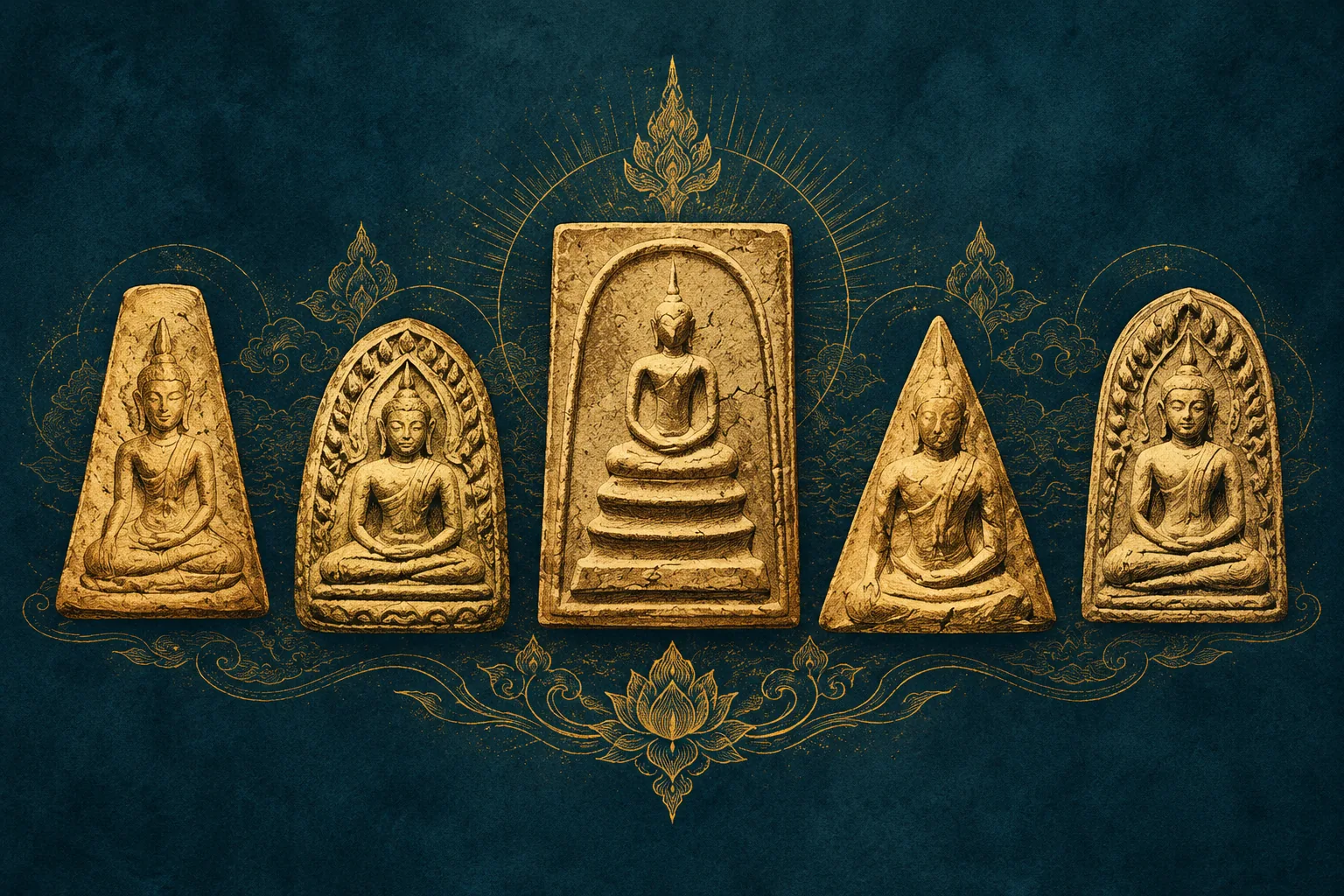
Somdej, Rod, Phong Supan, Som Kor, Nang Phaya. The five are not a scriptural set. They are a list written by collecting history. Useful, not exclusive.
22 min
The five ancient tablets: a canon the market wrote
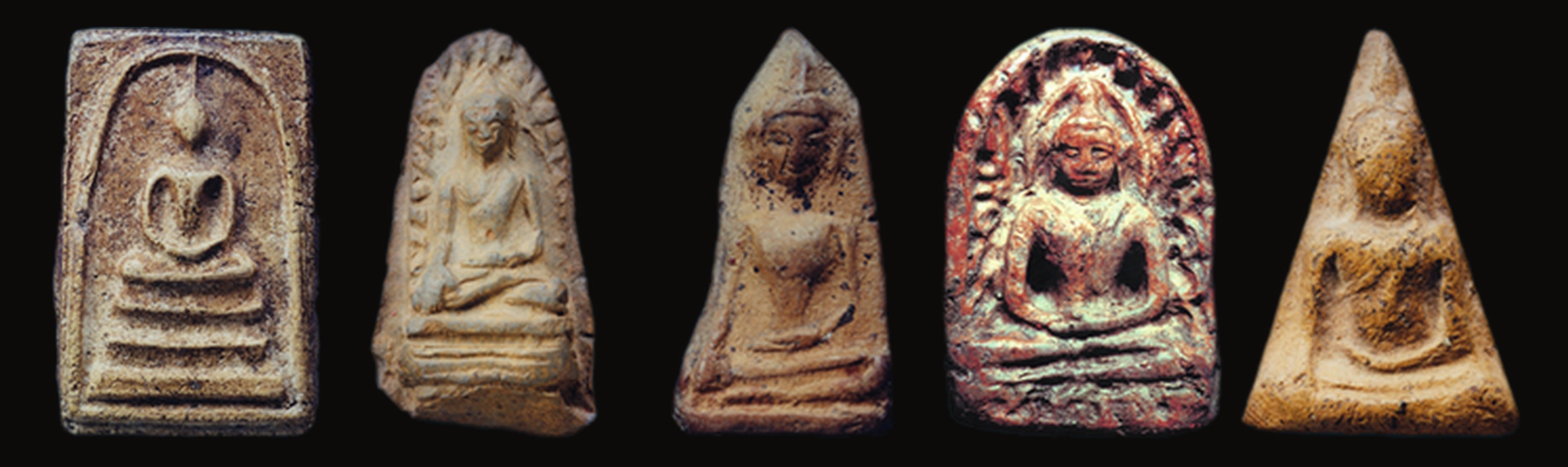
Somdej, Rod, Phong Supan, Som Kor, Nang Phaya. The five are not a scriptural set. They are a list written by collecting history. Useful, not exclusive.
Thai benjapakee means a set of five. Chinese collectors also call them the five ancient tablets. Twentieth-century collectors placed five old powder tablets together as a summit for beginners. The list helps price and orientation. It also pushes other kilns out of view. Canon always does this. Rank, date and talk of power below are how the list is told in Chinese. They are not verses, and not a warrant for any piece.
The list itself has a date. In C.E. 1952 (B.E. 2495) the soldier-collector Triyampawai first set a triad: Somdej of Wat Rakhang in the centre, Nang Phaya and Rod to the sides. Som Kor and Phong Supan were added later. That is collecting history, not an ancient rule.
1. Phra Somdej
The market often calls Phra Somdej the king of tablets, sometimes the emperor. Chinese notes usually place it around Rama IV, issued by Somdej Toh at Wat Rakhang. Surviving notes treat the making as a span, from late Rama II into Rama IV; Toh died in C.E. 1872 (B.E. 2415). One year is not a sole birthday. Of the five, Somdej is the youngest in date and the highest in the market.
The usual account is lime and shell-lime as the base, with flower pollen, scripture ash and scent added. There is not one recipe. Later talk of five sacred powders or a long bill of stuff is lore, not a lab result for every piece. Collectors name molds such as the large / principal, the chedi, the extra-base, the lotus-bud ushnisha, and the bodhi canopy. The large mold is the most hunted, and it splits further. The word Somdej covers a wide field. Later namesakes, including Wat Bang Khun Phrom, are many. The Rakhang line is the most prized. Not every Somdej comes from that temple.
Folk speech gives it livelihood, safety, grace, fortune and protection — almost everything. The wider the claim, the more it should be heard as selling speech, then returned to mold and powder. For the piece in hand, ask which mold, which span, whether the powder and the skin match a Rakhang line. Do not start from the four words ‘king of tablets’.
2. Phra Rod
Phra Rod is often told as the oldest of the five. The find-ground is Wat Mahawan in today’s Lamphun. Legend places it in the Hariphunchai period, with Queen Chamadevi’s founding of the city, more than a thousand years back. Thai rod is read as to pass through, to escape; some also tie the name to a shift from Narada the rishi. Legend can be written down. It is not a find-record.
Modern openings were not one event. In C.E. 1892 (B.E. 2435) the stupa was struck and fell; tablets spilled; some were put back, some left the temple — later called the old cache. A further lot came in C.E. 1908 (B.E. 2451) when the base was repaired. Dry-season digging around the wat followed; the temple later forbade it. More pieces appeared in C.E. 1955 (B.E. 2498) and 1963 (B.E. 2506) during repairs. Collectors name large, middle, small, short, and ushnisha-up molds. The circle says Rod comes from Mahawan alone. That is a collector’s sorting. Mold and find-notes still come first. A sentence that says ‘a thousand years’ is not enough.
Folk speech therefore gives it safety, the turning of danger, and even a claim that a violent death will not come. The meaning of a name is not proof of authenticity. Even if someone says the piece in hand is a thousand years old, first check whether the mold matches, and where it came out of the ground, and how it has been passed down.
3. Phra Phong Supan
Phra Phong Supan comes from the great prang of Wat Phra Si Rattana Mahathat in Suphan Buri. In C.E. 1913 (B.E. 2456), after repeated theft-digs, the governor Phraya Sunthonburi opened the cache in form; other old tablets came out with it. The style is often placed in the U-Thong period. Some push the making back to King U-Thong’s day. That is a later telling, not a label left on the opening day.
The common outline is a pointed trapezoid, subduing Mara, on a single board-base, broad in the chest. Collectors split molds by the face: old, middle, young (once called the mouse-face). The back often shows a rattan-cut mark. Colours run red, yellow, green, black. Shape helps the mold. ‘Broad chest means genuine’ does not. A later recast can be broad too.
Folk speech gives it rank, standing, nerve, and the lifting of trouble. That is talk of power. For the piece in hand, match the face-mold, the back mark, the powder and the firing to a Suphan prang line. Do not start from the word ‘authority’.
4. Phra Som Kor
Phra Som Kor comes from the Nakhon Chum area of Kamphaeng Phet. Collectors call that field of caches Thung Setthi — the field of the rich — including the relic stupa, the mid-field chedi, Wat Phikul, and the rishi cache. Most place it in the Sukhothai period. The Thai name sum ko is from the arch, bent like the letter ko. Chinese Som Kor is a sound-loan; they also call it the tablet of plenty, the wealth Buddha on the street.
The common form is meditation, on an elephant-nail lotus, often with kanok scrolls at the sides. Molds run large, middle, small; the large splits into with-scroll and without, the latter often darker. Clay, powder and tin-lead all occur. Folk speech says livelihood and saving run smoother, even that money need not be hard. That is talk of power, not a warrant that every Som Kor makes a person rich. Still less may the street name ‘wealth Buddha’ be used to call the piece in hand genuine.
Authenticity still turns on powder, firing, the way a Kamphaeng piece breaks, and which cache in Thung Setthi it came from. The field is large. Not every old Kamphaeng tablet is a Som Kor.
5. Phra Nang Phaya
Phra Nang Phaya comes from Phitsanulok. The wat sits across from the great Mahathat that holds Phra Phuttha Chinnarat, and is called Wat Nang Phaya. Legend places the making around C.E. 1547–1557 (B.E. 2090–2100), when Queen Wisutthikasat restored the wat. She was the mother of King Naresuan. The street name ‘queen’s tablet’ is this origin-story, not a rule that only women may wear it.
The modern fame starts in C.E. 1901 (B.E. 2444), when Rama V visited Phitsanulok to watch a recast of the Chinnarat image. Levelling the ground for the visit brought a large find. Some pieces were offered to the king and given out to the suite. The form is often a triangle, subduing Mara, no base, no arch, the cut edge tight to the body, full chest, soft arms, the back mostly flat. Collectors name large, middle, small, and also wide-chest, flat-chest, and deva molds. Further openings are noted around C.E. 1954 (B.E. 2497) and 1969 (B.E. 2512).
Folk speech gives it presence, authority, grace, command, and fortune for women. That is talk of power. Men wear it too. For the piece in hand, match the wat, the opening, and the mold. Do not start from the queen’s story.
Five in-depth studies
A list is a map, not a border.