Origins & Belief · Oct 2026 (B.E. 2569)
Suphannamatcha: the golden fish princess, the stolen stones and her own choice
She is more than the mermaid in a Hanuman romance. Ordered by her father to break the sea road, she later commands the fish to restore it, standing between family, war and her own decision.
18 min
Suphannamatcha: the golden fish princess, the stolen stones and her own choice
She is more than the mermaid in a Hanuman romance. Ordered by her father to break the sea road, she later commands the fish to restore it, standing between family, war and her own decision.
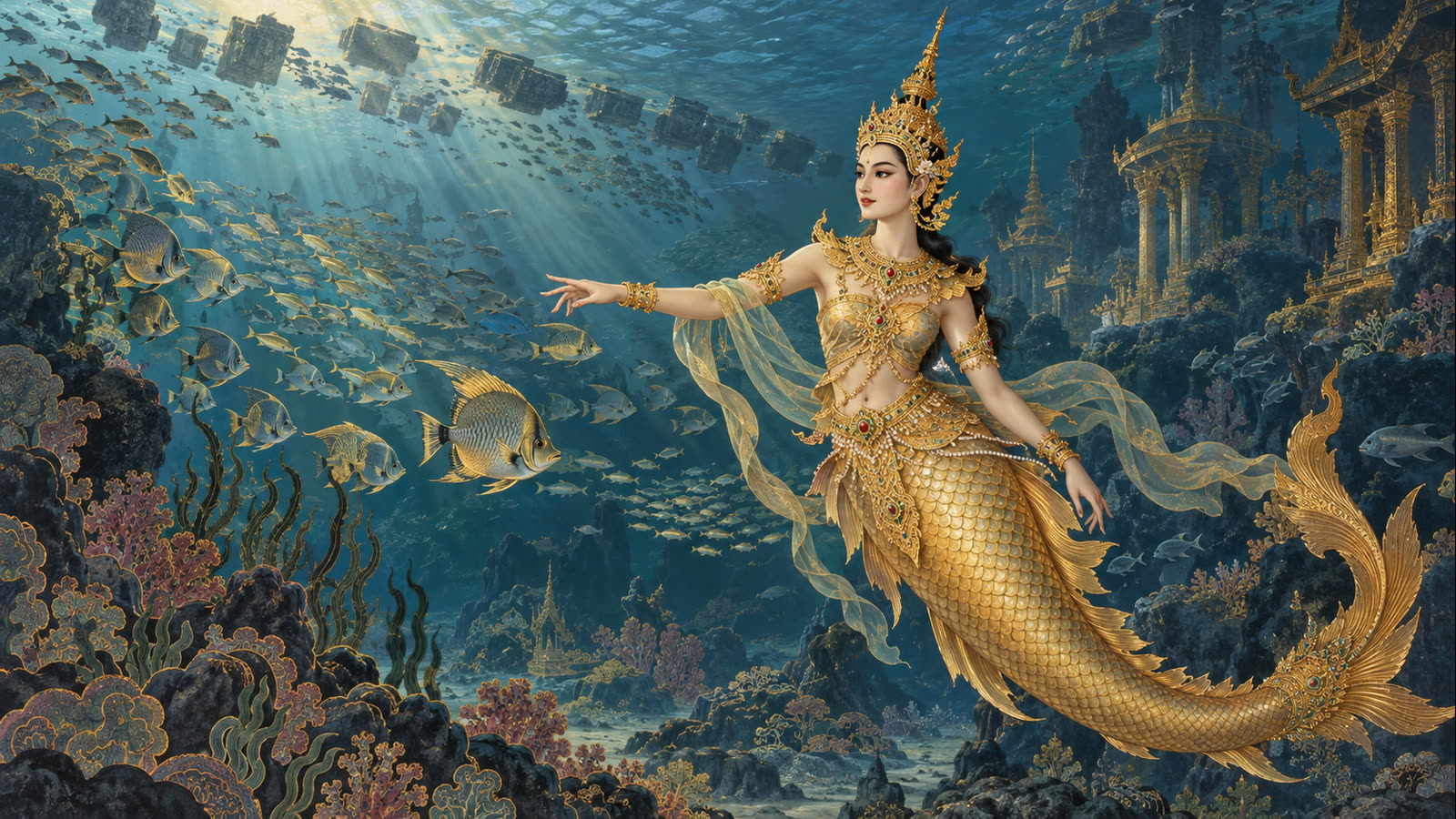
Suphannamatcha is among the most instantly recognisable yet most casually summarised figures in Thailand’s Ramakien. Daughter of Tosakanth and a fish-woman, she has the upper body of a crowned court lady and the lower body of a golden fish. She belongs to Lanka’s royal house and commands the creatures of the sea, joining land-bound kingship to an underwater realm. Her name already describes her form: suphan evokes gold, while matcha means fish. It is her literary identity, not a later prosperity slogan.
Why she removes the stones
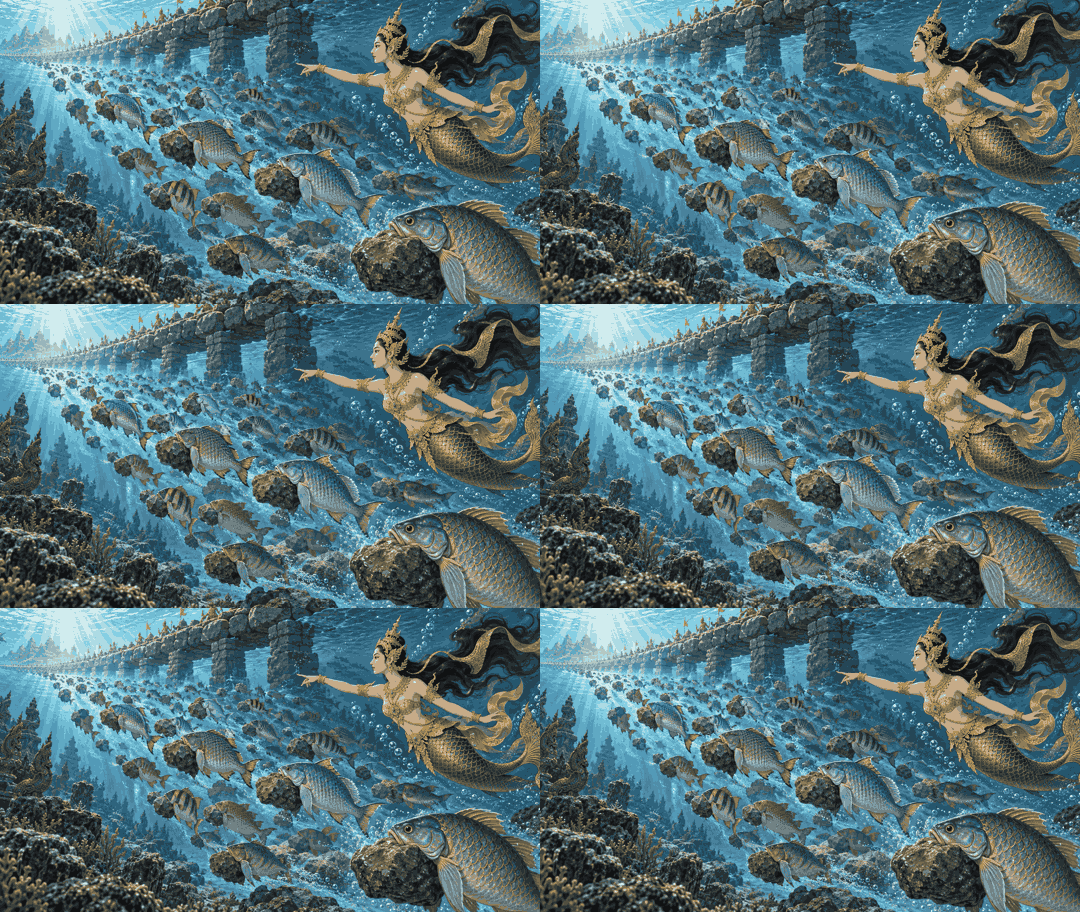
When Rama’s army begins a causeway across the sea toward Lanka, Tosakanth chooses sabotage rather than a direct interception. He orders his daughter to lead the fish in removing, one by one, the stones dropped by the monkey army. Work appears to advance above the water while its material vanishes below. Suphannamatcha is not a mermaid who happens to swim past. She is a commander acting under orders, with subordinates and the capacity to alter a campaign. The military role must be understood before the episode is reduced to romance.
Hanuman descends: pursuit, interrogation and unequal power
Sugriva notices the stones diminishing and sends Hanuman below to investigate. Hanuman sees the fish at work, pursues them and captures Suphannamatcha. Thai performance often reshapes the encounter as an elegant chase and love duet, yet the written plot begins with hostile operations, pursuit and interrogation. A modern reader can value the stage beauty while acknowledging unequal positions. To say merely that Hanuman meets a mermaid and falls in love erases her capture, her explanation of the mission and the pressure under which she decides.
Returning the stones: the end of obedience or the beginning of agency?
Suphannamatcha ultimately orders every stone returned, allowing the causeway to be completed. On the surface she merely reverses the sabotage at Hanuman’s demand. In her circumstances, however, the act defies her father and enables an enemy army to approach her own homeland. The text gives her no extended interior monologue, so a modern political position should not be invented for her. What can be said is that she is not passive throughout: she first executes one order, then uses her own command to reverse it, and the campaign changes through both decisions.
From the encounter to the birth of Matchanu
The encounter is followed by the birth of Matchanu, who inherits his father’s white monkey body and his mother’s fish tail, carrying two worlds in one form. Suphannamatcha tells the child who his father is and how to recognise him: the white monkey hero possesses jewel-like hair and fangs, wears earrings and can yawn forth sun, moon and stars. These become the evidence by which father and son later identify each other. Her maternal role is brief but structurally essential; without her preservation and transmission of identity, Matchanu could not recognise Hanuman.
Beyond Thailand: a shared Southeast Asian oceanic imagination
The golden fish princess is absent from the central bridge narrative of Valmiki’s Sanskrit Ramayana. She becomes prominent in Southeast Asian Rama traditions, especially Thailand’s Ramakien and Cambodia’s Reamker, where related dance is performed under the name Sovann Maccha. Rather than declaring without firm evidence that one nation invented the episode and handed it to another, it is safer to see a long regional circulation among texts, courts and stages. Ocean, fish peoples and local aesthetics entered an old epic. Suphannamatcha shows that adaptation is not a defective copy but the means by which an epic keeps growing.
Khon, mural and object: how to recognise her
In khon and Thai painting she normally retains the crown, collar, drapery and gestures of a court lady while the lower body is unmistakably a scaled fish with fins and tail. The Fine Arts Department preserves a painted spittoon dated to 1880 CE: one side shows Suphannamatcha holding a lotus and the other Matchanu. Mother and son therefore entered courtly decorative art long before modern illustration. Identification should combine the fish body, Thai female regalia, aquatic setting and narrative companions such as stones, Hanuman or Matchanu. Not every mermaid is Suphannamatcha.
Later romance and prosperity claims belong to a different layer
Modern decoration, amulets and online copy often connect Suphannamatcha with attraction, love, negotiation, wealth or water-related work. Such associations may grow from gold, fish, feminine charisma and her reversal of destruction into completion. They are not promises made by the Ramakien for every object bearing her image. An object must still be studied through maker, chosen episode, ritual and date. A literary figure supplies symbolic language; she does not replace provenance.
What matters is not simply that Suphannamatcha is a beautiful golden fish, but that she commands the fish and actually uses that authority to change the campaign.