Origins & Belief · Oct 2026 (B.E. 2569)
Hanuman: divine vanara, envoy and the white hero of the Ramakien
Hanuman’s greatest power is not merely leaping the ocean or burning Lanka. It is knowing when to conceal himself, when to speak, how to earn Sita’s trust and how to turn an impossible mission into strategy. Indian and Thai traditions share his loyalty but shape different heroes around it.
20 min
Hanuman: divine vanara, envoy and the white hero of the Ramakien
Hanuman’s greatest power is not merely leaping the ocean or burning Lanka. It is knowing when to conceal himself, when to speak, how to earn Sita’s trust and how to turn an impossible mission into strategy. Indian and Thai traditions share his loyalty but shape different heroes around it.
Hanuman in Sanskrit is Hanumān and in Thai หนุมาน. He is the great vanara hero but not the king of the monkey realm: the throne belongs to Vali and then Sugriva, while Hanuman serves as minister, envoy, commander and the most reliable agent. Phaya vanara may work as an honorific for a mighty vanara; treated as a strict political title, it obscures the loyalty and judgement he displays as a servant.
Birth is not one fixed genealogy: son of the Wind and the Thai divine court
The most stable Indian core is Hanuman’s bond with Vayu, the wind god; he identifies himself as Wind-born, and his mother is commonly Anjana. Regional traditions add Shiva’s energy, curses and release, or the child mistaking the sun for a fruit. The Ramakien reorganises divine genealogy in a more courtly manner, commonly naming Sawaha as mother and connecting paternity with Phra Phlai/the Wind and the power of Phra Isuan. Saying only ‘Shiva reincarnated directly as Hanuman’ or supplying one universal parentage collapses several textual layers into a false single answer.
Meeting Rama: language builds the alliance before strength is used
In the Kishkindha Kanda, Sugriva sends Hanuman to approach two unknown princes. Disguised as an ascetic, he first tests them. Hearing him, Rama praises his grammar, voice, structure and restraint, declaring that such speech requires deep learning. The encounter reveals Hanuman’s first real power: diplomacy. He identifies the visitors, removes mutual fear, translates each side’s need and creates the Rama–Sugriva alliance. Without that conversation there is no later leap, bridge or siege.
Crossing the sea to find Sita: an intelligence mission, not a strength display
Hanuman’s ocean leap contains a series of tests: an offer to rest, obstacles that test passage and an enemy that tries to swallow him. He does not answer everything with violence, alternating courtesy, changes of size, rapid judgement and necessary force. In Lanka he reduces his form, reconnoitres fortifications, palaces and troops, and finds Sita only in the Ashoka grove. This is an intelligence operation: the goal is not to conquer the city alone but to confirm the captive, establish contact and return with reliable information.
Ring, sequence and trust: why Sita believes him
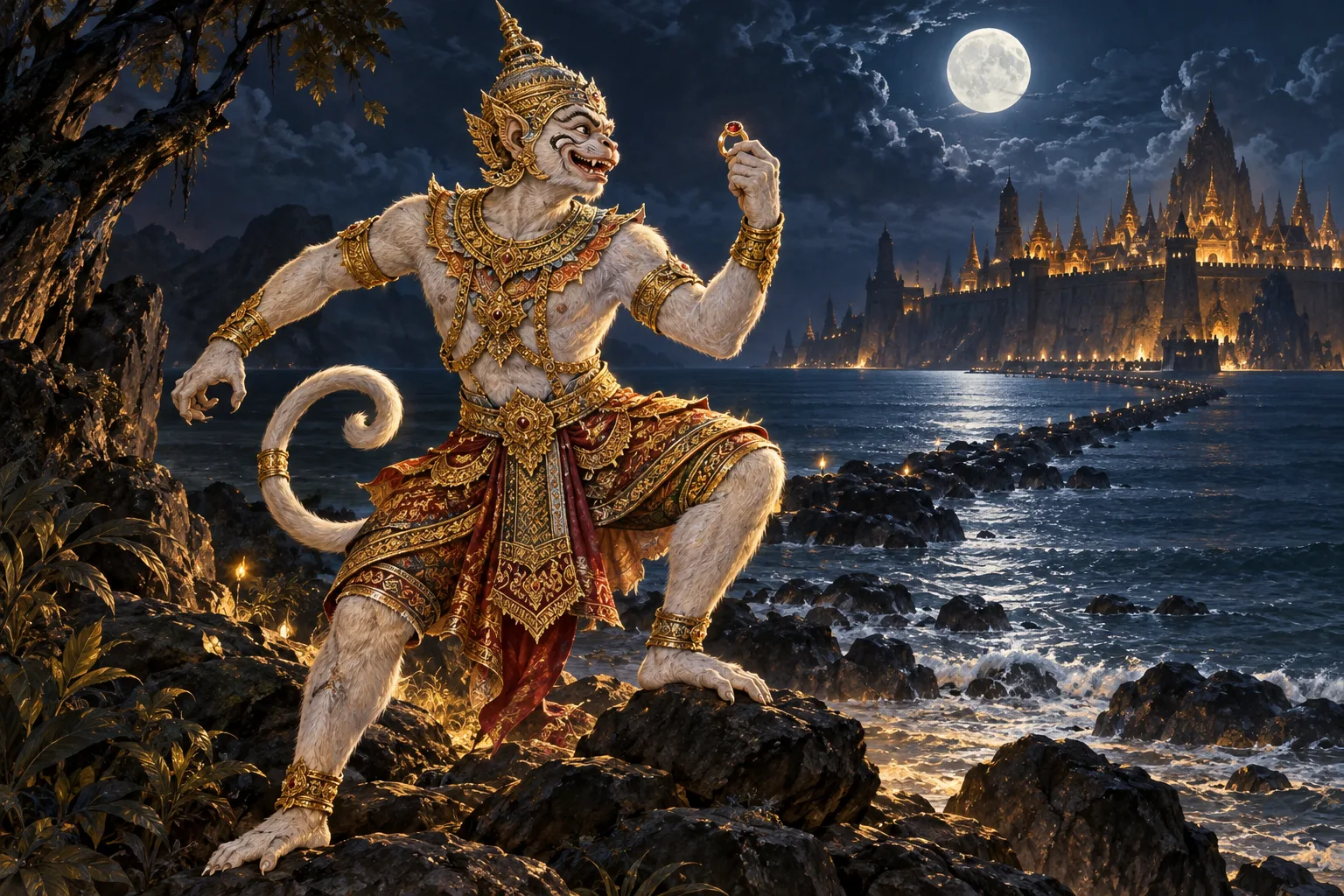
When a speaking monkey appears in captivity, Sita first suspects a trick by Ravana. Hanuman does not demand blind faith. From concealment he recounts Rama’s lineage and shared experiences, identifies himself as Sugriva’s minister and Rama’s envoy, then presents Rama’s ring. Sita answers with private memories and an ornament. Identity is established through narrative, object and reciprocal verification. More than any miracle, this episode offers a modern lesson in credible evidence: a token alone is insufficient; independent details must align.
Burning Lanka and carrying the mountain: strength serves the mission
After contacting Sita, Hanuman deliberately causes destruction, tests the garrison and allows himself to be taken before the enemy king. When his tail is set alight he turns punishment into the burning of Lanka. The act displays force and reverses humiliation. Later, when Lakshmana is gravely wounded, Hanuman is sent for a healing herb; unable to identify it exactly, he carries the mountain itself. The common theme is not limitless strength but mission focus: he understands the outcome and changes method rather than allowing pride or procedure to obstruct rescue.
Indian and Thai Hanuman: shared loyalty, different erotic character
Many later Indian bhakti traditions make Hanuman a celibate model of total devotion to Rama, whose power grows from selfless service. India still contains diverse regional narratives, so no single image covers all versions. The Ramakien creates a more worldly charismatic hero: witty, strategic and romantically active, with episodes involving Suphannamatcha, Wanarin and others. Such material supplies comedy, dance and interaction for khon without cancelling loyalty to Rama. Thai adaptation does not turn devotion into betrayal; it makes the loyal servant a full theatrical figure with desire, humour and battlefield agency.
White body, open mouth, crown and weapons: reading Thai Hanuman
Khon normally gives Hanuman a white open-mouthed monkey face, crown and ornate battle costume. White makes the chief instantly visible within the large monkey army, but not every white monkey image is automatically Hanuman. Fangs, crown form, weapon, pose and episode distinguish other white vanara characters. On an amulet, read Thai inscriptions, lineage, issuing temple, year and companion pieces. ‘White monkey’ alone cannot establish identity, and character identity cannot establish object authenticity.
From epic hero to amulet: claimed powers must return to issue context
Thai markets associate Hanuman with authority, eloquence, popularity, overcoming opposition, protection or military and police professions. These associations can be understood through his courage, diplomacy, transformation and loyalty, but they are not automatic guarantees shared by every Hanuman object. Monastic, temple or esoteric lineages select different episodes; commercial promotion may magnify them further. For any object, ask who made it, when and why it was issued, its material and ritual record, rather than deriving a promised effect directly from the mythic character.
Hanuman’s greatness is not that he never meets difficulty, but that each time he knows whether the moment requires an envoy, strategist, warrior or rescuer.