Origins & Belief · Oct 2026 (B.E. 2569)
Matchanu: the fish-tailed monkey warrior, two fathers and divided loyalty
He bears Hanuman’s white monkey body and Suphannamatcha’s fish tail, yet is raised by the underworld king Maiyarap. Recognition is not the end of the story but the first collision of blood and upbringing.
17 min
Matchanu: the fish-tailed monkey warrior, two fathers and divided loyalty
He bears Hanuman’s white monkey body and Suphannamatcha’s fish tail, yet is raised by the underworld king Maiyarap. Recognition is not the end of the story but the first collision of blood and upbringing.
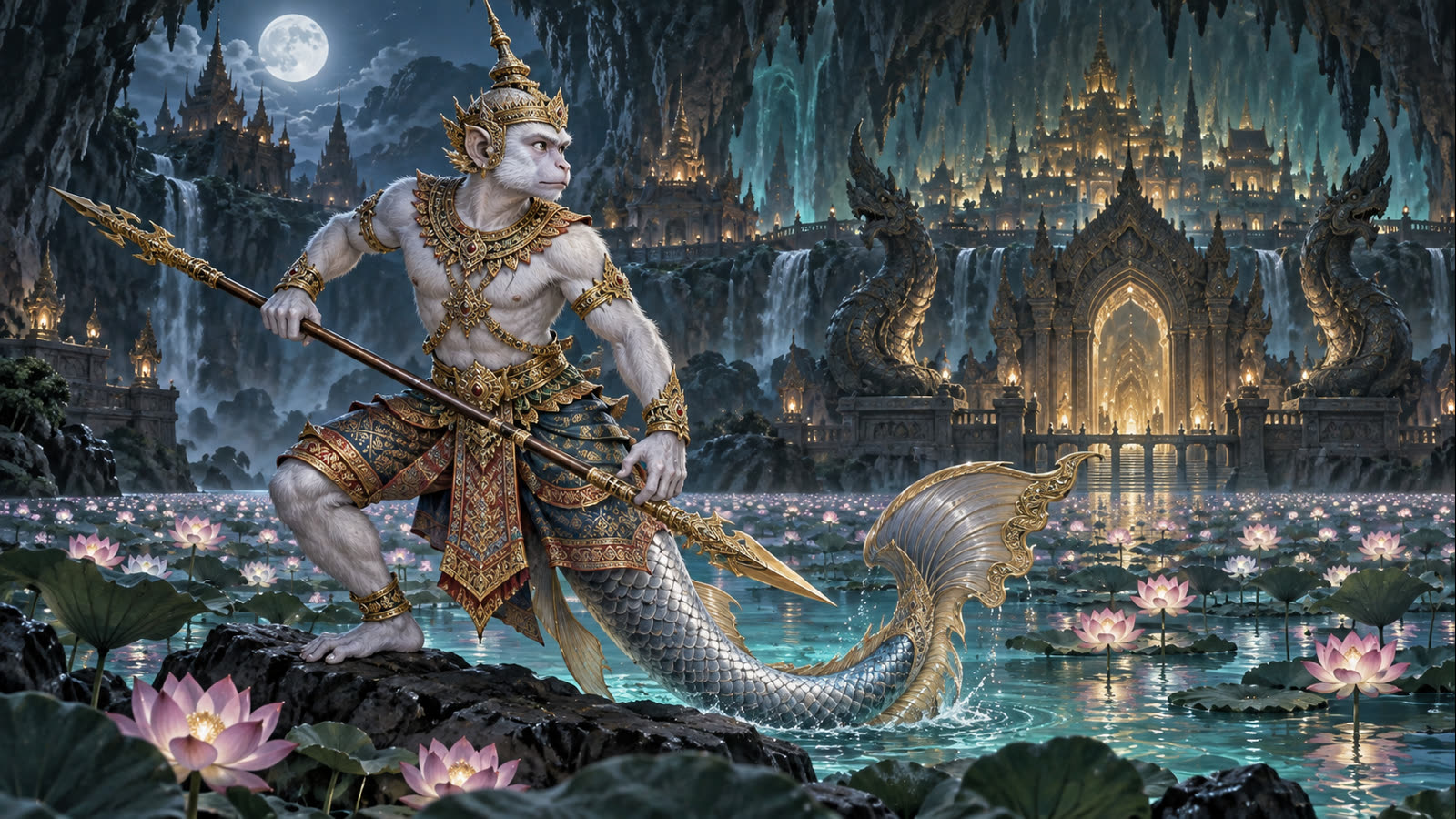
Matchanu is one of the few Ramakien figures whose biography is visible in his body. Face and torso are those of a white monkey; the tail is a fish. Son of Hanuman and Suphannamatcha, he belongs through his father to Rama’s monkey army and through his mother to Tosakanth’s house and the sea. The hybrid form does more than create spectacle. It announces the question of his life: where does he belong, and to whom does he owe loyalty?
Name and form: more than a monkey with a fish tail
The name Matchanu centres on matcha, ‘fish’, while the form fuses both parents. The Fine Arts Department describes the traditional image as monkey above and fish-tailed below; a nineteenth-century painted object places him with his mother among lotus and fish. Modern illustrations sometimes show an ordinary white monkey with an extra decorative fish tail. Traditional identification asks whether the fish tail truly replaces the normal monkey tail, together with settings such as water, a lotus pond, the underworld gate or the encounter with Hanuman.
A birth without the father: the mother leaves a method of recognition
Hanuman returns to the campaign after the causeway mission and takes no part in Matchanu’s upbringing. When Suphannamatcha gives birth, she tells the child his father’s name and leaves bodily and supernatural traits that can be checked, rather than asking him to trust a name alone. This matters later: kinship is not settled by the narrator’s assertion but through questions, resemblance and Hanuman’s demonstration of the power to yawn forth celestial lights. The mother’s oral account becomes verifiable identity evidence.
Adopted by Maiyarap: upbringing redraws allegiance
Maiyarap, ruler of the underworld city, later finds Matchanu, adopts him and assigns him the great lotus pond guarding the final approach to the city. Matchanu is not an imprisoned child but a young officer given nurture, status and duty. When Maiyarap abducts Rama and Hanuman descends in pursuit, Matchanu’s resistance is not foolish obstruction. He performs his post and repays the father who raised him. The story grants adoptive care enough moral force to stand against blood.
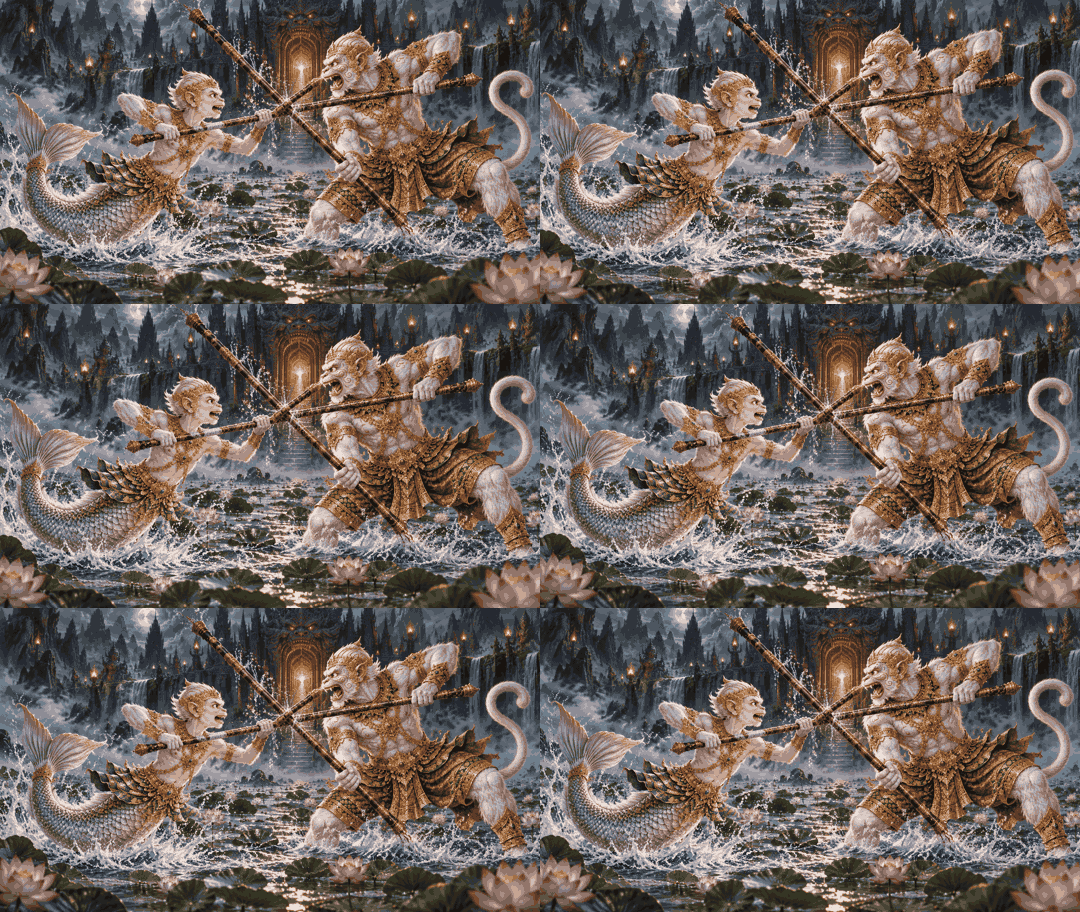
Why the inconclusive duel matters
Two white monkey warriors fight at the lotus pond. Hanuman cannot quickly overcome Matchanu, and Matchanu cannot defeat him. The draw is not merely extended action. Resemblance first appears through the body: equal courage, equal power, but one combatant has a fish tail. They stop to question names and origins. Hearing Suphannamatcha named as the mother, Hanuman understands; Matchanu still demands proof. Only when Hanuman displays the sign his mother described does he bow in recognition. Paternity is not made valid by the sentence ‘I am your father’ alone.
Recognising a birth father without betraying an adoptive father
After recognition, Hanuman asks for the entrance to the underworld city. Matchanu now faces the story’s real problem: his birth father stands before him, while his adoptive father is inside. He no longer tries to kill Hanuman, yet refuses to disclose Maiyarap’s secret directly, offering an oblique clue that lets Hanuman work out the route. Thai teaching often reads this as katanyu—remembering and repaying care. It is not a simple ‘blood is thicker than water’ lesson. Both father-son relationships remain morally real at the same time.
A life after recognition: viceroy, title and rule
Popular retellings often end with the embrace, but Matchanu later acquires a full political life. After Hanuman kills Maiyarap, Waiyawik succeeds in the underworld and Matchanu becomes viceroy. The two later travel to Rama, encounter a monkey army that does not recognise them and fight until Hanuman intervenes. Seeing the fish tail, Rama removes it, grants Matchanu the title Phaya Hanuratrithiron, arranges a marriage and gives him a city to rule; he later joins further campaigns. The arc absorbs a frontier guardian into Rama’s political order and reshapes his fish identity at the moment of investiture.
How should the removal of the fish tail be read?
To a modern reader, cutting away the maternal fish tail can suggest removal of hybrid identity so that Matchanu fits a monkey or royal order. This is a defensible interpretation, but it should not be presented as an authorial intention explicitly stated by the classical text. What the plot clearly shows is simultaneous change in body, identity and office: a hybrid guardian of a watery threshold becomes a ruler invested by Rama. To praise him as finally becoming a ‘complete monkey’ treats the mother’s oceanic half as a defect. A richer reading recognises that investiture gives status and also exacts an identity cost.
From khon character to an independent dance image
Matchanu’s body combines monkey movement vocabulary with aquatic motion, posing a distinctive problem for dancer and choreographer. Recent Thai dance research on Chui Chai Matchanu brings together monkey postures, fish movement, the birth episode and costume design, showing that he need not appear only as Hanuman’s accessory. Performance can contrast the quick, forceful upper body with the curve and flow of the lower form, translating hybrid identity into movement. This explains why a figure with less narrative time than Hanuman still sustains an independent artistic subject.
Matchanu on amulets: identify the figure, then ask about lineage
Modern markets may connect Matchanu with safety on water, adaptability, courage, gratitude or movement between realms. Such symbols can be related to the story, but they do not give every fish-tailed monkey object identical powers. First establish that the figure is Matchanu rather than Hanuman, another monkey warrior or an aquatic composite creature. Then examine Thai inscription, maker, temple or ritual lineage, date, material and companion records. Character history helps interpret design; it cannot authenticate an object.
Matchanu’s problem is not to choose one of two fathers before he can be loyal. It is to remember every debt and duty when both cannot be satisfied at once.