Origins & Belief · Nov 2026 (B.E. 2569)
Entering the World of Thai Amulets and Ritual Traditions | Chapter 6: Authenticity and Collecting
An amulet can be genuine yet misdated or attributed to the wrong ceremony. A compelling story is not proof. Learn to examine provenance, the object and the transaction separately.
11 min
Entering the World of Thai Amulets and Ritual Traditions | Chapter 6: Authenticity and Collecting
An amulet can be genuine yet misdated or attributed to the wrong ceremony. A compelling story is not proof. Learn to examine provenance, the object and the transaction separately.
Based on the original work by Yang Gongzi; adapted by TAMRA
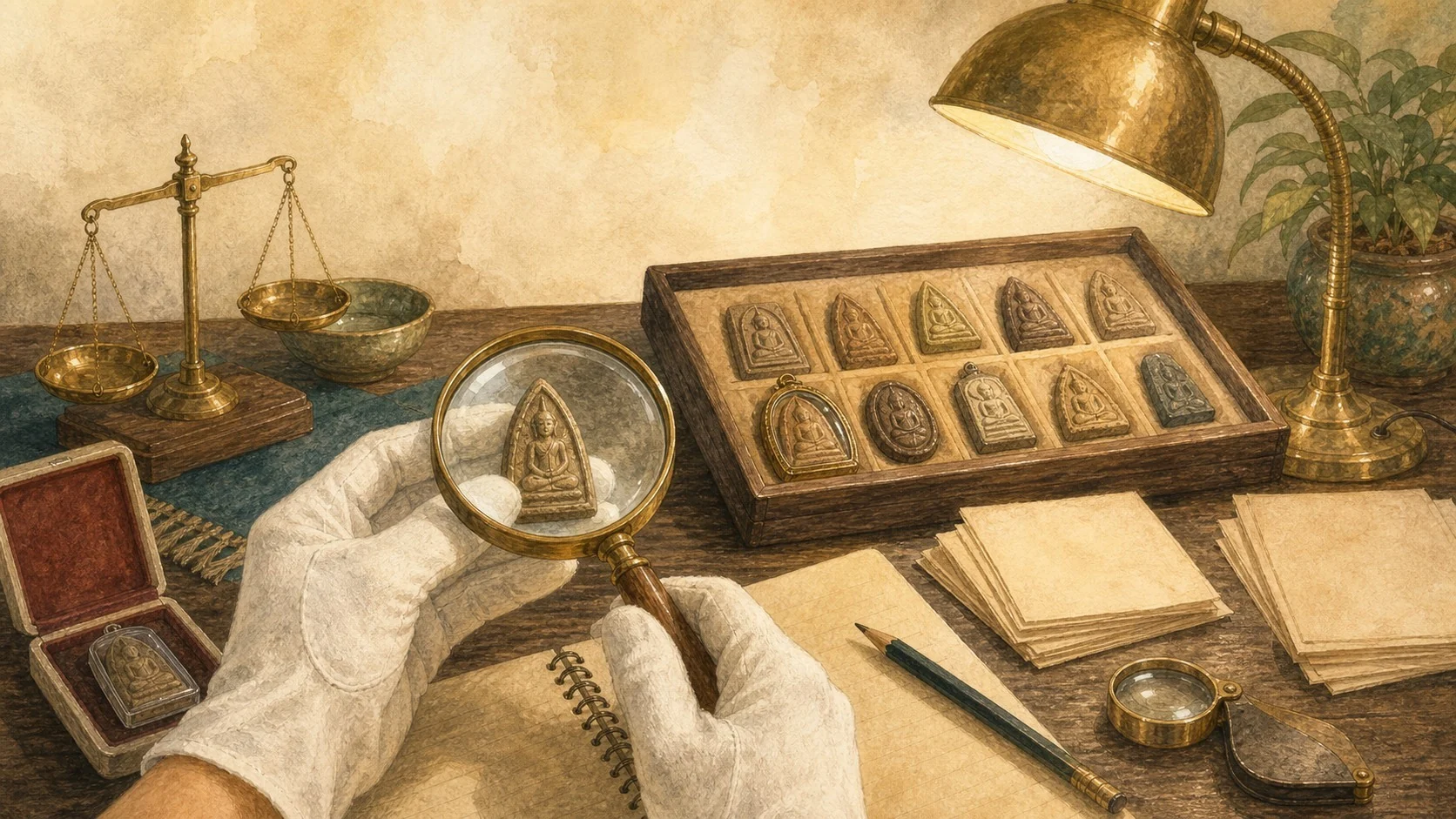
Two amulets lie on a table. One has worn edges; the other looks freshly pressed. Which belongs in a collection? The book's sixth chapter reminds us that faith may bring us to an amulet, but a purchase still calls for evidence. A convincing story can be more misleading than an unfamiliar object.
1. What does 'genuine' mean?
The original book groups risks into three layers: the object itself may be a copy; the object may exist, but its maker, issue or consecration story may be misstated; or a legitimate name may be used to sell exaggerated ritual claims. This is a practical editorial framework, not an official three-grade Thai authentication system.
'Genuine' therefore hides several questions. Is this the stated issue? Are its date and temple documented? Do its material, mould and manufacture fit? Can the seller explain its provenance? Whether a particular teacher blessed it is a separate historical claim requiring contemporary records or credible witnesses; appearance alone cannot establish it.
2. Build evidence from provenance and the object
Begin with the issue history. Do temple notices, contemporary photographs, quantities and variant records agree? Receipts, older collection photographs and transfer records help trace an object, but a single certificate or oral account is not the final answer. Evidence closer to the time of issue deserves particular attention.
Then examine the object. Photograph the front, back, edge and dimensions, and compare it with reliable examples of the same issue. Do mould lines, material, casting or pressing traces, surface change and wear make sense together? A Thai Fine Arts Department publication discusses mould, corrosion and material as comparison points while noting that forgers can imitate surface signs. No single 'secret test' settles the case.
Record what remains unknown: an unverified variant, alternative temple spellings, an encasement that hides the edge, or photographs too poor for comparison. For costly or disputed pieces, seek an independent specialist familiar with that issue, compare opinions and agree in writing on returns and disputes. 'No problem noticed' is not the same as 'proven genuine'.
3. Market names, ritual stories and personal sensations
The book cautions against presenting Chinese-market labels such as 'nine-tailed fox amulet' as if they automatically belonged to an ancient Thai temple lineage. That caution is useful, but the name alone cannot prove every such object counterfeit. Cross-cultural imagery, modern production and commercial naming can coexist. The test is whether the claimed maker, date, lineage and rite have evidence of their own.
Feeling warmth, dreaming or sensing a change after wearing an amulet may matter personally, but it is not a repeatable test of date, mould, provenance or ceremony. Equally, the absence of such feelings proves nothing against an object. Personal experience can be respected while physical and historical claims are checked separately.
4. Set your own collecting rules
Start by naming your purpose. Are you studying design and craft, remembering a teacher's guidance, or keeping a link to a temple or family? Different purposes call for different budgets, tolerances for missing records and care. New amulets are not inferior because they are new, nor are old ones automatically worth more. Context tells you what you are collecting.
For each transaction, save the listing, full photographs, the seller's description of variant and defects, payment and shipping records. Pause if someone demands an immediate transfer yet refuses a photograph of the back or an explanation of provenance. Thai police have warned of fake auction pages using amulet images to attract bids, then delivering the wrong object or disappearing. The risk lies in the transaction, not in faith itself.
At home, store the piece in a dry, stable setting suited to its material. Do not scratch, soak, heat or dismantle it as a supposed authenticity test. If protected antiquities, human-derived material or other restricted substances are claimed, establish provenance and applicable rules before handling or trading. Respect for an amulet includes respect for its history and for people affected by its sourcing.
Faith may begin a collection; evidence should guide an attribution. Where the record is incomplete, write 'unconfirmed'.
Back at the table, worn edges and a pristine surface are only clues. The more useful question is not 'Which feels more powerful?' but 'Which story can I check, step by step?' A collection can retain both reverence and judgment. The next chapter turns to personal accounts and examples of how amulets enter everyday life.