Origins & Belief · Nov 2026 (B.E. 2569)
Three number systems for auspicious protection: Yan Solot Mongkhon (ยันต์โสฬสมงคล)
Sixteen numbers outside, twelve in the middle and a nine-cell square at the centre. Manuscripts, a temple account and numerical research reveal what each layer means and where versions diverge.
12 min
Three number systems for auspicious protection: Yan Solot Mongkhon (ยันต์โสฬสมงคล)
Sixteen numbers outside, twelve in the middle and a nine-cell square at the centre. Manuscripts, a temple account and numerical research reveal what each layer means and where versions diverge.
Why place sets of sixteen, twelve and nine numbers inside one square? The key is the position and order of each number, and the name given to each layer. To read the diagram, we must distinguish the visible numerals, the words recited while inscribing them, and later interpretations from particular lineages.
Name and pronunciation: sixteen auspicious signs or sixteen heavens?
The Thai name is yan solot mongkhon, ยันต์โสฬสมงคล. Solot, โสฬส, comes from Pali soḷasa and means sixteen. Thai educational material gives its pronunciation as so-lot; mongkhon means auspiciousness. Some lineages interpret sixteen as the sixteen form-realm Brahma heavens or sixteen Buddha qualities. These are interpretations of the number, not the only literal translation of the name.
Related names include yan solot, ariya sat solot and solot maha mongkhon. Similar names do not ensure identical border mantras. This is neither the Nine Spires yantra nor a different name for the Itipi so recollection of the Buddha's qualities. A chant may supply words for a yantra, but the chant and diagram remain distinct.
Three yantras combined
A Thai manuscript transcribed by the Sirindhorn Anthropology Centre explicitly names the outer Solot ring of sixteen, the middle Trinisinghe ring of twelve and the inner Jaturo square of nine. Wat Kaew Charoen describes the same three-part structure. This combination identifies the yantra family more securely than a single border inscription.
Outer ring: sixteen numbers and a square of 34
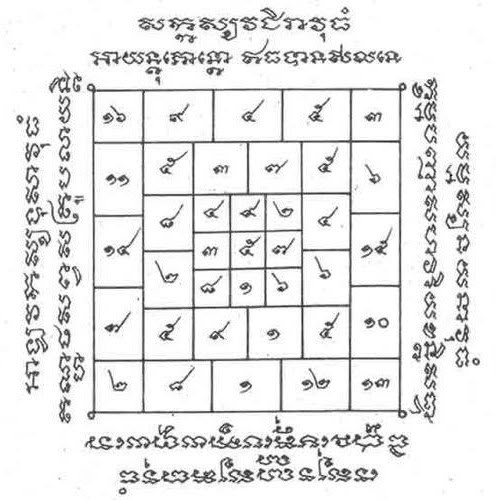
Start at ๑๖ in the upper-left corner and follow the outer ring clockwise: 16, 9, 4, 5, 3, 6, 15, 10, 13, 12, 1, 8, 2, 7, 14, 11. Fold the sequence into rows of four: 16 9 4 5 / 3 6 15 10 / 13 12 1 8 / 2 7 14 11. Every row, column and main diagonal totals 34. This is a verifiable property of the arrangement, not proof of a protective effect.
A temple-published recital links the first six numbers to sixteen auspicious things, the nine supramundane dhammas, four continents, five Buddhas of the present fortunate aeon, the three baskets of scripture and six sense-sphere heavens. The nine dhammas are four paths, four fruits and nibbana. These words interpret the numbers; they are not additional letters hidden in the cells.
The temple version then connects 15 with fifteen states of becoming; 10 with precepts; 13 with ascetic practices; 12 with miracles; 1 with Mount Meru; 8 with celestial beings; 2 with sun and moon; 7 with factors of awakening; 14 with wheel-turning rulers; and 11 with Vishnu rulers. The page does not enumerate every member of the groups of eight, twelve or fourteen. Those lists should not be invented.
Middle ring: four triplets, each totalling fifteen
The Trinisinghe ring reads 3–7–5, 4–6–5, 1–9–5 and 2–8–5. In each triplet the first pair totals ten and the final five brings it to fifteen. Scholars call this pattern the twelve-number auspicious formula, attrā thawāthasa mongkhon, and trace its arrangement to the inner nine-cell square. It is an ordered system, not a random collection of powerful numbers.
The manuscript's recital associates the first triplet with three lions, seven nagas and a fivefold sacred artisan group. The second invokes four devas, a group of six and five Indras. The third names one yaksha, nine devas and five Brahmas. The fourth names two rulers, eight arahants and five Buddhas. The number five appears four times but carries a different name in each group.
A mural at Wat Chi Pa Khao turns the twelve positions into lions, nagas, a yaksha, arahants and devas. One label refers to six horses, although the accompanying description is inconsistent about their depicted number. Such images show how a formula could be visualised; they cannot replace a reading of a particular inscription. Nor does the middle-ring six necessarily mean the six sense-sphere heavens of the outer recital.
Centre: the Jaturo square and its fixed five
The Jaturo square reads 4 9 2 / 3 5 7 / 8 1 6. All three rows, three columns and two main diagonals total fifteen. Five remains at the centre. The description 'nine-cell square' names its shape; Jaturo itself does not mean nine. Wat Kaew Charoen records its independent use in rites for setting a house pillar, as well as associations with gain and protection. That use should not become the sole meaning of the whole three-layer yantra.
Border inscriptions: same numbers, different recitals
The outer writing resembles Khom Thai, a Khmer-derived script used in Thai ritual manuscripts. The related manuscript contains Thai, Khom Thai and Pali. Wat Kaew Charoen describes one border with the thirty perfections recital and another with the four divine weapons: Alavaka's noose, Yama's eye, Indra's thunderbolt and Vessavana's mace. The numerical core identifies a family of designs; it cannot by itself identify every border syllable or the maker's lineage.
What the manuscript says it was used for
Ongkan Maha Makrut Paet King records the complete Solot yantra placed over the mouth of a medicinal pot, while separate Trinisinghe copies were fixed to the ritual cord in eight directions. This documented use places the diagram in traditional medicine and protective rites, beyond later amulet designs. Temple accounts add pillar-setting, protection of objects and wishes for gain. These are uses within particular traditions, not experimentally established physical effects.
A textual discrepancy worth preserving
The pictured outer ring contains 2, as does the temple's recital for sun and moon. Yet the Anthropology Centre's manuscript transcription repeats 5 in the corresponding position and omits 2. It also first labels the middle-ring jatu thewa as 5, then gives 4 when the sequence is repeated. These may be manuscript variants or transcription and layout errors; the available evidence does not settle which. A careful reading compares the diagram, transcription and other versions separately.