Origins & Belief · Oct 2026 (B.E. 2569)
Occult-associated materials in Thai amulets and talismans: an eight-part guide
Athan is not the name of one mysterious powder. Begin by distinguishing material, function and provenance before examining each tradition in depth.
9 min
Occult-associated materials in Thai amulets and talismans: an eight-part guide
Athan is not the name of one mysterious powder. Begin by distinguishing material, function and provenance before examining each tradition in depth.
The Thai word athan often appears in discussions of phra khrueng and khrueang rang, or amulets and talismans. For some it suggests unusual wood or stone; for others, special powders, cemetery earth or still more contentious substances. The word alone, however, tells us neither what an object contains nor what an ingredient does or whether its provenance is documented. This article offers a map; later articles can examine each material closely.
What does athan mean here?
In Thai usage, athan can evoke occult power, ritual practice and taboo. It is not a substance with a fixed chemical composition, nor does it automatically mean evil or human remains. A study of amulet culture catalogued by Chulalongkorn University discusses rolled takrut, protective cloth bands and small charm pellets under the wider idea of watthu athan. In such usage the term describes objects invested with belief, not one ingredient hidden inside them.
A phra khrueng commonly takes the portable form of a Buddha or revered monk, while khrueang rang covers a wider range of talismans: inscribed cloth, rolled metal sheets, pieces of wood and naturally unusual objects. The categories overlap. Neither is governed by a single athan recipe.
Separate substance from function
One amulet can have a clay body, herbal inclusions, ritually prepared powder and wax or resin as a binder. An inscribed metal sheet may stand alone as a charm or be inserted into another object. The Thailand Cultural Encyclopedia summarizes four principal amulet-body families as wan, din, chin and phong: herbs, clay, metal and powder. Those are a useful starting point, not a complete inventory of talismanic media. The eight groups below are an editorial guide, not an official eight-part system shared by every lineage.
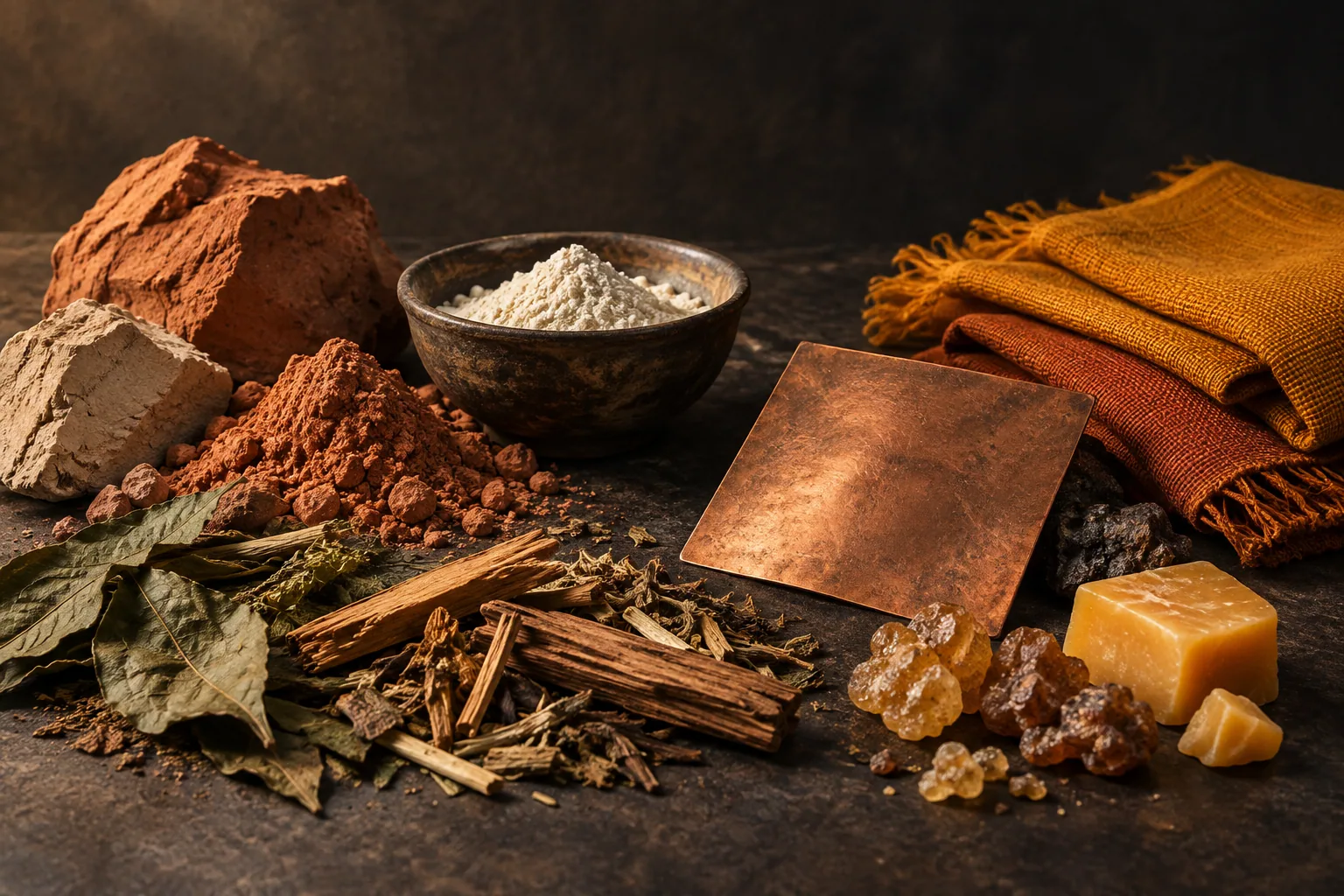
A material map: eight lines of inquiry
- 01Earth, stone and minerals can form a moulded body or be minor inclusions. Soil from a named place may carry a temple, burial-ground or historical association, but the story of its origin is distinct from verified composition.
- 02Herbs, flowers, leaves and wood may be ground into a body, mixed in small quantities, carved or used as a container. Lineage, a plant's name, scent, durability and local custom can all inform the choice; they are not one universal power.
- 03Ritual powders, incense ash and fragments of earlier objects may form the body or a small additive. Some powders are tied to writing and erasing sacred characters; ash and fragments have different histories. The mere presence of powder does not identify which kind it is.
- 04Metal can be cast as an amulet or medal, inscribed as a sheet, or rolled into a takrut. Copper, silver and lead affect making and preservation; the inscription, lineage and ritual form a separate layer of meaning.
- 05Cloth, paper, palm leaf and cord often carry inscriptions, wrap another object or make it wearable. A yantra on cloth and one on metal may share a design while differing in construction, use and care.
- 06Oils, waxes and resins may be the medium of a charm or serve as binders, seals and coatings. Physical purpose and ritual narrative can coexist; smell, colour and texture alone do not establish provenance.
- 07Historical accounts mention teeth, horns, shells and unusual natural objects known as khot. Identification, acquisition and conservation ethics are particularly important here. A market name does not establish species or lawful provenance.
- 08Funerary materials and spirit narratives appear in some traditions and sales claims: cemetery soil, coffin-related objects, cremation ash and even alleged human material. None is a universal athan ingredient. The story, actual composition, manner of acquisition and ethical questions each require separate scrutiny.
Why choose these materials?
The first reason is practical: clay and powder take a mould, metal can be cast or inscribed, cloth folds and ties, and wax binds or seals. The second is symbolic: a material's name, place of collection, previous use or connection to a teacher may matter to devotees. The third is lineage and rite. Within a particular tradition, an ordinary copper sheet and one that has been inscribed are not understood as the same object, even though their physical material matches.
Rarity alone does not make an amulet superior. More useful questions are who made it, for what purpose, what records survive and whether its materials and technique fit the claimed edition. The Thailand Cultural Encyclopedia warns that a dark body need not contain burnt palm leaf and red flecks need not be herbs. Colour and narrative are leads, not proof of composition, authenticity or effects.
Four questions to ask
- 01Is the claimed material the main body, a minor inclusion, an outer carrier or an object used only in a rite?
- 02Does the name come from contemporary records, temple documentation, lineage accounts or a later sales description?
- 03Do appearance, technique and ageing fit the claimed period and batch, and can they be compared with reliable examples?
- 04If burial grounds, human remains or wildlife are alleged, are provenance, respect for the deceased and conservation concerns addressed?
Where this series goes next
Future studies can take herbs and unusual woods, ritual powders and older fragments, earth and cemetery traditions, metal takrut, inscribed cloth and palm leaf, then oils and waxes in turn. Claims involving animals or funerary matter call for especially careful provenance and ethical review. Each account should return to a particular maker, temple, edition or locality. Two objects called athan need not share ingredients, methods or attributed effects.
A connection to life today
A person need not accept every supernatural account to value or wear an amulet. Learning its materials can reveal craft, lineage and local culture while encouraging respect for the people and environments behind them. Asking both what an object is and what it means to its community gives us a fuller account of its life.