Origins & Belief · Oct 2026 (B.E. 2569)
Phraya Phichai Dap Hak: From Thong Dee Fun Khao to Uttaradit's Broken-Sword Hero
A farmer's son became a boxer, swordsman and commander under King Taksin. One battle, fought on after a blade broke, carried his name into Thai history, local devotion and amulet collecting.
9 min
Phraya Phichai Dap Hak: From Thong Dee Fun Khao to Uttaradit's Broken-Sword Hero
A farmer's son became a boxer, swordsman and commander under King Taksin. One battle, fought on after a blade broke, carried his name into Thai history, local devotion and amulet collecting.
In Uttaradit, Phraya Phichai Dap Hak is more than a commander in a history book. His monuments, shrine, museum, annual commemorations and the affectionate title Than Pho—revered father—preserve a local idea of courage: not that a sword can never break, but that duty continues after it does. Phraya was a noble rank, while Phichai was the city he later governed. Dap Hak means broken sword.
A fighter from Ban Huai Kha
The most widely repeated biographies place his birth around B.E. 2284, or 1741, in a farming family at Ban Huai Kha in the old city of Phichai. His childhood name was Choi, later changed to Thong Dee. Local biography remembers a boy educated at Wat Mahathat who loved boxing, left home to seek notable teachers and studied swordsmanship at Sawankhalok. Because he did not chew betel and kept conspicuously white teeth, he became known as Thong Dee Fun Khao—White-Toothed Thong Dee. Later commemorative accounts do not all calculate his birth year and age in the same way, but they consistently place his active life across the final Ayutthaya years and the Thonburi period.
The turning point came at a festival in Tak. Thong Dee won successive boxing contests and caught the attention of Phraya Tak, then governor of the city and later King Taksin. He entered his service and developed from fighter to trusted guard and vanguard commander. The titles associated with his rise include Luang Phichai Asa, Chao Muen Waiworanat and Phraya Siharat Decho. When Ayutthaya fell in B.E. 2310 and Phraya Tak broke out, gathered forces and established the Thonburi kingdom, Thong Dee fought in the campaigns that followed.
From field commander to governor of Phichai
In B.E. 2313, after King Taksin's forces defeated the Lord of Fang, rewards were granted at Phitsanulok. An Uttaradit government account quoting the royal chronicle records that Phraya Siharat Decho was appointed Phraya Phichai and sent to govern his home city, with authority over nine thousand people and troops. The appointment brought him back to the country of his childhood and turned an office—Lord of Phichai—into the name by which later generations remember him.
He helped repel an attack near Laplae in B.E. 2315. The following year, a Burmese force under Po Suphla advanced on Phichai again. On the seventh waning day of the second lunar month in B.E. 2316, Phraya Phichai led his men outside the walls and fought near the fields of Wat E-ka. In close combat he wielded two swords; one broke, yet he continued and the attackers were driven back. Official local histories and Uttaradit's commemorations use this battle to explain the name Dap Hak. Some later tellings break one blade, others both, but the enduring image is the same: the weapon failed before the fighter's resolve did.
A change of dynasty and a final act of loyalty
The Thonburi order collapsed in B.E. 2325. Local cultural sources and later biographies preserve a final story: the new king was prepared to retain Phraya Phichai, but he refused to serve a second lord and chose death after King Taksin, at about forty-one. The dialogue survives through later biography and local memory rather than a verbatim courtroom record. Even so, it shaped the qualities Uttaradit most closely associates with him—courage joined to gratitude, fidelity and loyalty to a benefactor.
From historical commander to local moral symbol
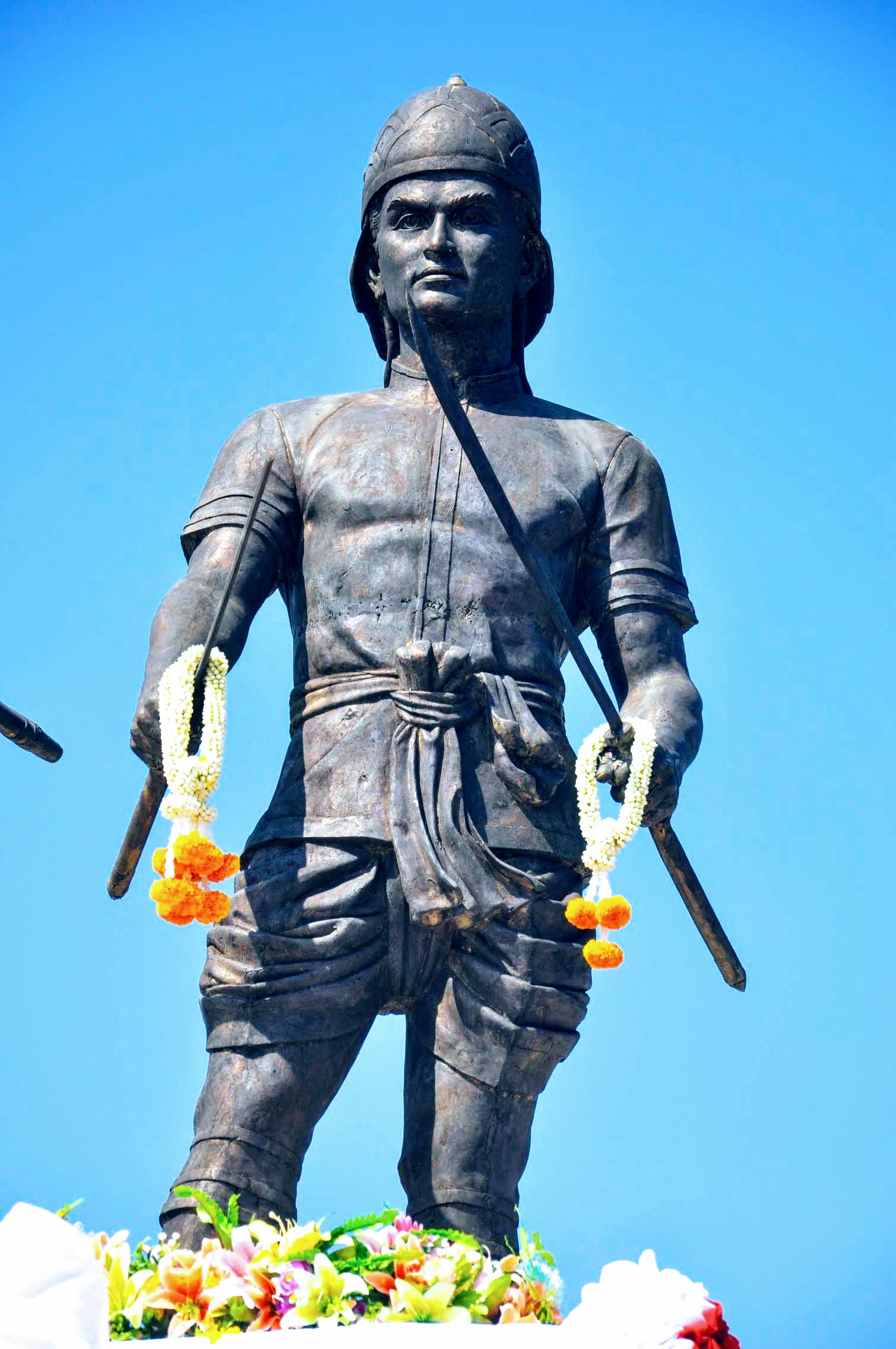
The principal monument before Uttaradit Provincial Hall was designed and cast by Thailand's Fine Arts Department and opened on 20 February B.E. 2512. The shrine by Wat Mahathat in Phichai, the birthplace memorial at Ban Huai Kha, and the paired Taksin–Phichai monument at Wat Khung Taphao allow different communities to carry the story. Visitors offer garlands and food; boxing or sword performances may fulfil vows. This does not turn a military nobleman into a Buddhist monk. It shows how Thai local communities can place a remembered defender within traditions of ancestor respect and civic guardianship.
The first commemorative medal of B.E. 2513
One year after the main monument opened, Uttaradit issued the first Phraya Phichai Dap Hak commemorative medal in B.E. 2513. Collector documentation describes an oval struck medal. Its obverse follows the monument: the standing commander holds two swords, one broken, above the words Phraya Phichai Dap Hak, Uttaradit Province. The reverse combines several yantra and Khom inscriptions with the date 1 February B.E. 2513. Gold, silver and copper are recorded. Collectors also distinguish a Bor Tem and Bor Khat die according to whether the lower stroke of the Thai letter bo in dap is complete or missing.
The consecration was held before the Uttaradit monument, with Supreme Patriarch Chuan lighting the victory candle and respected monks from several regions participating. Later collector accounts preserve production totals and stories of inscribed metal sheets and older sacred metal added to the alloy. They are useful for understanding the issue's tradition, but an individual medal still has to be studied through its complete die work, lettering, edge, metal, natural wear and provenance. A Bor Tem or Bor Khat label alone cannot authenticate the rest of the object.
A broken blade does not require a broken spirit
Phraya Phichai's story has survived for more than two centuries because it joins more than one dramatic battle. It connects Muay Thai, swordsmanship, military service, civic leadership and loyalty, turning a broken blade into Uttaradit's most recognisable symbol. To collect one of his medals is therefore to preserve more than metal or market value. The deeper inheritance is a local ethic: skill is built through practice, responsibility is accepted in danger, and opportunity is answered with gratitude. The broken sword matters because its bearer remained standing.