Origins & Belief · Oct 2026 (B.E. 2569)
Khun Chang: From a Wealthy Literary Anti-Hero to an Amulet of Prosperity
Wealthy, powerful and bald, he deceives others to possess Wanthong—yet he is more than a stock villain. Centuries of recitation, revision and local memory carried Khun Chang from epic poetry into Thai amulet culture.
10 min
Khun Chang: From a Wealthy Literary Anti-Hero to an Amulet of Prosperity
Wealthy, powerful and bald, he deceives others to possess Wanthong—yet he is more than a stock villain. Centuries of recitation, revision and local memory carried Khun Chang from epic poetry into Thai amulet culture.
In Thai literature, Khun Chang scarcely needs an introduction. He is bald, plump, immensely wealthy, litigious and adept at using connections. With the handsome, magically skilled Khun Phaen and Wanthong, the woman caught between them, he forms the best-known triangle of desire and power in The Tale of Khun Chang Khun Phaen. The first step in understanding him is not to decide whether he is good or evil. It is to recognise that he is not a merchant with a complete historical dossier, but a literary figure shaped by centuries of oral performance, courtly revision and print editing.
First a recited tale, later a fixed book
The epic was not written as a novel by a single author in one sitting. Chris Baker and Pasuk Phongpaichit argue from early manuscripts, language and performance history that its core was taking shape in local recitation around 1600. Sepha performers repeatedly retold and enlarged it. Between the eighteenth and nineteenth centuries the work moved from popular performance into courtly literary circles; after the mid-nineteenth century it passed from manuscript into print. Prince Damrong's National Library edition of B.E. 2460–61 (1917–18) became the most influential standard text. The Khun Chang read today therefore carries traces of provincial comedy, performance rhythm, court taste and modern editing at once.
Wealth, appearance and an unequal contest
Khun Chang is no poor outsider. He is a Suphanburi magnate with a great house, servants, land and money sufficient to work the official system. The poem deliberately opposes his appearance to Khun Phaen's. Phaen is handsome, martial and magically accomplished; Chang is bald, big-bellied and comic. The contrast works on stage, but it also turns male rivalry into a collision between two kinds of power: beauty, warfare and occult knowledge on one side; money, law and social networks on the other. Without Phaen's heroic image, Chang repeatedly uses deception, matchmakers, litigation and court connections to overcome his insecurity.
His most notorious scheme comes while Khun Phaen is away at war. Chang brings supposed bones, reports Phaen dead and invents a rule that Wanthong will become crown property unless she remarries. Her mother then compels her to marry him. Chang later makes false accusations, seeks revenge and even attempts to kill Phlai Ngam, whom he knows is not his son. Such acts make him the story's conventional villain, but they also expose Wanthong's deeper predicament: her mother, husbands, officials and king repeatedly decide where she will live. At the climax, she must instantly choose Phaen, Chang or her son. Her refusal to compress a complicated life into one answer leads to execution. The tragedy comes not only from two men contesting a woman, but from an order that leaves the woman no secure voice of her own.
Is he only a villain?
The Thai Cultural Encyclopedia notes that Chang's love for Wanthong is at once strength and failing: selfish and possessive, yet also sustained. During their many years together he treats her as principal wife, gives her material security and tends her through childbirth, illness, heat and cold. In a scene when others think Chang has been beaten to death, Wanthong herself recalls this daily care. It does not cancel his deception or violence, but it frees him from the flat label of a rich, ugly man. He can love sincerely and still turn love into control through fear of loss. That contradiction makes him more human than a simple villain.
A literary landscape in Suphanburi
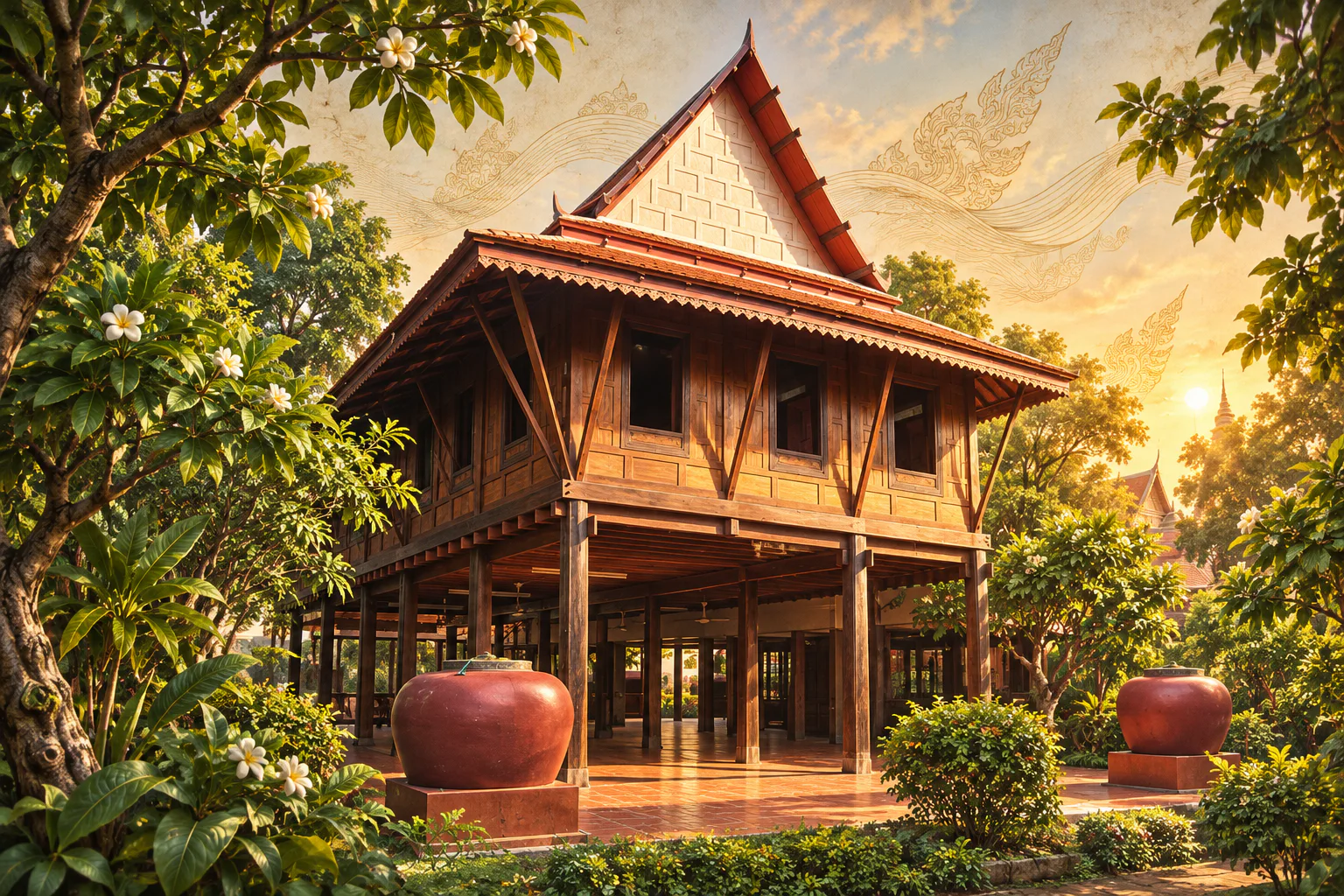
The poem writes real places—Suphanburi, Kanchanaburi and Ayutthaya—into its characters' lives, leaving a literary map behind. Wat Palelai in Suphanburi now has murals devoted to the tale and a reconstructed traditional house called the House of Khun Chang. This is not an excavated historical residence and cannot prove that every event in the poem occurred. It functions more like a local literary museum, joining oral story, temple, civic identity and tourism. The cover is an editorial illustration based on a public-domain photograph of that reconstruction; it does not present the building as Chang's authenticated home.
From wealthy character to prosperity amulet
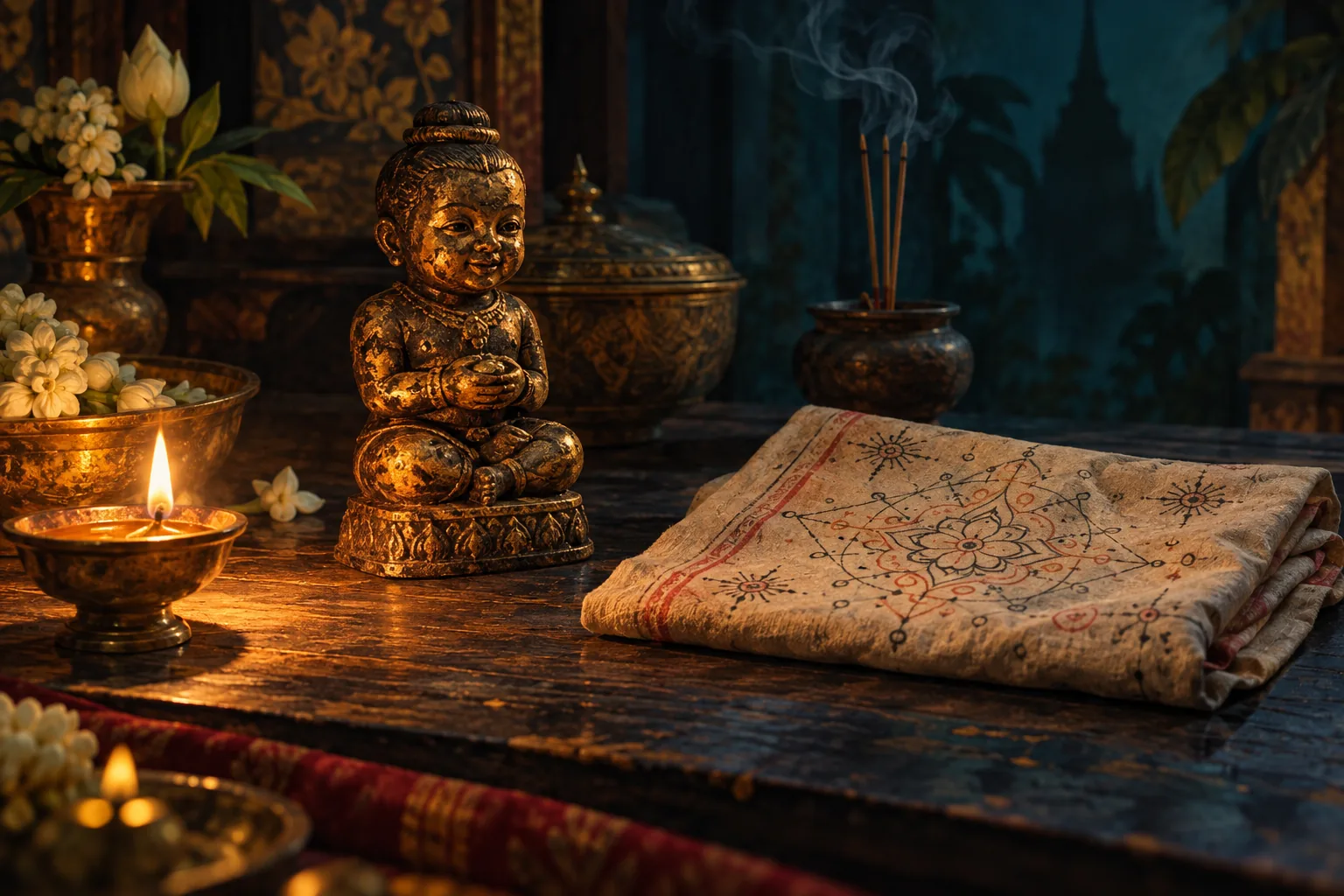
When a literary figure is remembered for generations, communities often lift out a defining trait and give it new ritual meaning. Khun Phaen entered amulet culture through charisma, magic and combat; Khun Chang became associated with trade, attracting and retaining wealth because he was the town's richest man. The British Museum holds a clay tablet acquired at Wat Palelai and dated around 2000–05. Its bare-chested, pot-bellied figure sits with bent legs and grips a money bag; a magic diagram appears on the back. The museum records that the temple produced tablets of both Chang and Phaen, and observes that Chang's pose recalls Thai images of the wealth deity Thao Kuwen. This is a later iconographic and devotional development. It does not mean the original recited poem already worshipped Chang as a god.
Three layers of evidence for collectors
- 01Literary layer: how the poem and its manuscript traditions portray Chang. This explains the character, not the date of a particular amulet.
- 02Issue layer: which temple or group made it, when, and whether packaging and reverse inscriptions match contemporary records. This is central to identifying an edition.
- 03Devotional and market layer: claims about prosperity, business or popularity should be attributed to devotees or collectors. They guarantee no result and cannot replace material, mould and provenance.
Khun Chang endures because he never fits a comfortable answer. He has wealth without security, can care for the person he loves and can harm her in love's name. The poem mocks him, yet he understands the power of money and institutions—forces that often outlast swords. Today the detested rival has also become, for some devotees, an image of steady trade and retained wealth. To read him well is neither to excuse his harm nor to crown him uncritically as a wealth god. It is to see how Thai literature preserves human contradiction, and how local society and amulet culture interpret it anew in each generation.