Identification Guides · Oct 2026 (B.E. 2569)
How Provenance and Catalogues Support Amulet Identification
A famous collection, a book appearance or temple acquisition is not an automatic guarantee; value lies in connecting the record to this individual object.
18 min
How Provenance and Catalogues Support Amulet Identification
A famous collection, a book appearance or temple acquisition is not an automatic guarantee; value lies in connecting the record to this individual object.
‘Famous old collection’, ‘published in a book’ and ‘obtained from the temple’ sound weighty, but their value lies in connecting a collection, publication or acquisition event to the object in hand. Provenance is an object history built link by link, not an automatic authenticity label.
Good records narrow uncertainty: they show that an object existed by a date, where it was recorded and how it was named. They need not fill every gap since manufacture. Museum provenance, inscription numbers and publication records illuminate individual identity, duplicate counting and the honest preservation of unknown history.
Same type and same object are different claims
A matching composition in an old catalogue first establishes a type comparison. Only corresponding edges, breaks, text positions and individualising details may support that the pictured object is the one in hand. Niche, phrase and pose recur across a type. Individual matching requires a combination not naturally shared by every impression, not one common chipped corner.
Image quality limits the claim. A small old front-only crop may not exclude another example of the same type. The correct statement may be ‘an early publication of this type exists’, not ‘this object was published in that year’.
A recorded starting point is not a complete biography
Smithsonian S2005.428 belonged to the Hauge family from at least 1973 to 2005 and was given to the museum in 2005. Notes list dealers, markets and an Ayutthaya merchant among the collectors’ principal Bangkok-area channels. The 32 years from 1973 to 2005 are the span of that record, not the object’s age, and general channels are not a findspot. ‘At least’ acknowledges that the known beginning may not be the real one.
An old collection connects an object to a clearer modern history but does not fill earlier gaps through the collector’s prestige. A family photograph that identifies the object shows existence at the time of the photograph, not generations of prior ownership simply because the sitter is elderly.
Identify numbering systems before counting objects
Na Dun tablet 2 also carries identifiers including มค. 3 and 1106/2522 from different registration systems; they are not separate objects. A red-cord copper-sheet amulet in the British Museum’s Asia collection is 2002,0202.2; 2014,3010.2 is explicitly recorded as an erroneously applied number, not another object or issue.
Rows are not objects. One object may have museum, inscription, catalogue and former numbers. Preserve institution, department or link when citing. Five websites repeating one photograph, number and caption are five appearances, not five independent specimens. Merge reposts and aliases into one object record, then list its documents.
A number in one publication cannot be moved into another
Fa Daet Sung Yang entry 858 preserves a conflict between an older publication and later classification: aliases and registration mention ‘object 3’, while the history calls the relevant published object ‘object 4’. Do not resolve it without returning to the plates. The entry also notes very similar composition and text across publications without treating all as one object. Same text, similar design, possibly same mould and same individual are different claims.
A number may refer to article order, site type, museum registration or a market issue. ‘First’ and ‘second’ need not be chronological releases. Record book title, edition, year, page, plate and object number; ‘published in a book’ alone cannot be audited.
Discovery, display and research dates are not interchangeable
For Old Mon votive 24/2523, the database records display in King Narai National Museum from B.E. 2523, or 1980, and points to Christian Bauer for first publication of the inscription. His ‘Notes on Mon Epigraphy II’ appears in Journal of the Siam Society 79.2, labelled 1991, and section one confirms the 1980 accession/display context. Display and scholarly publication are separate events; a volume year is not a precise publication date.
Question stories and documents by the same standard
Oral memory should not be rejected wholesale, nor print accepted wholesale. Ask who said it, when, whether they witnessed it, whether the object is identifiable, and whether hearsay became personal memory. ‘Left by my father’ is a family lead; a list, old photograph and matching detail strengthen the link. An unattached name cannot be expanded into a dated ownership history.
Catalogues can inherit old errors. Repetition creates familiarity, not independent support. Trace a claim to the earliest accessible description and ask what later writers added. Beware loops: website A cites catalogue B, B cites collector C, and C later cites A. Three voices may have one source.
Continue the record after the object changes
The same object may be recased, restrung, cleaned or remounted. Change does not prove substitution, but undocumented change hinders matching. Photograph before and after; record body and attachments separately. An inscription on a case traces the case, not necessarily its contents. An old box does not transfer its history to a later occupant, and a new case does not erase an early record of the amulet.
Online titles, cases and backgrounds change. Match several details independent of packaging. If images remain inadequate, record ‘possibly the same object, pending comparison’ rather than convert an uncertain chain into continuous provenance.
Build an object file without exaggeration
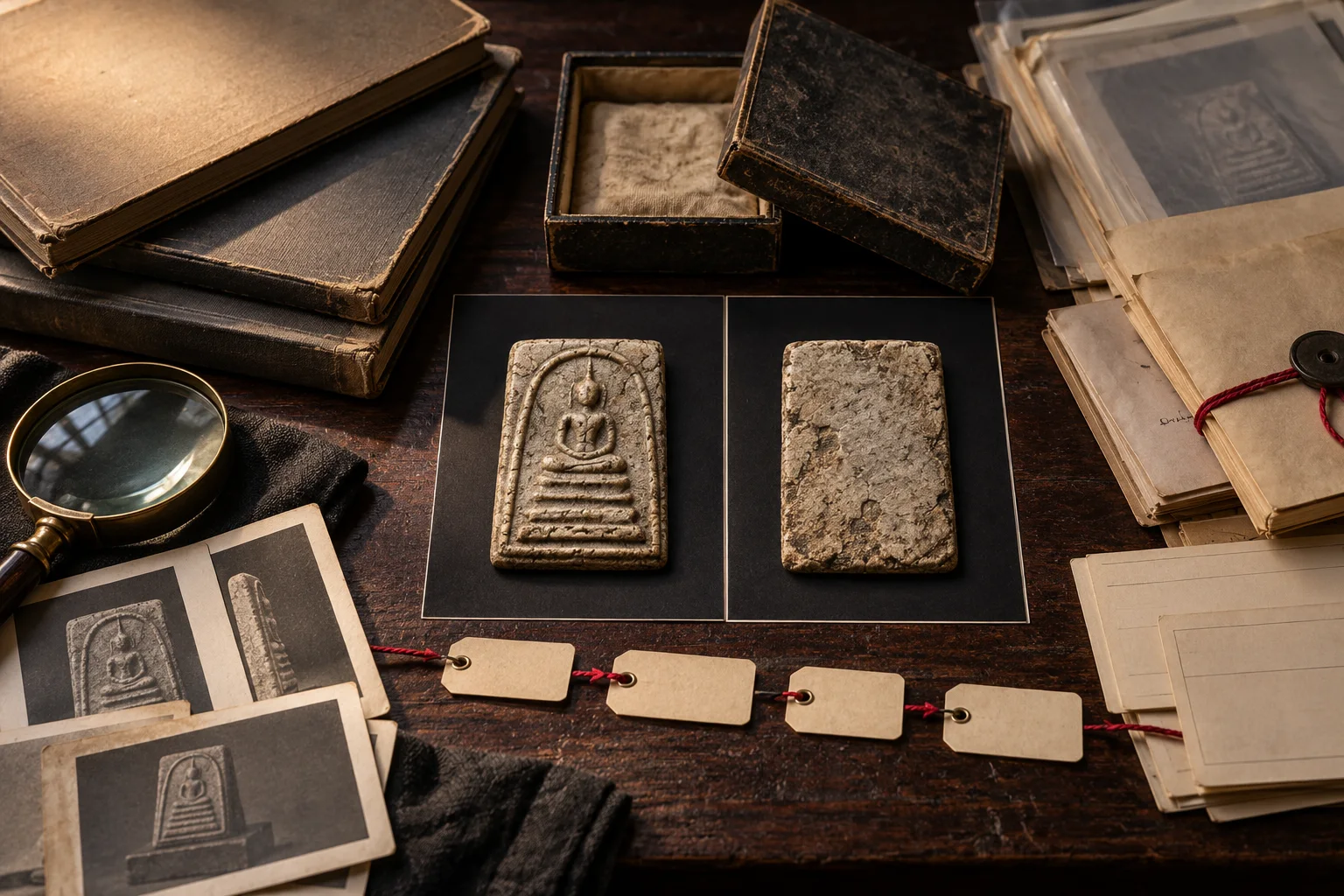
Begin with confirmable events: acquisition date, the seller’s name for the object, front/back/side photographs, measurement method, original packaging and source of documents. Separate others’ statements from facts you can verify. Each added historical link must answer ‘how do we know it is the same object?’ Evidence only for the same design belongs in comparison, not individual provenance. Preserve conflicting documents and the point of disagreement.
Do not reduce provenance to an arbitrary score. Twenty years in a famous collection need not answer a question better than ten years of clear individual photographs; a thick catalogue may be weaker than one precisely matched early record. Preserve not an immutable title but a chain that lets the next reader see what is known and where the gaps remain. That makes the object more, not less, historically valuable.