Identification Guides · Oct 2026 (B.E. 2569)
Luang Pu Toh Jumbo 2: Five Areas to Study on the B.E. 2521–2523 Palm-Leaf-Powder Version
Focus on a single popular issue, mould and material: the large Jumbo 2 palm-leaf-powder Pidta from Wat Pradu Chimphli. Study the front, reverse and edges in a repeatable order.
11 min
Luang Pu Toh Jumbo 2: Five Areas to Study on the B.E. 2521–2523 Palm-Leaf-Powder Version
Focus on a single popular issue, mould and material: the large Jumbo 2 palm-leaf-powder Pidta from Wat Pradu Chimphli. Study the front, reverse and edges in a repeatable order.
Chinese collectors often call this popular Luang Pu Toh Pidta ‘Jumbo 2’; Thai sources use พระปิดตาจัมโบ้ 2. It belongs to Wat Pradu Chimphli. This lesson concerns only the large mould in palm-leaf powder (เนื้อผงใบลาน). Jumbo 1, the smaller Jumbo 2 design and other powder mixes are separate comparisons. An issue, mould and material must be fixed before small details can mean anything.
Even within the name ‘Jumbo 2’, a different mould or material changes the comparison. Match the Thai issue name first, then read the front, reverse and edges together. A coherent object tells more than one isolated ‘secret mark’.
Identify the issue before comparing Pidta details
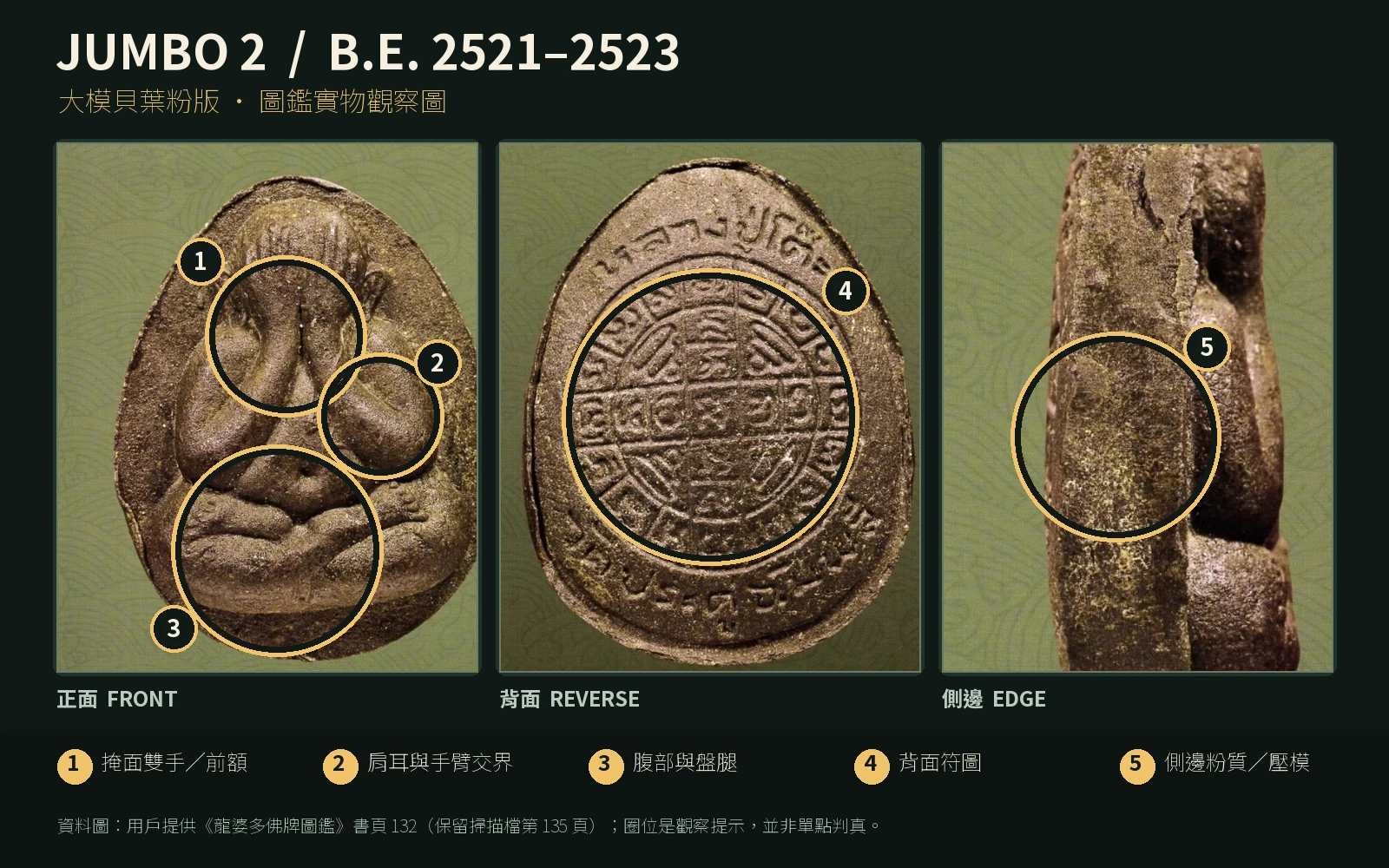
The catalogue places Jumbo 2 in B.E. 2521–2523 (1978–1980); Thai collectors commonly describe its history through three rainy-season retreats. The large tablet has a broadly oval outline, hands covering the face above crossed legs, and a reverse yantra called Sukittima (ยันต์สุคิตติมา). That front-and-back pairing identifies the subject of this lesson, but similar figures or motifs may occur elsewhere. It is a starting point, not a verdict.
A five-zone reading: structure before tiny lines
On the photographed specimen above, ring one covers the front oval, covering hands and forehead: finger separation, palm depth and a coherent relief from head to arms. Ring two follows the shoulder, ear and arm junction; ring three the abdomen, crossed legs and feet. These rings identify areas to study, not a checklist where one faint line becomes a ‘secret mark’. Pressing pressure and wear can weaken individual lines.
Zone four is the reverse: read the Sukittima yantra's outer ring, letter band, central grid and turns together in one clear view. Zone five follows both sides and the bottom for thickness, compressed powder, finishing traces and continuity between front and back surfaces. One sharp glyph or one weak line cannot replace a whole-reverse and edge comparison.
Palm-leaf powder is not a ‘blacker means genuine’ test
Catalogue examples of this palm-leaf-powder version range from deep brown and black-brown to grey-green and mottled surfaces. Mix, pressing, exposure and storage may all affect colour; darkness alone is unreliable. Study grains, small pores, compaction, wear on high and low relief and whether the front, reverse and four edges belong to the same material history. A dry-looking front paired with glossy resin-like backing, or regular seams, bubbles or sanding lines along the side, calls for a same-material, same-mould comparison rather than a snap decision.
So-called tiger-striping or Tang-iu oil tones, and a takrut inserted at the base, occur on some examples. Neither is mandatory for every palm-leaf-powder Jumbo 2. Presence is not proof and absence is not disproof; the surrounding powder and workmanship still have to make sense.
Ask for a complete view, not a cropped ‘secret mark’
For remote study, request unfiltered daylight images of front, reverse, left and right edges, top and base, plus angled light, a scale and close views of the powder. A slow rotation video is better still. Keep original files rather than red-circled, heavily sharpened crops. Compare reliable examples of the same issue, mould and material, asking whether structure, substance, edges and provenance reinforce one another. Valuable purchases still warrant an independent, uncased inspection by someone familiar with this version; an article or photograph is not an authenticity certificate.
The useful outcome is not a memorised list of ‘genuine marks’. It is a way to test whether the issue, mould, powder, pressing and wear make sense together on one tablet. When photographs cannot resolve part of that picture, ask for better views or inspect the object rather than rushing to a verdict.