Identification Guides · Oct 2026 (B.E. 2569)
Ajarn Pin's Single-Eye Coconut-Shell Rahu: Reading Five Carving Styles
Crown, face, arms, lunar disc, side serpents and border density can reveal markedly different hands within the same moon-swallowing Rahu design. Using a B.E. 2561 collector-group chart, competition catalogues, Thai reporting and five owner-supplied specimens, this guide builds a whole-to-detail comparison sequence.
16 min
Ajarn Pin's Single-Eye Coconut-Shell Rahu: Reading Five Carving Styles
Crown, face, arms, lunar disc, side serpents and border density can reveal markedly different hands within the same moon-swallowing Rahu design. Using a B.E. 2561 collector-group chart, competition catalogues, Thai reporting and five owner-supplied specimens, this guide builds a whole-to-detail comparison sequence.
Wat Sisa Thong in Nakhon Pathom is closely associated with Rahu. Provincial material links the temple's history with local astronomical and astrological learning and credits Luang Pho Noi with reviving Rahu devotion; provincial tourism material likewise identifies single-eye coconut-shell Rahu as a defining memory of the temple. A small carving therefore sits at the meeting point of lineage, local craft and later collecting taxonomy.
Thai collecting columns commonly describe Phra Ajarn Pin as a major disciple of Luang Pho Noi who continued single-eye coconut-shell Rahu while serving as abbot. Early ‘teacher-face’ examples are often linked to Lung Si Yai. This is a history preserved by collecting journalism, not a published temple ledger assigning every object to a named carver and year. It provides context; it cannot automatically turn every similar carving into a supervised Ajarn Pin piece.
Read the whole hand before fixed landmarks. One eye, one patch of cross-hatching or one suspension hole can never prove a carver on its own.
Method: place all five in the same visual grid
The photographs differ in scale, mount and wear, so apparent size is not comparable. Align the central axis, then inspect suspension, top band, crown and face, the way the hands hold the lunar disc, the lower legs or lozenges, the side serpent or wing forms and the outer border. Record shape, position, line direction and density instead of merely writing ‘similar’ or ‘different’.
Style one: Lung Si Yai — a rounded figure within layered enclosure
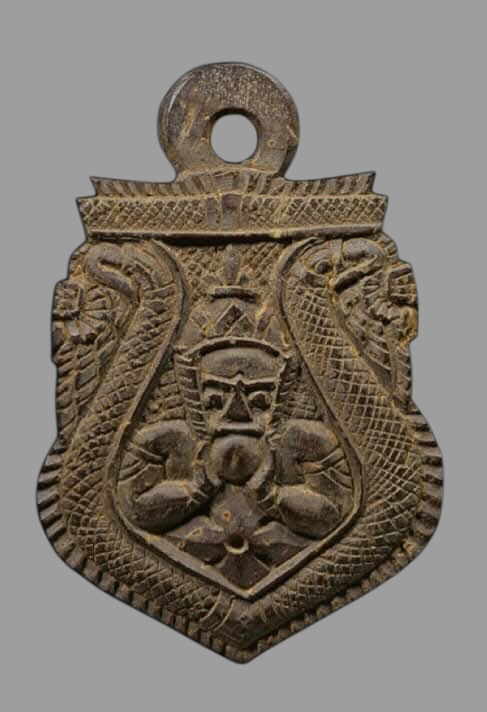
Here the suspension is nearly circular and the broad top band is layered. The short, broad face uses heavy cuts for eyes, nose and mouth, while shoulders and arms feel rounded. Both hands enclose a central circular moon, followed below by petal- or foot-like forms. Great side curves resemble serpents or spread wings, with dense cross-hatching inside and out before the outline narrows to a point. Treat the full combination—full figure, central moon and tightly worked enclosure—as the clue, not the round loop alone.
Style two: Ta Lek — upright proportions, geometric crown and vertical lower field
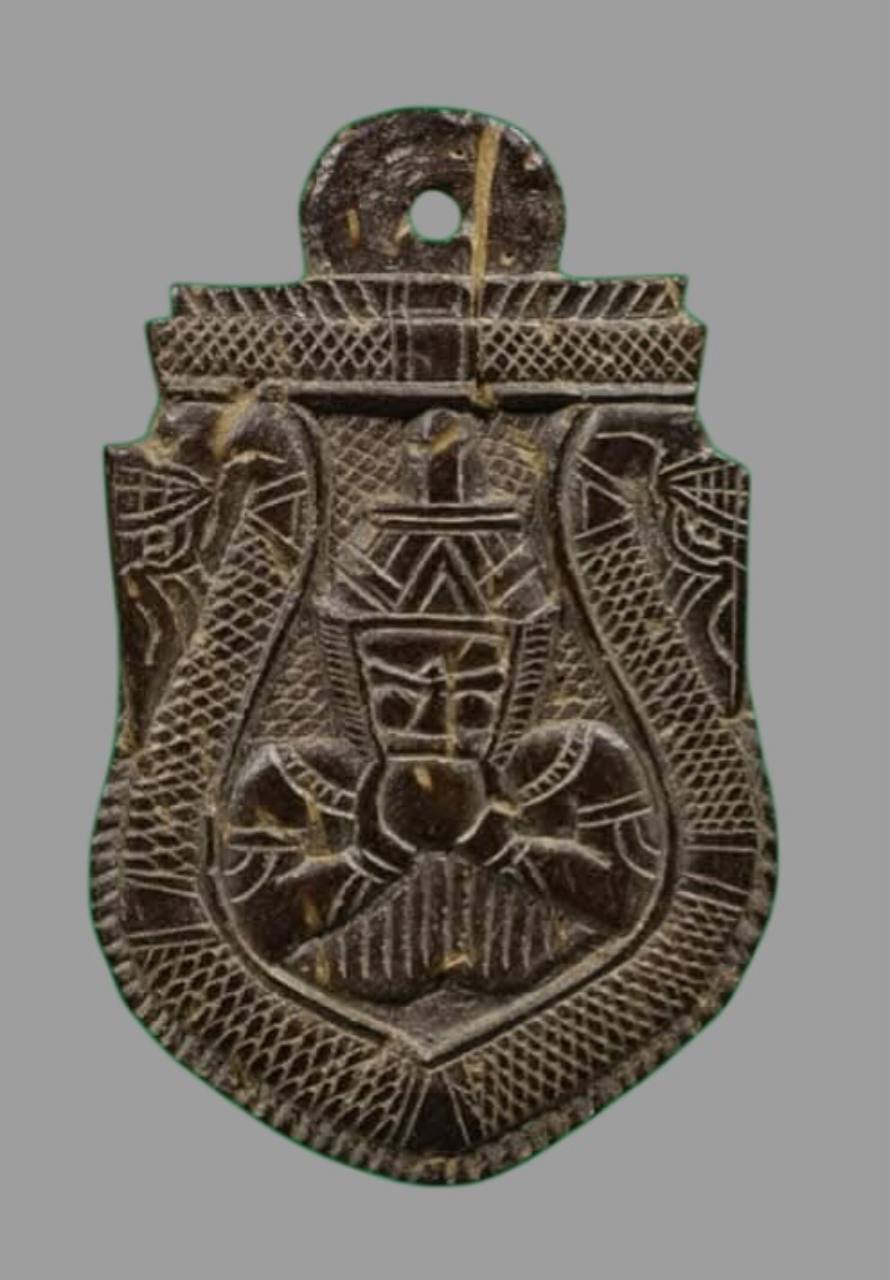
This specimen is more elongated. Cross-hatching and a central panel organize the top band, while triangles and stepped geometry build the crown. The face is almost rectangular, with horizontal eyes and mouth; the shoulders extend laterally and dense vertical lines appear beneath the moon. Large side curves remain, but divide more clearly from the outer lattice. Side serpents alone would confuse it with other groups. The useful feature is the vertical order running from band through crown, face and shoulders into the lower striations.
Style three: Lung Si Lek — compact symmetry and an open central figure
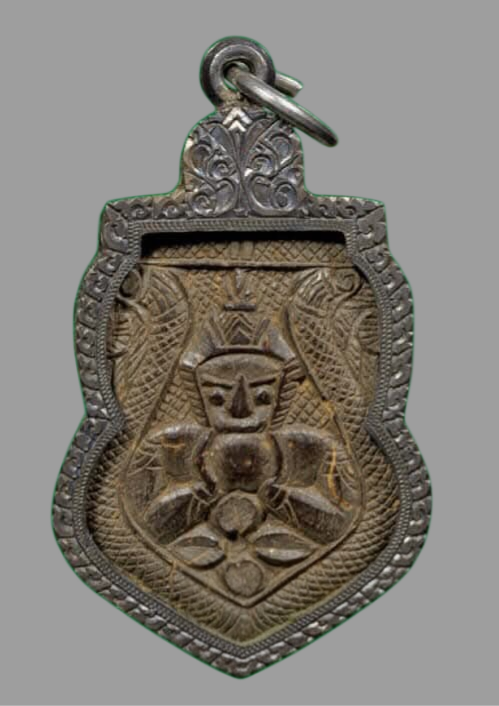
Inside the mount the figure is more compact than Ta Lek: a low, broad headdress, small trapezoidal face and economical deep cuts for features. Shoulders spread, but the central moon and lower petals retain clear separation. Diagonal and lattice fields remain at the sides without crowding the figure. The metal mount hides the original edge, top and thickness, so its present silhouette, suspension and dimensions cannot be compared with uncased shells.
Style four: Ta Phuk — body piercing, crossed arms and a broad lower lattice
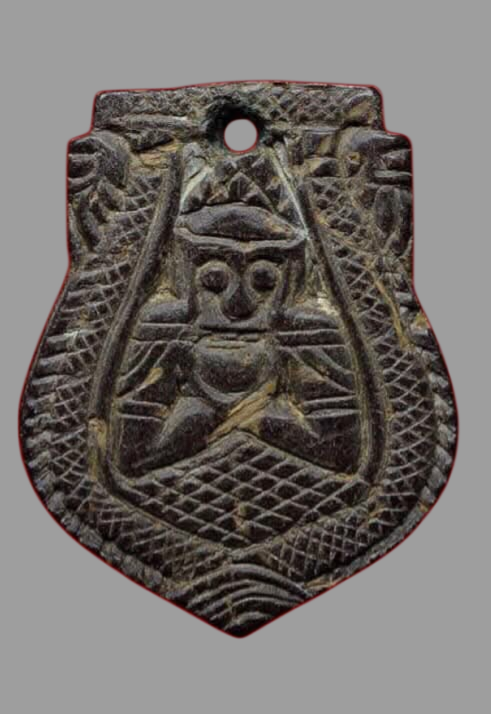
The top is relatively flat and pierced directly. Large round recessed eyes sit above a short, heavy nose and rounded cap. The arms cross clearly at the chest, placing the lunar disc below the crossing. A broad cross-hatched field then narrows to the point, where stacked arcs finish the base. Direct piercing, round-eyed short face, crossed arms and lower lattice are more informative together than any one feature.
Style five: Ta Nui — broad top band, long face and chequered lower field
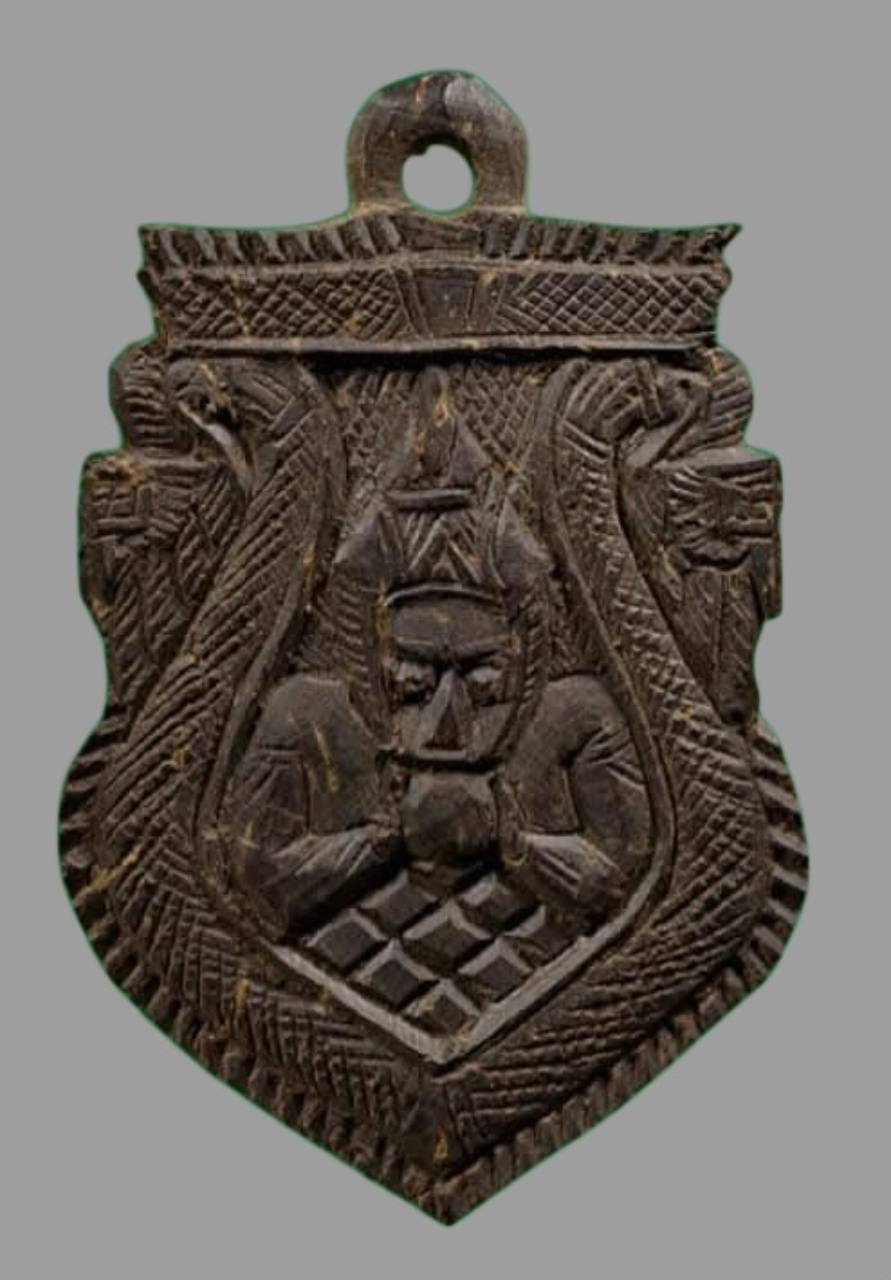
The suspension rises high above a broad two-level band: short radiating cuts above, dense cross-hatching below. Crown and face form a distinctly slender axis, with a long mouth line beneath the nose. Hands meet at the chest, followed by several large lozenges. Great side curves overlap profile-like forms and the outer field is filled with directional hatching. Begin with the three-part relation of broad band, slender centre and large lower lozenges.
Why do the names and counts differ?
Collector taxonomies often take shape years after production. One writer groups by a carver's name, another by compositional hand, and another merges related hands. The same nickname may also receive Ta, Lung or Chang. Competition catalogues do use headings such as Chang Lek, Si Lek, Phuk and Nui, while market indexes also show Si Yai and Ta Nui. The names clearly circulate, but their boundaries are not identical across every platform.
A front carving style is not automatically a reverse inscription hand
Because the original chart shows fronts and reverses together, it is easy to assume that carver, inscription hand and ritual specialist were one person. They must be separated: who carved the front, who inscribed the reverse, and who consecrated or participated in the rite. The five publication images show fronts only, so this article does not infer reverse handwriting. Further attribution needs unfiltered front, reverse, both sides, top, base, dimensions and thickness.
Seven steps for an object-level comparison
- 01First establish that the object belongs in the Ajarn Pin / Wat Sisa Thong comparison set; Rahu imagery alone is insufficient.
- 02Align orientation and scale, using the centre axis, eye line, lunar disc and base point as coordinates.
- 03Compare silhouette, top band, crown-face, arms and lower field before small hatching or short lines.
- 04Record wear, cracks, later piercing, cord, casing and repair separately from carving style.
- 05Separate front carver, reverse hand and ritual attribution; write ‘not observed’ when the reverse is unavailable.
- 06Use several traceable references, never one sales photograph as the standard.
- 07Conclude only as far as the evidence reaches: related hand, provisional group, conflict, or physical examination required. Style attribution is not a certificate.
Conclusion: turn five names into testable visual language
The five-carver framework matters not because it supplies five labels to paste onto photographs, but because it reveals how local hands vary proportion, cut, spatial density and geometry within one sacred subject. Record whole structure first and cross-check traceable examples, and the names become a revisable research language. Reduce them to one eye or one line and they become another set of superstitious passwords.