Origins & Belief · Oct 2026 (B.E. 2569)
Phra Phikanet: Ganesha
An emblem of learning, arts and overcoming obstacles — and a familiar figure in Thai creative culture.
16 min
Phra Phikanet: Ganesha
An emblem of learning, arts and overcoming obstacles — and a familiar figure in Thai creative culture.
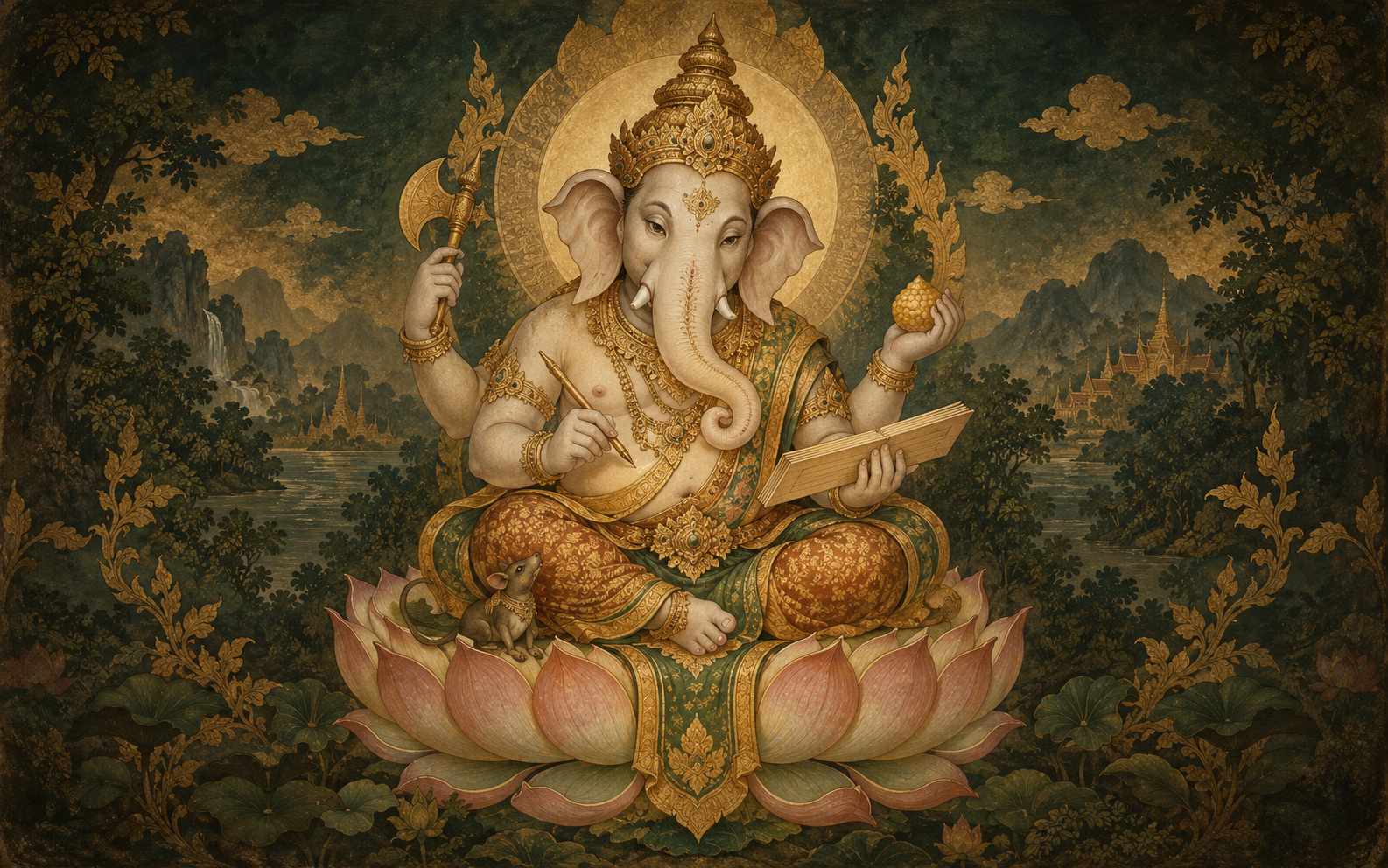
Ganesha (Gaṇeśa; พระพิฆเนศ or พระคเณศ in Thai, widely known in Chinese as the Elephant God) is recognisable by his elephant head and human body, but that form cannot be explained merely by saying ‘he is the elephant god’. It belongs to long-developed clusters of story, image and worship. In the best-known version, Parvati fashions a boy from the paste or dirt from her body before bathing, gives him life and tells him to guard the door. Shiva returns without knowing who he is; the boy refuses him entry, conflict follows and Shiva removes his head. Parvati’s anger leads Shiva to restore the child, using the head of the first living creature encountered—an elephant in this telling.
Why an elephant head? There is more than one version
The gatekeeper–beheading–restoration version is highly influential in traditions associated with the Shiva Purāṇa, and it explains both the elephant head and the single tusk: some tellings specify that the returned head belonged to a one-tusked elephant. Other Purāṇic or local stories narrate birth, decapitation and elephant head differently, involving Saturn’s gaze, Shiva’s forehead or other divine interventions. A careful website should not present one account as sole historical fact. It should identify it as a widely told version and preserve the fact of variation. The story is not only about a changed head: a child created by Parvati is recognised by Shiva and then granted leadership among divine attendants and precedence in worship.
Elephant head, ears, trunk, belly and single tusk: how to read the image
The elephant head makes Ganesha immediately identifiable among the gods. Large ears, long trunk and round belly receive different artistic treatments across time and region; they should not be mechanically translated into a table of promised benefits. A common four-armed form holds an axe, a noose, sweets (modaka or laddu) and a broken tusk, but number of arms and attributes vary by image tradition. The broken tusk itself has several readings: one story has him use it as a pen to write the Mahābhārata, while others connect it with the moon or a conflict. A single tusk should therefore not be rushed into one anecdote; it is a symbol moving across several traditions.
The mouse and ‘removing obstacles’: not a promise of an effortless path
Phra Phikanet is commonly associated with a mouse vehicle, a small agile figure set against the massive elephant head. Interpretations may connect it with desire, resourcefulness, a mind able to enter narrow openings or the discipline of self; no single reading should be claimed as the only one. He is often honoured before work, study, performance or ceremony begins and is therefore translated as a remover of obstacles. Yet in religious narrative an obstacle can also be protective: it can block an unsuitable beginning or demand discernment and discipline. ‘One prayer and instant success’ loses the gatekeeper and tester within the stories.
In Thailand: art, education and cross-cultural transmission
Ganesha’s presence in Thailand is not only a recent commercial trend. Research preserved by Thailand’s National Library traces textual and archaeological evidence across India, Southeast Asia and Thailand, while the Fine Arts Department uses him as a familiar cultural and artistic emblem. Devotion among contemporary creators, performers, designers and educational communities is one modern continuation of this longer cultural movement. It should not be misrepresented either as an ancient tradition unchanged or as a purely new market invention. Different images, shrines and institutions have their own practices and should be approached on their own terms.
Reading an amulet: ask image provenance before object provenance
An ‘Elephant God amulet’ may be a temple commemorative, an issue from a Hindu shrine, a private studio design or a wholly commercial ornament. Elephant head, mouse, sweets, a single tusk or four arms tell us that it cites Ganesha’s iconographic language; they do not establish issuer, date, material or authenticity. A collector should ask for a specific issuer, date, ceremony or purpose, material and public record. A devotee can meanwhile respect the stories and rules of a shrine. These approaches can coexist without replacing checkable history with miracle hearsay.