Origins & Belief · Oct 2026 (B.E. 2569)
Phra Isuan: Shiva
A deity of asceticism, transformation and cosmic cycles, deeply present in Thai Brahmanical ceremony and the Ramakien.
16 min
Phra Isuan: Shiva
A deity of asceticism, transformation and cosmic cycles, deeply present in Thai Brahmanical ceremony and the Ramakien.
Shiva (Śiva; พระศิวะ or พระอิศวร in Thai, here called Phra Isuan in the title) cannot be exhausted by the phrase ‘destroyer god’. He is an ascetic and yogic practitioner, a partner and father, a dancer, the divinity evoked through the liṅga, a principal deity in local temples, and—for some Shaiva traditions—the supreme divine reality. Different periods, regions, schools and texts tell different Shivas; a responsible introduction should not flatten them into one story.
From Rudra to Shiva: not a single straight origin story
Scholarship often discusses the relationship between Vedic Rudra and later Shiva traditions. Rudra carries associations with storm, wilderness, illness and healing; epics, Purāṇas, temple ritual and local devotion later formed many layers of Shiva imagery and theology. This does not license treating every early deity, Indus object or ancient seal as Shiva’s single proven origin—those interpretations remain debated. The safer account is that Shiva traditions emerged over long periods through interwoven Vedic, ascetic, local, textual and temple cultures.
Destruction is not mere ending: dissolution, transformation and cycle
Placing Shiva within a language of creation, maintenance and dissolution is closer to many Hindu traditions than simply saying he ‘rules destruction’. Dissolution is not just blowing up the world: old forms end and conditions change so another cycle can begin. This is why Shiva may be connected at once with solitary asceticism, kinetic dance, family relations and cosmic order. Nor should this be forced into a doctrine accepted identically by all Hindus. The trimūrti is a familiar introduction, but lived religions and philosophies are much more complex.
How to read an image of Shiva: attributes are not a decorative checklist
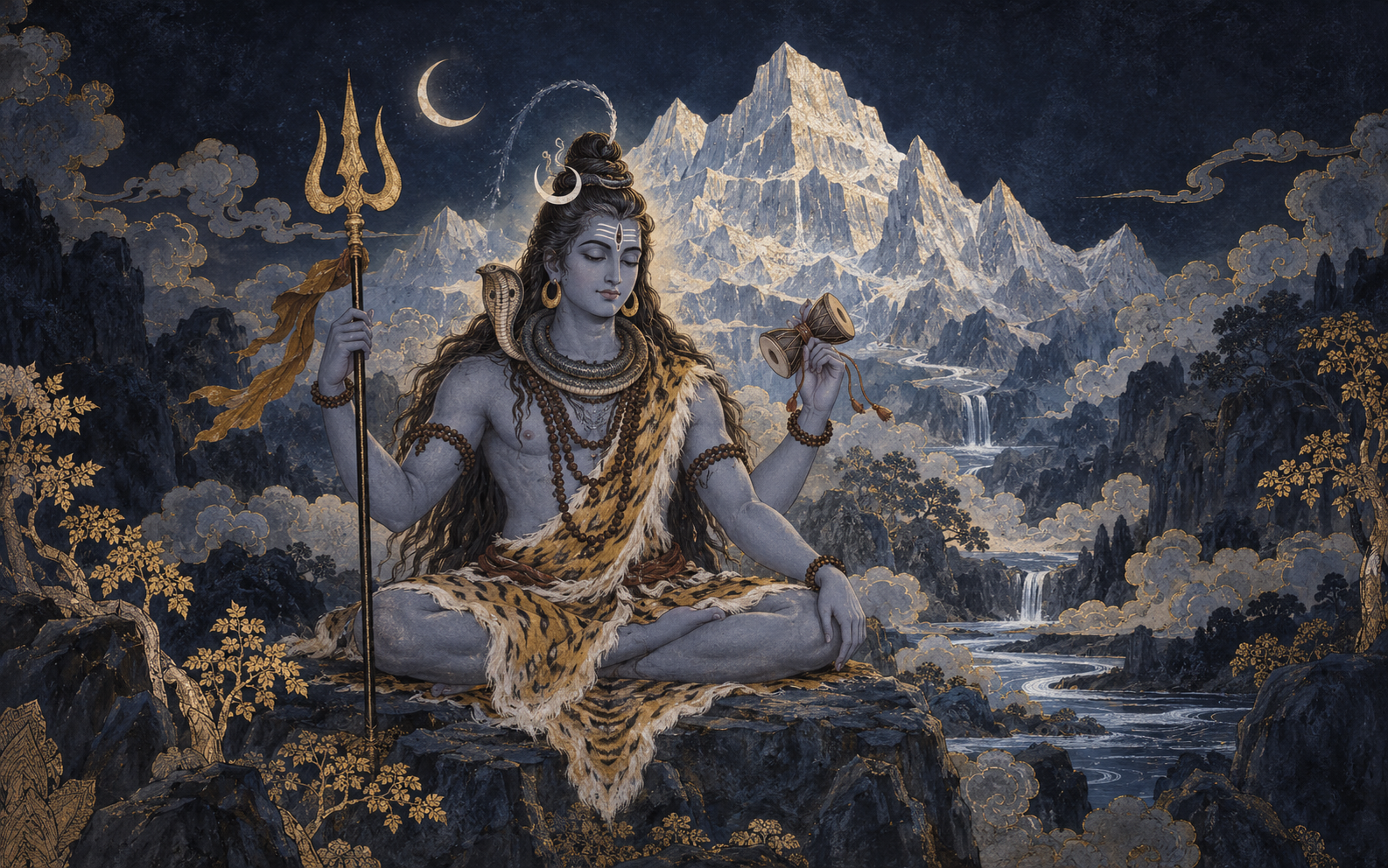
The trident (triśūla), hourglass drum (ḍamaru), crescent moon, snake, piled matted hair, third eye, bull Nandi and Ganga are clues to divine identity. The trident can evoke power and multiple cosmic levels; in dancing images the drum signals rhythm and the first sound of creation, while fire commonly signals dissolution. The third eye, ascetic hair and crescent are not market codes in which more symbols mean more efficacy. First ask which form is present: meditating yogi, Uma-Maheshvara seated with Uma, a bull or Nandi association, a multi-armed deity, or Nataraja. Each composition speaks a different theological and artistic language.
Nataraja: time, ignorance and refuge in one moving image
One of the best-known Shiva forms is Nataraja, Lord of Dance. South Indian bronzes and temple art often show him dancing within a ring of fire: one hand holds a drum and one a flame; one offers fearlessness; another points toward the raised foot; beneath the planted foot is Apasmara, a figure of ignorance. This is not a generic portrait of a ‘dancing god’. It concentrates creation, maintenance, dissolution, concealment and grace or liberation into one composition. It also belongs to specific South Indian temple and casting traditions; calling every dancing deity or every flaming amulet Nataraja is a common but imprecise shortcut.
Family, goddess and sons: relations are not side notes
In many narratives Uma/Parvati is Shiva’s partner, while Ganesha and Skanda/Kartikeya are commonly described as their sons; versions, names and relations nevertheless vary across South Asia. Uma-Maheshvara images of the divine couple remind us that Shiva is not only a solitary ascetic. One pole of his imagery is mountain, cremation ground, meditation and renunciation; another is marriage, family, urban festival and temple routine. The goddess is not a mere accessory. In goddess traditions, shakti has its own theological standing, and Uma, Durga and Kali should not be casually collapsed into one name.
From Indic traditions to Thailand: the localisation of Phra Isuan
Phra Isuan in Thailand is not an untouched copy of an Indian original. Long sea and land exchanges across South and Southeast Asia, Sanskrit and Pali culture, royal ritual, Khmer artistic networks, and later Ayutthaya art and literature all left their marks. Thai art records include Shiva images related to Lopburi/Khmer styles as well as important Ayutthaya works; in the Ramakien, Phra Isuan also enters Thai theatre and royal literary relations. A Thai image must therefore be situated: is it an ancient Brahmanical-Hindu remnant, a decorative or protective vocabulary in a Buddhist temple, a court-drama figure, or a modern sacred object made for a temple ceremony? The same name does not prove the same date, religious function or maker.
Devotional language and the sacred-object market: two separate questions
People may address Phra Isuan for courage, discipline, endurance or life transition. That is devotional language of persons and communities and deserves respectful recording; it cannot become a seller’s guarantee for any pendant or amulet. For an object labelled Shiva, Phra Isuan, Nataraja or Uma-Maheshvara, ask four questions first: Which iconographic form does it cite? Which temple or maker issued it? When, and for what ceremony or purpose? Is there original public documentation or comparable objects? A similar image, an attached story or a divine name does not prove age, authenticity or efficacy. Respect for belief and careful verification can coexist.