Identification Guides · Nov 2026 (B.E. 2569)
How Metal Amulets Record Their Making: Dies, Striking and Recasting
Are crisp letters enough, or can an aged surface settle the question? Following one teaching video, this article reads lettering, facial relief, robe lines and later-applied marks as evidence of an object's manufacturing sequence.
12 min
How Metal Amulets Record Their Making: Dies, Striking and Recasting
Are crisp letters enough, or can an aged surface settle the question? Following one teaching video, this article reads lettering, facial relief, robe lines and later-applied marks as evidence of an object's manufacturing sequence.
Two metal amulets may share a motif, inscription and aged colour yet have different manufacturing histories. This episode of Phra Khruang Zhen Zhang returns to sequence: a design and die precede the struck metal blank; piercing, edge work or later lettering may follow. Understanding that order makes apparently isolated marks intelligible.
From blank to relief: start with how the surface formed
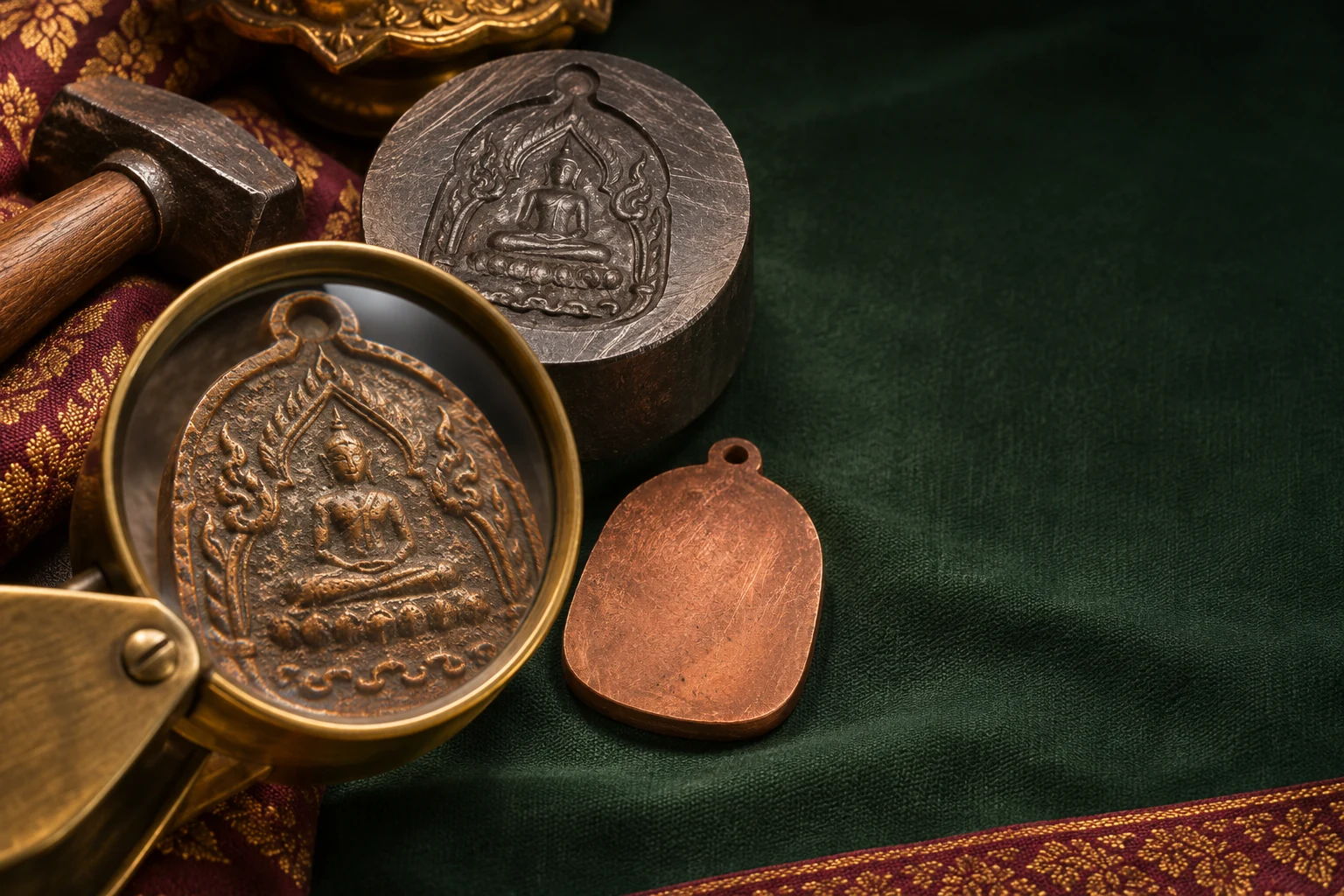
The episode first relates engraving a steel die to striking a blank. Pressure produces relief, line boundaries and metal displacement together. Instead of asking only whether one detail is sharp, examine how its raised and recessed parts meet the surrounding field. Die variation and wear can alter clarity substantially; reference examples must come from the same die family.
Lettering: follow turns, terminals and joins
An inscription tempts the viewer to read its words and stop. The video treats each character as relief: where a straight stroke turns, how a terminal ends and whether joining strokes retain their boundaries. Rounded corners, filled counters and fused joins repeated across several letters require investigation into imaging, wear, the original die or later transfer. One soft character is not a verdict.
Face and robe: separate relief from glare
Eyes, nose, mouth and ears pack several relief levels into a small area. The episode follows how contours connect, instead of treating a single likeness as proof. Robe folds should be traced through bends, overlaps and endings. Raking light can invent an apparent extra line through reflection; change the light and angle and compare a same-die reference before calling it relief.
Transfer-copy questions: look for shared loss of detail
Taking a new impression from an existing piece may preserve the overall design while softening shallow lines, acute corners and fine letters. The video's stronger question is cross-area consistency: are letter turns, facial layers and robe-line terminals all softened in the same manner? Yet weak strikes, die wear, long use and poor focus can also reduce detail. Softness alone does not prove transfer.
The decisive sequence question: when was lettering added?
The final example concerns a particular design whose lettering, according to the episode, was impressed after the main body had been formed. A purported counterpart whose letters appear to have formed integrally in one mold creates a sequence contradiction. This is a test for that design, not a rule that all amulet inscriptions must be added later. Verify the sequence on reliable examples through letter position, pressure direction and the adjacent metal.
Neither patina nor sharpness settles the question
An aged-looking surface cannot erase a contradiction in manufacturing order. Conversely, a freshly cut imitation die may strike very sharp lines. The episode therefore asks whether multiple details tell one plausible manufacturing story. Record front, reverse, edge, dimensions and weight; photograph a reliable same-issue reference under similar light; list unresolved differences. Valuable objects warrant examination in hand by a specialist in that issue.
Ask how it was made before asking which detail looks convincing. Manufacturing sequence connects the evidence.
Teaching video: Metal amulets, dies and manufacturing clues
Approximately 14 minutes. The video credits คนชอบ พระ and presenter อ.โอ๊ต บางแพ as its source. Process animations are explanatory illustrations, not archival footage of historical production.
Open on YouTube