Identification Guides · Oct 2026 (B.E. 2569)
How to Separate a Person’s Era from an Amulet Issue
Naming the portrait is only the first step. An issue is a historical event that must be reconstructed independently.
18 min
How to Separate a Person’s Era from an Amulet Issue
Naming the portrait is only the first step. An issue is a historical event that must be reconstructed independently.
A monk-portrait amulet raises at least three questions: who is depicted, when was this object made, and who issued it? Market names compress all three into ‘an amulet of Master X’, erasing the distance between person and object. An early person does not make every portrait early; association with a temple does not make the temple issuer of every related object.
Dated modern objects and an official Thai event announcement are used to separate portrait, event, issue and circulation. An issue is not an attribute attached to a famous name; it is an organised act of production and distribution that requires its own reconstruction.
One object can involve five different dates
Two comparisons involving Somdet To
British Museum 1991,1023.59 is a cast copper-alloy amulet whose front is identified as Somdet To teaching the future Rama V. Production is dated 1973 and acquisition 1991. The scene and people are earlier; the object is not therefore catalogued in their period.
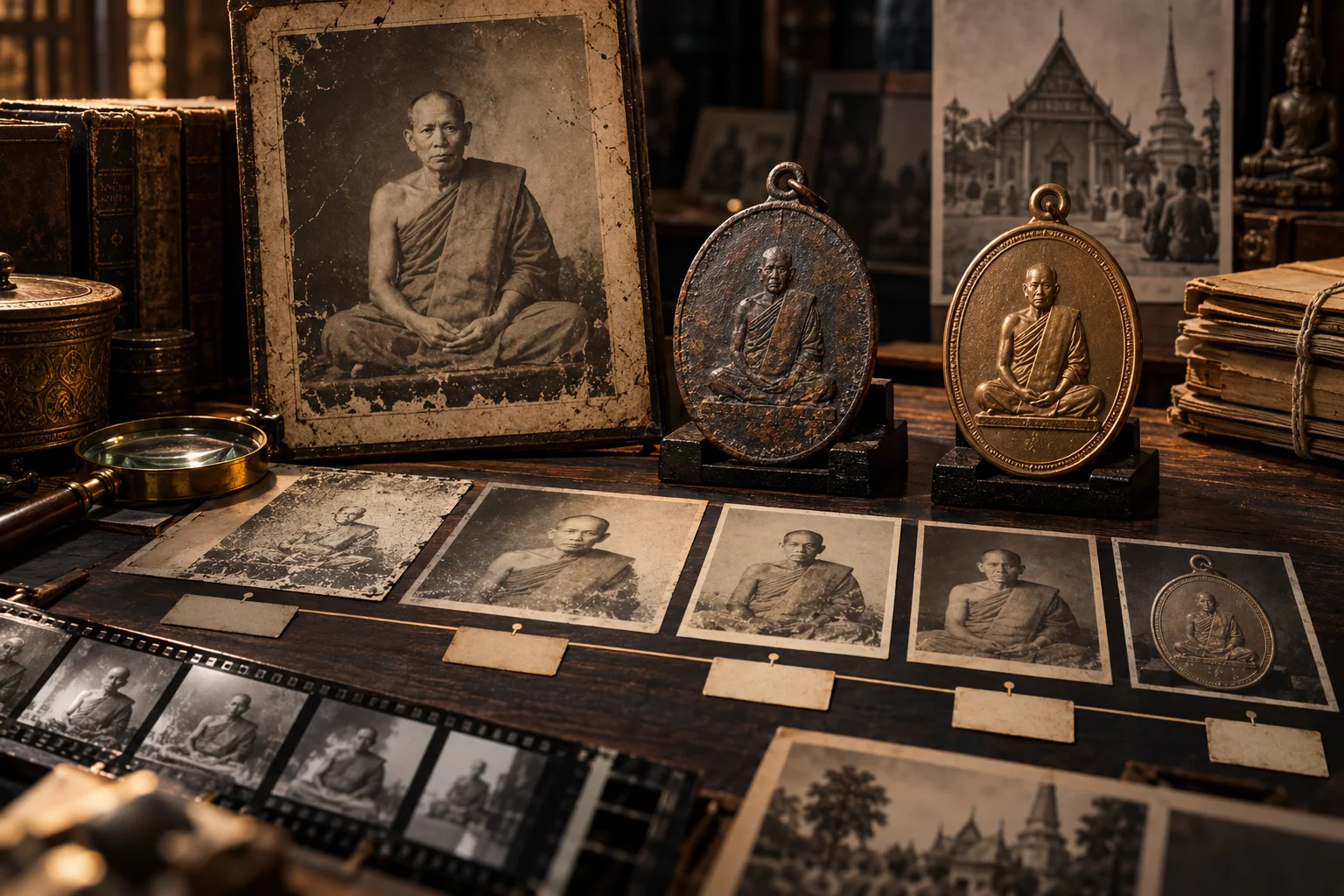
Object 2014,3035.1 is a religious print, not an amulet. It uses a nineteenth-century photograph of Somdet To but was printed in 2013–2014. An object can preserve an old appearance without being old. Together the cases show only that identity and production date are separate propositions, not that every portrait amulet is late.
Old photographs, designs, temple emblems and historical titles can all be reused by later commemorative issues. When a familiar face appears, ask which issue reused it rather than absorbing the object into everything made during the person’s life.
Made during a lifetime does not prove personal participation
Even existence during a master’s life does not prove that he supervised production, conducted a rite or handled every object. ‘Chronologically possible’ is not ‘documented’. Participation can be divided into design, organisation, manufacture, ritual and distribution. A group photograph may show attendance, not every role; a dated contemporary record assigning roles is stronger.
A later commemorative issue is not automatically fraudulent. With a clear issuer, date and purpose, it is a well-identified later object. The problem is misrepresenting it as an original lifetime issue. Accurate naming often handles the distinction better than a binary real-or-fake label.
Issue, design and material are not the same category
Thai รุ่น may mean version, series or batch; พิมพ์ commonly concerns mould or design; เนื้อ concerns material. Actual hierarchy depends on the source. Here, issue means one shared production-and-release event, design means visual and formal arrangement, and material version means a material difference within that event. These are working definitions.
One issue may contain several designs, and one design may reappear in later issues. ‘Large mould’ does not identify the issue; a year does not identify material or size. A fuller description gives subject, issuer, issue name, date, design and material. If evidence is incomplete, ‘copper-alloy portrait of Somdet To, specific issue unconfirmed’ is better than an invented temple and year.
Issue quantities require a denominator
For the Bangkok National Museum’s 2023 Songkran event, the Fine Arts Department announced fifteen ‘พิพิธคเณศ’ Ganesha medal designs, 15,000 medals in total, distributed 7–9 April B.E. 2566 at one per person per day. This is an official event distribution notice, not evidence supplied here for consecration or temple-amulet status.
Fifteen thousand is the series total, fifteen the number of designs, one per person per day a rule, and three days the duration. 15,000 ÷ 15 gives an arithmetic mean of 1,000, but the notice does not state equal allocation. It also does not prove all were made, distributed or survive. Ask whether a limit covers the series or one design, combines materials, means planned, completed or distributed, and includes special-use variants. Unknown values are not zero.
Obtained at a temple is not issued by the temple
The Somdet To print was acquired from a stall outside Wat Rakhang in Bangkok. That supports purchase location, not temple manufacture or authorisation. Claims such as ‘obtained at the temple’, ‘given by the master’ or ‘made by disciples’ should be divided into who, when, where and which object. Later memory should remain separate from dated contemporary documentation tied to the object.
The most useful evidence may be short: do the announced front and back match; does a receipt distinguish this item from others of the same event; does packaging identify the issue rather than merely the person? A longer story is not necessarily stronger proof.
Compare competing issue claims
If one object is claimed as both a lifetime issue and a later commemoration, list the conditions for each. The lifetime claim needs an earliest secure appearance, contemporary name and connection to master or issuer. The later claim must match the later documentation to this design, not merely a similar object. Neither side can rest on ‘looks old’ or ‘I have seen it before’.
If evidence shows only that an object existed no later than a certain year, stop at that boundary. Failure to find a later notice does not prove an early issue; failure to find an early photograph does not prove a later one. Absence of discovery is not exclusionary evidence.
Replace vague prestige with an issue identity
A useful record separates depicted person, object date, issue evidence and tentative attribution. Once person, issue, design and material are distinct, apparent disputes often dissolve into different questions about image, ritual or quantity. A complete but limited and checkable description carries more information than ‘an authentic amulet of Master X’. A clear later commemoration has cultural value without masquerading as early, and a documented early issue needs no vague prestige.