Identification Guides · Oct 2026 (B.E. 2569)
How to Compare Amulet Dimensions and Formats: Six Catalogued Objects
Dimensions first describe an object. Millimetre differences become evidence only after the comparison group, measured area and condition are controlled.
15 min
How to Compare Amulet Dimensions and Formats: Six Catalogued Objects
Dimensions first describe an object. Millimetre differences become evidence only after the comparison group, measured area and condition are controlled.
Online images can make a two-centimetre amulet appear as large as a twenty-centimetre votive. Once scale disappears, similar compositions are merged, while a few millimetres may be promoted into an authenticity verdict. Dimensions matter only inside a properly defined comparison group.
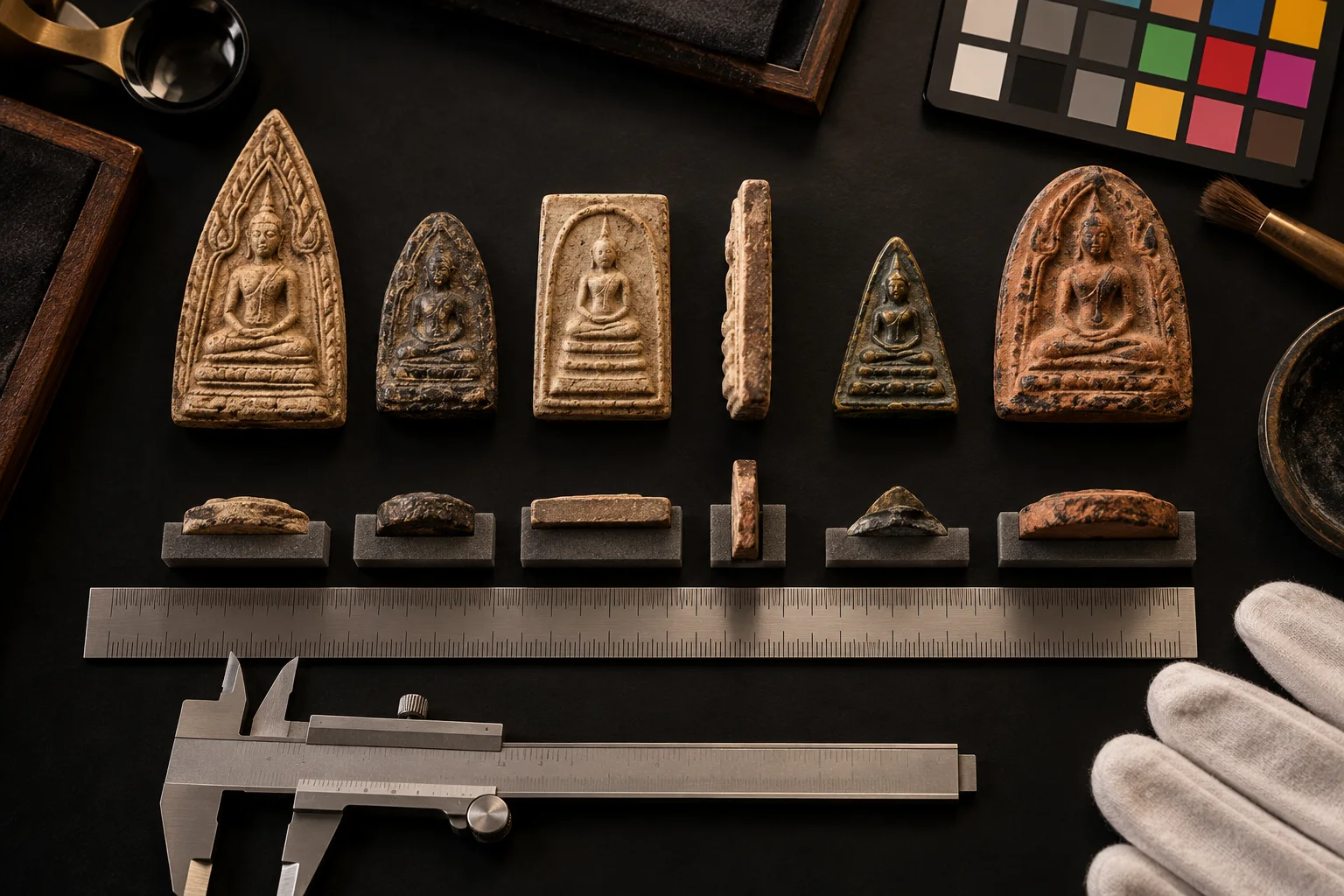
Six Thai votives with published height and width are used to distinguish visual resemblance from proportional similarity. They are deliberately heterogeneous cases, not a random sample and not a universal size standard for authentic amulets.
First define what was measured
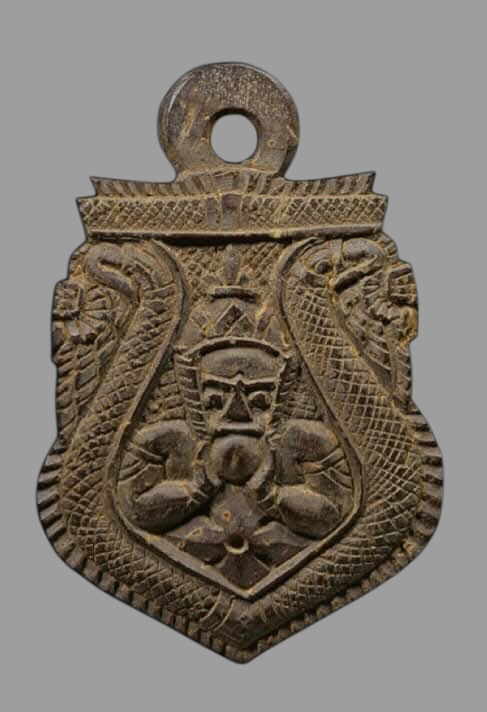
‘Four centimetres high’ may mean body only, body plus loop, or the cased object. Width may mean maximum, base or frame. British Museum 1991,1023.59 specifies 3.90 cm including the suspension loop and 2.50 cm at maximum width. A record measuring body only is not directly comparable.
A demonstration makes the point: body height 35 mm, height with loop 39 mm, width 25 mm. The two ratios are 1.40 and 1.56. The object has not changed; only the measuring boundary has. These figures are hypothetical, not an issue standard.
Six published catalogue records
Heights range from 5.4 to 23.1 cm, a maximum-to-minimum factor of about 4.28; ratios range from 1.33 to 1.94. These results describe only the six records. Selection required published height and width without the height explicitly being only a fragment. Missing thickness remains missing.
Similar ratios do not mean the same format
The gold-sheet votive at 1.50 and the Eighteen Buddhas tablet at 1.53 are close in ratio but differ in material and composition. One ratio describes only the outer rectangle. Conversely, related compositions can have different outer ratios because of margins, trimming and protrusions. Separate body boundary from image boundary.
Equalising image height hides real scale; forcing equal height and width distorts proportion. Show objects once at a common scale, then make a separately labelled equal-height arrangement for compositional comparison.
Fragments cannot be divided like complete outlines
The Ban Khu Bua fragment is 4.5 cm high, 6 wide and 0.8 thick, with its upper part missing. A ratio of 0.75 describes the surviving fragment, not the original tablet. Na Dun 2 is likewise fragmentary at 3.8 by 4.2 cm. Including either in a mean of complete forms would mix condition into size distribution, so both are excluded. Fragments remain valuable for script, partial imagery and reconstruction, but answer another question.
Build a like-for-like group before discussing deviation
For one issue, fix subject, material, production method and measurement protocol before collecting securely identified examples. A hundred mixed sizes, materials and cased measurements may be weaker than ten clearly defined records. Each row needs an independent object identity. Three listings of one photograph are not three specimens, nor are two sales of one object.
Do not delete inconvenient sizes and then announce consistency. Groups must arise from independent identity evidence and explicit criteria, not from the desired answer. Unclassified objects should remain visible.
What a photograph needs before it can support measurement
Measurement requires a square-on view, complete boundaries and a scale in the same plane. Oblique views shorten an axis, thick cases hide edges and crops conceal exclusions. Without a scale, say only ‘appears narrower’; do not turn screen pixels or finger width into millimetres. Close perspective may enlarge the loop nearest the lens. A straight front and side view are more useful than elaborate calculations on a distorted image.
Data should improve the questions
A mismatch is most useful when it prompts a check of measured area, size variant, missing edge and material reference. There is no universal tolerance for all amulets. Without a reliable issue sample, claims such as ‘one millimetre means false’ or ‘three per cent means copied mould’ merely dress incomplete experience as law.
Record body height, height with loop, maximum width, thickness, casing and damage. That is more reusable than ‘the ratio looks right’. The six values come from the listed records consulted on 17 October 2026; ratios are calculated here and missing values were not imputed. No market authenticity labels were used, so the exercise produces neither accuracy rates nor thresholds.