Origins & Belief · Oct 2026 (B.E. 2569)
From the Rāmāyaṇa to the Ramakien: Deities, epic and Thai reinterpretation
The Ramakien is not a line-by-line Thai translation of the Indian Ramayana. Over centuries, Thailand reorganised the epic through court literature, religious ideas, murals, khon and popular storytelling. This essay follows that transformation from the divine order, seven books, Nonthuk prehistory and celestial monkey army to changed biographies and endings.
28 min
From the Rāmāyaṇa to the Ramakien: Deities, epic and Thai reinterpretation
The Ramakien is not a line-by-line Thai translation of the Indian Ramayana. Over centuries, Thailand reorganised the epic through court literature, religious ideas, murals, khon and popular storytelling. This essay follows that transformation from the divine order, seven books, Nonthuk prehistory and celestial monkey army to changed biographies and endings.
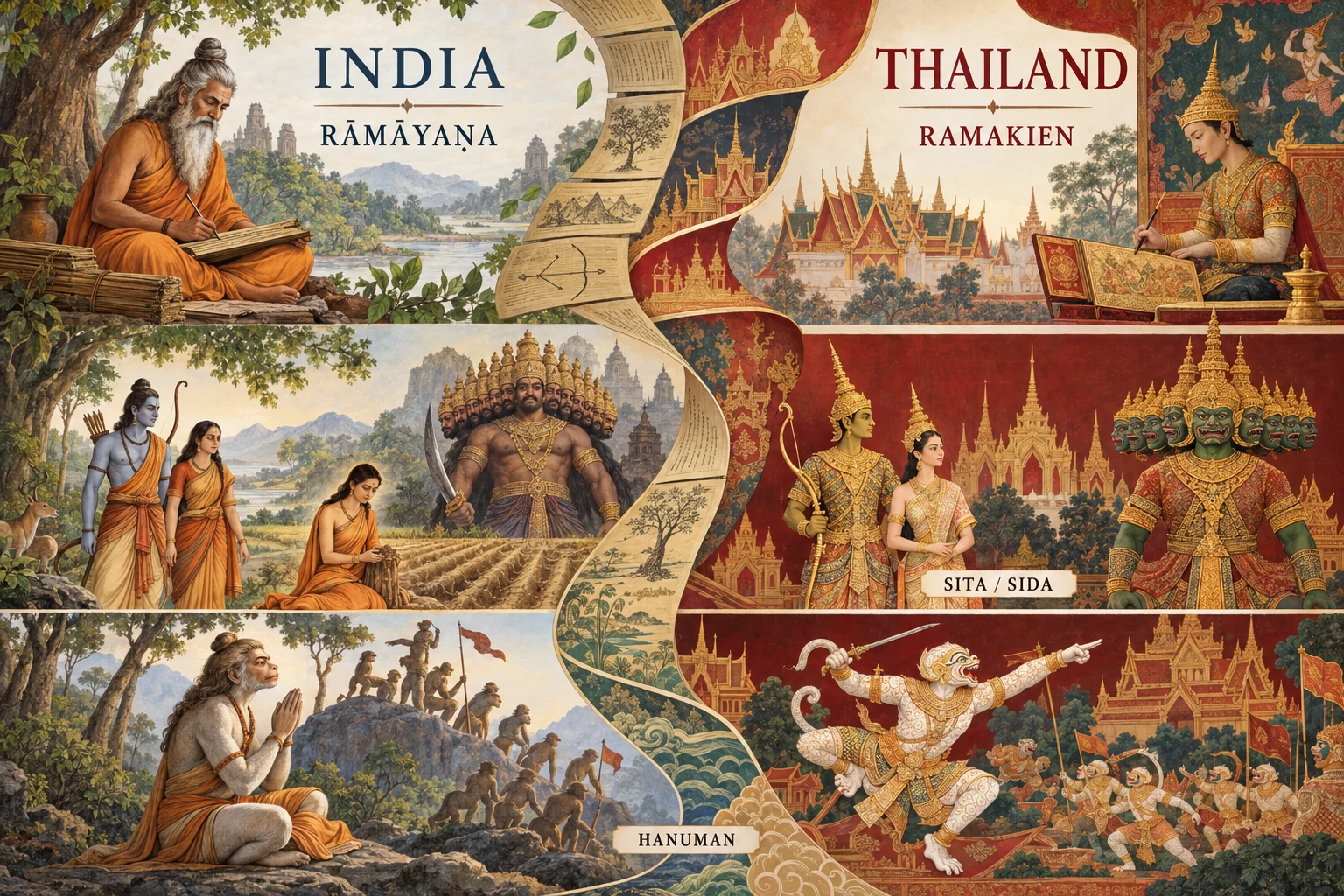
The Rāmāyaṇa is a Sanskrit epic of ancient India, traditionally attributed to Vālmīki; it is not itself one of the Vedas. The Ramakien (รามเกียรติ์) is a long Thai tradition of adaptation and retelling. They share figures such as Rama, Sita, Ravana/Thotsakan and Hanuman, and a broad war narrative, but they are not line-by-line translations or simply two languages of one book.
A Thai epic, not a literal translation
The Rama story reached Thailand before the surviving texts and moved through oral telling, literature, murals, shadow theatre and khon. Many older works were lost after Ayutthaya fell. A Ramakien compiled and rewritten under Rama I became one of the most influential court texts; later performance, adaptation and local storytelling continued to add detail. So when someone says ‘the Thai version’, the useful next question is: which text, which performance tradition, or which mural?
How the story travelled from India into Siam
The Ramayana took shape over a long period and generated Sanskrit, vernacular, religious and performance traditions across South and Southeast Asia. Its arrival in Thailand was likewise not the work of one book or one translation. Khmer art, the Javanese and Malay worlds, maritime and overland exchange, Brahmanical ritual, and local oral performance all formed possible routes. Traces of Rama stories existed in Sukhothai and Ayutthaya. Although many texts vanished when Ayutthaya fell, the narrative survived among performers, poets, images and ritual practices.
After Bangkok became the capital, Rama I sponsored the compilation and rewriting of the Ramakien. The project did more than preserve a tale: it reorganised fractured cultural memory into a royal epic fit for reading, performance and painting. Khon texts associated with Rama II, the mural cycle around the Temple of the Emerald Buddha, masks, choreography, music and court crafts then turned writing into a complete visual and theatrical language. The Ramakien therefore carries an Indian epic skeleton clothed in Siamese kingship, aesthetics and social order.
The gods are not background figures: how divine power creates the war
The causal chain often begins with a divine boon. In Indian traditions Ravana pleases Brahma through austerities and receives protection against many classes of gods and supernatural beings, but not absolute immortality. In contempt he leaves humans outside the requested protection, creating the opening through which a human hero can defeat him. The gods therefore ask Vishnu to be born as Rama. The logic matters: a divine promise cannot simply be revoked. Cosmic order is restored by acting within the boon’s conditions, not by breaking them.
In the Thai Ramakien, Thotsakan likewise possesses power gained through austerity, divine weapons and relations with heaven. Yet Thai texts personalise the conflict through Nonthuk: humiliated, granted the diamond finger, corrupted by its power and finally bound to Phra Narai in a future-life enmity. The war is therefore both a restoration of order and a continuation of karma linking gods, humans and yakshas. The two explanations illuminate one another, but should not be fused into a single ‘Indian original’ setting.
Four familiar names, four narrative positions
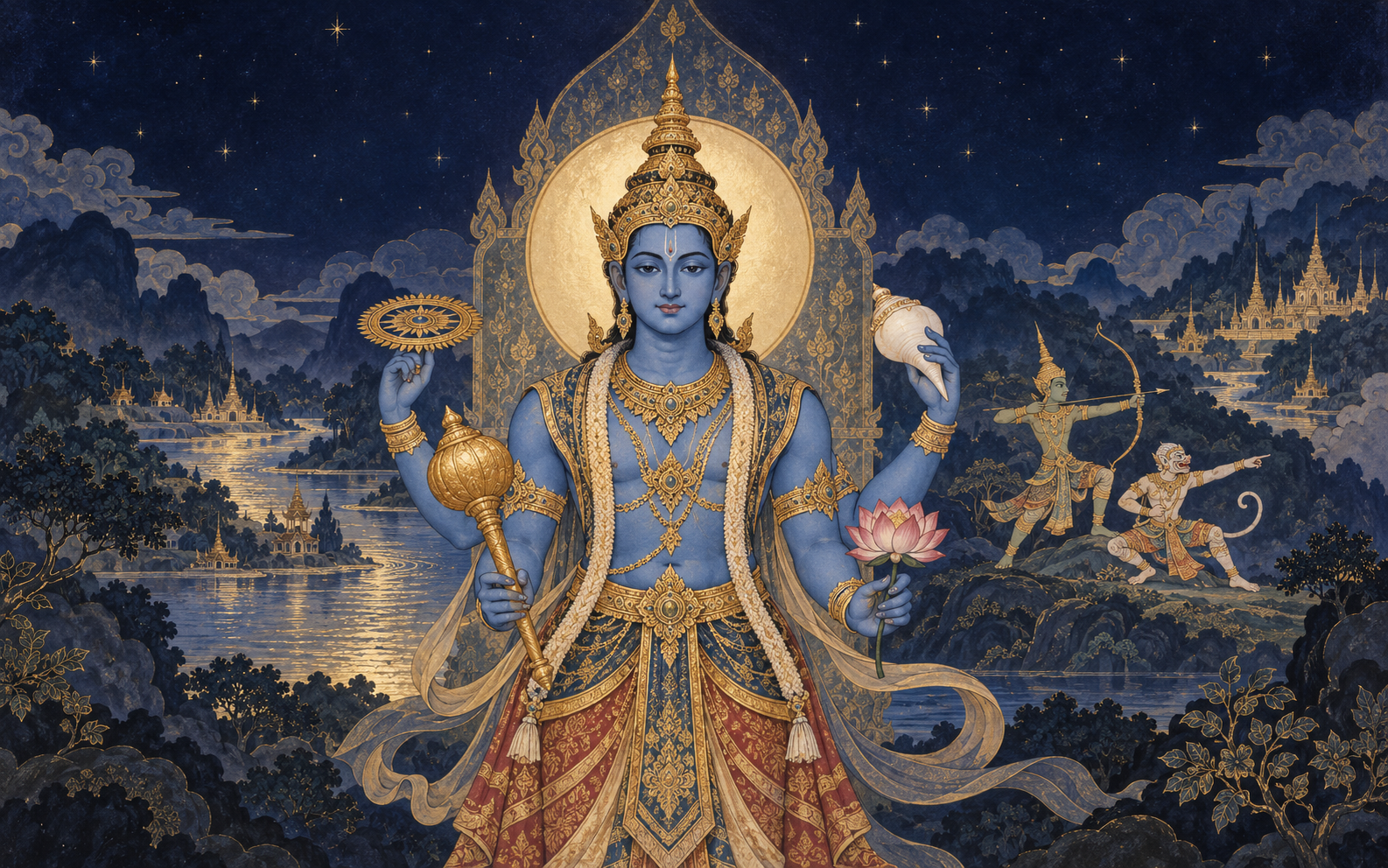
Phra Narai/Vishnu (พระนารายณ์) is connected in Hindu traditions with preservation and cosmic order; Rama is often understood as his incarnation in the Rama story. Phra Isuan/Śiva (พระอิศวร) is linked with Mount Kailasa, asceticism, destruction and renewal, and appears in Thai narratives as an important giver of authority and mediator. Phra Phrom/Brahmā (พระพรหม) is commonly understood as a creator and, in some versions, advances the plot through boons or conditions. Phra In/Indra (พระอินทร์), king of the heavens and a deity of rain and thunder, is familiar in both Thai Buddhist and Brahmanical-Hindu visual worlds.
It oversimplifies matters to treat the three gods as permanently equal co-leads with fixed jobs. The familiar triad is a useful later theological arrangement, but texts, regions and traditions do not describe their relations in exactly the same way. In any episode, the safer approach is to see who does what there rather than forcing a later template onto every version.
Phra Phrom/Brahma: the boon-giver bound by his own word
Brahma’s role is not to enter battle but to define the rules by which the crisis can be solved. Once Ravana abuses his protection and troubles the three worlds, the gods cannot merely declare the boon void. Victory therefore depends not only on force but on reading conditions, identity and destiny. In modern Thailand Phra Phrom is commonly approached as the four-faced deity, whose faces may evoke the directions, comprehensive vision or sets of virtues. Such devotional iconography is a later interpretive layer, not the plot of the epic itself.
Phra Narai/Vishnu: not lending Rama power, but acting through Rama
Rama is commonly understood as Vishnu’s incarnation, yet the epic makes him endure exile, loss, alliances, suspicion and kingship in human form. This tension—divinity concealed within humanity—means the story is more than a good god destroying a demon. It asks how an ideal prince chooses among kinship, vows, public duty and private pain. The Ramakien places that royal ethic in a Siamese courtly world, where Phra Narai also became associated with legitimate kingship, protection of the realm and restored order.
Phra Isuan/Shiva: the two edges of favour, weapons and mediation
Shiva does not intervene identically across the immense Indian Rama tradition. Famous Ravana–Kailasa, divine sword and devotional episodes belong especially to later epic strata, Puranic and Shaiva narration. In the Thai Ramakien, Phra Isuan’s Kailasa court is more visibly central: he grants powers and weapons, then must address their misuse. Nonthuk’s episode exposes the risk of divine favour—the problem is not power itself but whether its receiver has the character to bear it. Some Thai performance redactions also make Phra Isuan mediate between Rama and Sita at the end, stressing his role in restoring cosmic and royal order.
From Nonthuk to Thotsakan: a Thai opening
Many Thai Ramakien tellings prepare the conflict with Nonthuk (นนทุก). Washing the gods’ feet below Mount Kailasa and repeatedly humiliated, he asks Phra Isuan for a destructive diamond finger. When he abuses it, Phra Narai appears as a dancer and draws him into imitating a fatal pose. Nonthuk is then reborn as Thotsakan (ทศกัณฐ์), giving the later war a strongly Thai dramatic prehistory. It is a major Thai literary and performance episode, not an opening shared by every Indian Rāmāyaṇa.
The prehistory is powerful because Nonthuk is not born evil. He begins as the bullied servant of a divine court that fails to correct injustice; after receiving power, he turns from victim into killer. Phra Narai defeats him in female dancer form, making dance itself a weapon and a language of fate. Dying, Nonthuk protests that disguise made the victory unfair. Phra Narai promises that in another life he will be human while Nonthuk will possess ten faces and twenty arms. The scene explains Thotsakan’s form and rivalry while asking how power transforms someone once humiliated.
The seven books of the Ramayana: more than abduction and war
The received Valmiki Ramayana is arranged in seven kandas. Scholars have long discussed the textual strata of the first and seventh books, yet the seven-book structure remains the most practical map of the transmitted epic. It is not a fixed table of contents for the Ramakien, but it shows what Thai retellings retained, enlarged or softened.
- 01Bala Kanda introduces Rama’s divine birth and youth, his journey with the sage Vishvamitra, defeat of disruptive beings, breaking of the great bow and marriage to Sita. It establishes lineage, divine purpose and the ideal prince’s qualifications.
- 02Ayodhya Kanda begins with Rama’s intended coronation. Kaikeyi invokes two old promises to demand his fourteen-year exile and Bharata’s succession. Rama leaves to uphold his father’s word, joined by Sita and Lakshmana. Its centre is the collision of vow, kinship and political legitimacy.
- 03Aranya Kanda follows life in the forest. Conflict escalates from Shurpanakha’s humiliation and the golden-deer deception to Ravana’s abduction of Sita to Lanka. It is not one isolated crime but a chain of desire, misrecognition, revenge and ignored warnings.
- 04Kishkindha Kanda brings Rama together with Hanuman and Sugriva. Rama helps Sugriva defeat his brother Vali in return for the monkey search for Sita. Private grief becomes political alliance, while Rama’s concealed killing of Vali opens an enduring ethical debate.
- 05Sundara Kanda centres on Hanuman’s leap across the sea, discovery of captive Sita, delivery of Rama’s token and return with news. His capture, escape and burning of Lanka concentrate loyalty, intelligence and shape-shifting power in the figure of the messenger.
- 06Yuddha Kanda covers the sea bridge, siege of Lanka, deaths of heroes and rakshasas, Ravana’s defeat and Sita’s ordeal by fire. Victory does not erase injury; it carries the battlefield’s questions into kingship and public judgement.
- 07Uttara Kanda supplies Ravana’s ancestry and tells how public gossip drives Rama to banish the pregnant Sita, followed by the twins’ birth, recognition and Sita’s return to the earth. It pushes ideal kingship into its harshest contradiction: can sacrificing the closest person for public reputation still be called justice?
The celestial monkey army: divine power sent into the human world
When Vishnu descends as Rama, other deities generate allies through portions of their own power. Common Indian accounts connect Vali with Indra, Sugriva with the Sun and Hanuman with the wind god Vayu. Texts speak variously of fathering, emanation or manifestation; these should not all be flattened into one kind of reincarnation. The monkeys are not an ordinary animal army but heaven’s answer to a constrained crisis: the gods cannot violate Brahma’s boon directly, yet their powers can enter battle in other identities.
The Ramakien develops the colours, crowns, weapons, temperaments and genealogies of monkey commanders with exceptional clarity, allowing a khon audience to recognise them at once. Hanuman expands from devoted messenger into strategist, shape-shifter, city-burner and hero of romantic adventures. He remains loyal to Rama, but is more worldly and playful than the celibate Hanuman emphasised in many later Indian devotional traditions. This is not a contest over correctness: Thai performance needed rhythm, romance, comedy and spectacle, and the character acquired a new life.
Same names, changed biographies, temperaments and ethics
Sita: from daughter of the furrow to daughter of Thotsakan
In the Valmiki tradition, King Janaka discovers Sita in a furrow while ploughing, linking her to earth, fertility and purity. The Ramakien commonly makes her the daughter of Thotsakan and Nang Montho, abandoned because an omen foretells disaster for Lanka and later adopted by Janaka. The change sharpens abduction into family tragedy: the woman Thotsakan seeks to possess is the daughter he discarded out of fear of fate.
Thotsakan: beyond villainy, a tragic figure enlarged by performance
Ravana/Thotsakan’s central wrongdoing is not erased: he abuses power, violates others, rejects counsel and makes his kingdom and kin pay the price. Thai texts and khon nevertheless give him more court life, romance, pride, magic and family relationships, while mask and music make his majesty palpable. An audience may understand his charisma and tragedy without excusing him. Holding culpability and human depth together is closer to epic power than flattening him into a purely evil monster.
The endings cannot be reduced to ‘Indian tragedy, Thai reunion’
Indian traditions themselves preserve several endings. In the Uttara Kanda of the Valmiki text, public gossip pressures Rama to send the pregnant Sita away. She gives birth to twins in a sage’s refuge and, when later brought before the court, calls on the Earth to witness and returns to her mother. The ending sharply questions royal ethics and allows Sita to end her repeated trials by her own decision. Later retellings soften it, theologise it or end earlier with victory and coronation.
Rama I’s Ramakien is not an immediate happy reunion after victory. Rama is deceived into believing Sida still longs for Thotsakan and orders her death; Phra Lak cannot carry it out. Sida later manoeuvres to make Rama confront the truth. Even after he admits fault, she refuses simply to return and enters the underworld. Hanuman’s stratagem and divine intervention are required before reconciliation becomes possible; some khon redactions conclude with Phra Isuan’s mediation and reunion on Kailasa. ‘The Thai version has a happy ending’ therefore describes selected performance endings, not the whole textual tradition.
Six common errors when comparing the two traditions
- 01Calling the Ramayana part of the Vedas. It is a Sanskrit epic deeply connected with Indian religious thought, but not one of the four Vedas.
- 02Treating the Trimurti as an eternally fixed trio of equal status. Texts and traditions distribute supremacy and function differently.
- 03Describing Brahma’s boon as total immortality. The plot depends on its conditions and Ravana’s omission of humans.
- 04Projecting Thai episodes—Nonthuk, Thotsakan’s hidden heart or Sida as his daughter—back into every Indian version.
- 05Treating celibate Hanuman as the sole unchanging Indian image. Celibacy is especially stressed in many later devotional traditions, while India also has diverse regional tellings.
- 06Treating any one ending as the only canon. Texts, regional versions, devotional retellings and stage redactions stop at different points and judge characters differently.
From narrative to devotion: common associations, not promises of effect
In Thailand today, Phra Phrom is often approached at popular shrines for hopes concerning work, study, family or wellbeing. Phra Narai is commonly linked with order, protection, royal symbolism and classical art; Phra Isuan with asceticism, power and transformation; and Phra In with heaven, rain and imagery shared across Buddhist and Brahmanical settings. These are popular devotional and cultural associations, not theology accepted by everyone and not a guaranteed result of any amulet, visit or prayer.
Hanuman calls for a separate category: he is an epic and performance hero, not one of the Trimurti. His image is popular and appears on many amulets and commercial images. Claims such as wealth, protection or victory should nevertheless be checked against the specific temple, issue, date and maker, not accepted wholesale because of a famous character.
Myth can be read devotionally, appreciated as art and compared historically. Naming the version, source and setting clearly respects both belief and the reader.