Origins & Belief · Oct 2026 (B.E. 2569)
The walking Buddha: movement, grace and Thai sculptural rhythm
The walking Buddha is not merely a travel amulet. Thai art transforms the Buddha moving to teach, descending or approaching beings into an image of exceptional grace.
14 min

The walking Buddha: movement, grace and Thai sculptural rhythm
The walking Buddha is not merely a travel amulet. Thai art transforms the Buddha moving to teach, descending or approaching beings into an image of exceptional grace.
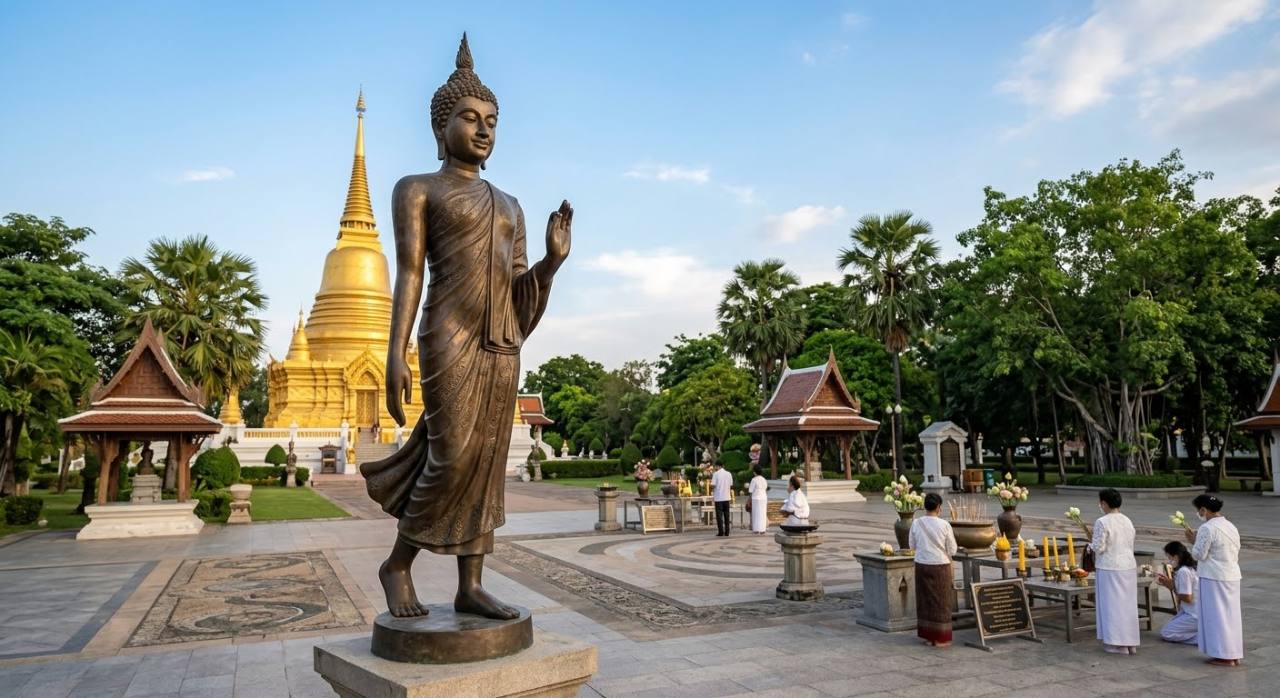
Phra Leela shows the Buddha walking with grace: one foot bears weight, the other lifts, the body forms a gentle S-curve and one hand rises near the chest in reassurance or a related gesture. It is celebrated in Sukhothai art, while Ayutthaya and other periods have their own proportions and robe lines. Reduced to an amulet, every line of foot, waist, hand and flame aureole becomes diagnostic.
Why the Buddha walks
Traditions connect the walking Buddha with teaching journeys, intervention in a dispute over water, descent from Tavatimsa or other movements among beings; not every image illustrates one episode. Artists solve a deeper problem: how to place superhuman serenity within motion. The body advances while the mind remains still. Reducing this to a travel benefit misses the image's central tension.
Sukhothai aesthetics: body as flame and flowing water
Sukhothai walking Buddhas often have oval faces, arched brows, narrow waists, long arms, clinging robes and flame finials. Their contour rises like flame and continues like water. Later amulets add arches, bases or texts and may straighten the body. Appreciation should not assume thinner means older; compare regional proportion, robe turns and the process of that mould.
What movement comes to mean devotionally
Wearing culture associates the image with progress, promotion, leaving stagnation, safe journeys and smooth movement in work. These extend the symbolism of going forward; they are not original labels on every old image. A sound reading joins action to composure: move, but not chaotically; change, but not without direction.
Who may be especially drawn to it
Career change, enterprise, relocation, recovery or a new beginning make the lifted foot compelling. Determine whether the object is a cache tablet, modern powder piece or cast metal image, because their ageing and authentication differ. A graceful, documented walking Buddha recalls that progress is not haste but direction in every step.