Origins & Belief · Oct 2026 (B.E. 2569)
Phaya Phali (Vali): vanara king, broken trust and Rama’s arrow
Vali is not a minor obstacle placed before Rama. He is Indra’s son, Sugriva’s brother, a formidable vanara king and the centre of one of the Ramayana’s hardest ethical disputes. The Thai Ramakien reshapes his life through divine power, oath and final instruction.
18 min
Phaya Phali (Vali): vanara king, broken trust and Rama’s arrow
Vali is not a minor obstacle placed before Rama. He is Indra’s son, Sugriva’s brother, a formidable vanara king and the centre of one of the Ramayana’s hardest ethical disputes. The Thai Ramakien reshapes his life through divine power, oath and final instruction.
The Sanskrit name is usually written Vāli; the Ramakien calls him พาลี, with the honorific พระยาพาลี or พญาพาลี. Vanara should not be reduced to an ordinary zoological monkey: these beings possess speech, cities, kingship, marriage, armies and divine ancestry. Vali rules Kishkindha, called Mueang Khitkhin in Thai tradition. The traditions share a framework of names, city and kinship, while the Thai text adds a distinct divine-court ethic.
Son of Indra and the ‘half-strength’ boon: keep the Indian and Thai accounts distinct
The Valmiki Ramayana calls Vali a son of Indra and Sugriva a son of the Sun. Divine paternity explains their extraordinary strength, but it does not mean every Indian passage mechanically states that Vali absorbs half an opponent’s power. That boon is especially prominent in the Ramakien: after Phali helps restore the leaning Mount Meru, Phra Isuan names him Phaya Phali Thirat, gives him the divine tri-phet-surakan weapon and grants him half an enemy’s strength in combat. The device explains both his near invincibility and why Rama cannot confront him like an ordinary duellist.
How the brothers became enemies: cave, misjudgement and a lost throne
The tragedy begins with combat inside a cave. Vali enters after a powerful enemy and orders Sugriva to wait outside, sealing the entrance only if the enemy’s blood emerges. A blood-coloured flow makes the brother believe Vali dead; he closes the cave and is later installed by the court. Vali survives and returns to find his throne occupied, reading a fearful error as treason. Versions vary over blood, rainwater and the reason for sealing the cave, but the core remains: incomplete information, fear and power destroy trust.
Vali not only expels Sugriva but takes his younger brother’s wife into his household. This becomes Rama’s central reason for accepting an alliance and promising to restore wife and throne. From Vali’s perspective he punishes a usurper; from Sugriva’s, an overwhelmingly powerful brother strips him of everything. The epic offers no perfectly innocent position, binding family conflict, royal legitimacy and personal revenge together.
Why did Rama shoot from concealment? One of the epic’s great ethical debates
At Sugriva’s first challenge Rama cannot distinguish the brothers and does not shoot. At the second, Sugriva wears a garland, and Rama strikes Vali from concealment. The dying king objects: he is not Rama’s subject, has not challenged him, and has been shot like hunted game. Rama answers that royal duty includes punishing the taking of a brother’s wife, protecting one who seeks refuge and maintaining dharma; he also invokes the hunting of forest animals. The defence has remained troubling precisely because the epic does not make every act of its ideal king ethically effortless.
Thai ‘Phali breaks his oath’: divine power must answer to a promise
The Ramakien adds another causal layer. Phra Isuan entrusts Phali with a casket containing Nang Thepdara for Sugriva. Phali swears that if he betrays his brother, he may die by Phra Narai’s arrow; he nevertheless keeps the woman. The oath becomes the divine basis on which Rama—Narai incarnate—later kills him. The Thai stage theme satja Phali, ‘Phali’s truth/oath’, is more than a romantic dispute. It asks whether a ruler is bound by his own speech: the greater the power, the heavier the consequence of broken trust.
‘Phali instructs his brother’: a warrior’s last legacy is governance, not force
Thai culture gives special weight to Phali’s final instruction to Sugriva, developed into Phali Son Nong poetry and khon episodes. Accepting death, he transmits knowledge of rule, appointments, service to Rama, discernment between loyal and treacherous advisers, and care for subordinates; he also entrusts his son Angada. A king ruled by strength and suspicion completes succession through knowledge. This is why Phali is not simply a villain: he bears guilt, dignity, political intelligence and self-knowledge that arrives too late.
Recognising Phali: the green vanara king and the royal barge
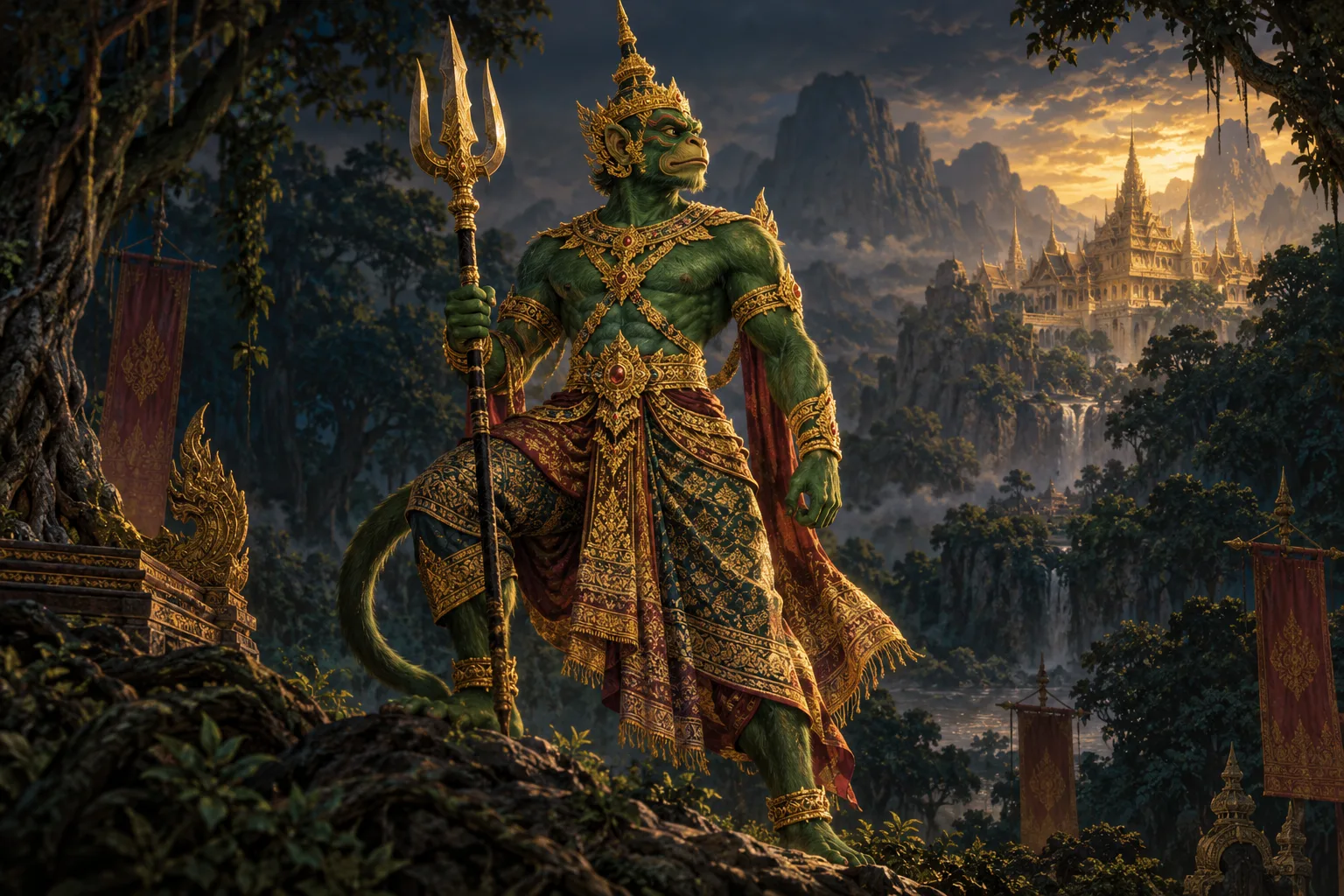
Thai khon usually presents Phali with a green monkey face, royal crown and kingly vanara costume; crown, weapon and gesture vary by troupe, period and episode. The royal barge Phali Rang Thawip likewise bears a crowned green vanara prow, its name recalling the mighty king crossing the quarters to honour the Sun. Such imagery helps identify a character but cannot prove an amulet’s date, provenance or authenticity. A market slogan that reduces Phali to ‘stealing an opponent’s strength’ removes oath, kingship and ethical controversy—the parts most worth reading.