Origins & Belief · Oct 2026 (B.E. 2569)
Mo Lam, Nang Ram and Southern Nora: Three Different Performance Worlds
One is an Isan sung-narrative tradition with khaen; one is a broad description; one is a Southern Thai dance-drama with song and ritual lineages. Distinguish them before comparing them.
13 min
Mo Lam, Nang Ram and Southern Nora: Three Different Performance Worlds
One is an Isan sung-narrative tradition with khaen; one is a broad description; one is a Southern Thai dance-drama with song and ritual lineages. Distinguish them before comparing them.
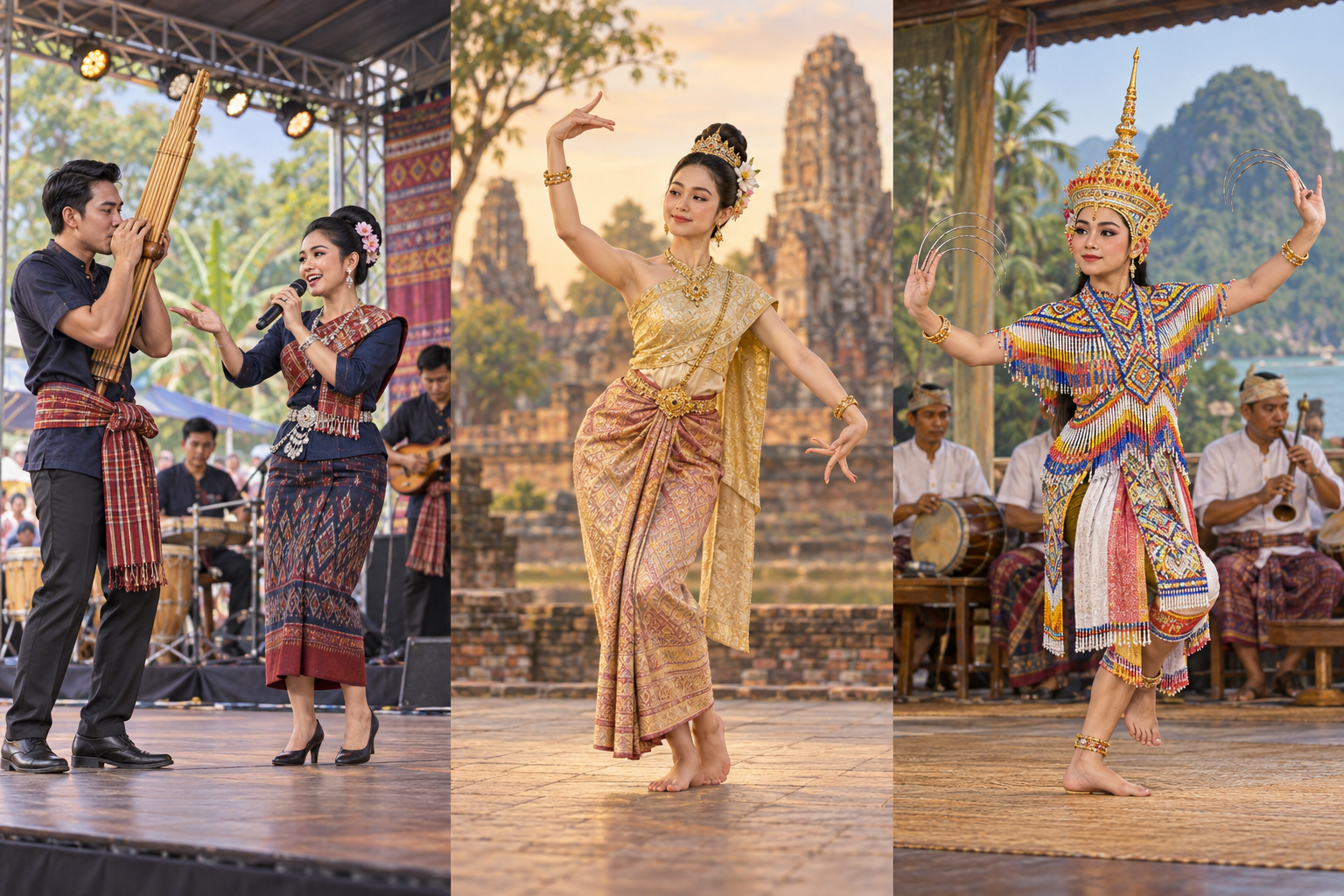
Overseas viewers often call any Thai stage performance in traditional dress ‘Thai dance’. The shortcut is convenient, but it erases important differences of region, language, music and ritual. Mo Lam (หมอลำ), the commonly used phrase nang ram (นางรำ, female dancer), and Southern Nora (โนรา, also written มโนราห์) are not one system: the first centres on Isan sung narration and instruments; the second is not itself a fixed genre; the third carries a long southern tradition of dance drama, improvised song and ritual lineage.
The short distinction
- 01Mo Lam is an Isan–Lao cultural tradition of singing, narration, responsive exchange and stage performance; lam is storytelling and social expression through melody.
- 02Nang ram usually describes a female dancer or dancing role. The term alone cannot tell us whether she performs classical dance, a local dance, choreography in a Mo Lam troupe or something else.
- 03Nora is a distinct Southern Thai dance-drama and singing tradition, with its own costume, rhythm, movement, oral literature and teacher-honouring ritual.
Mo Lam: sung narration, not a costume category
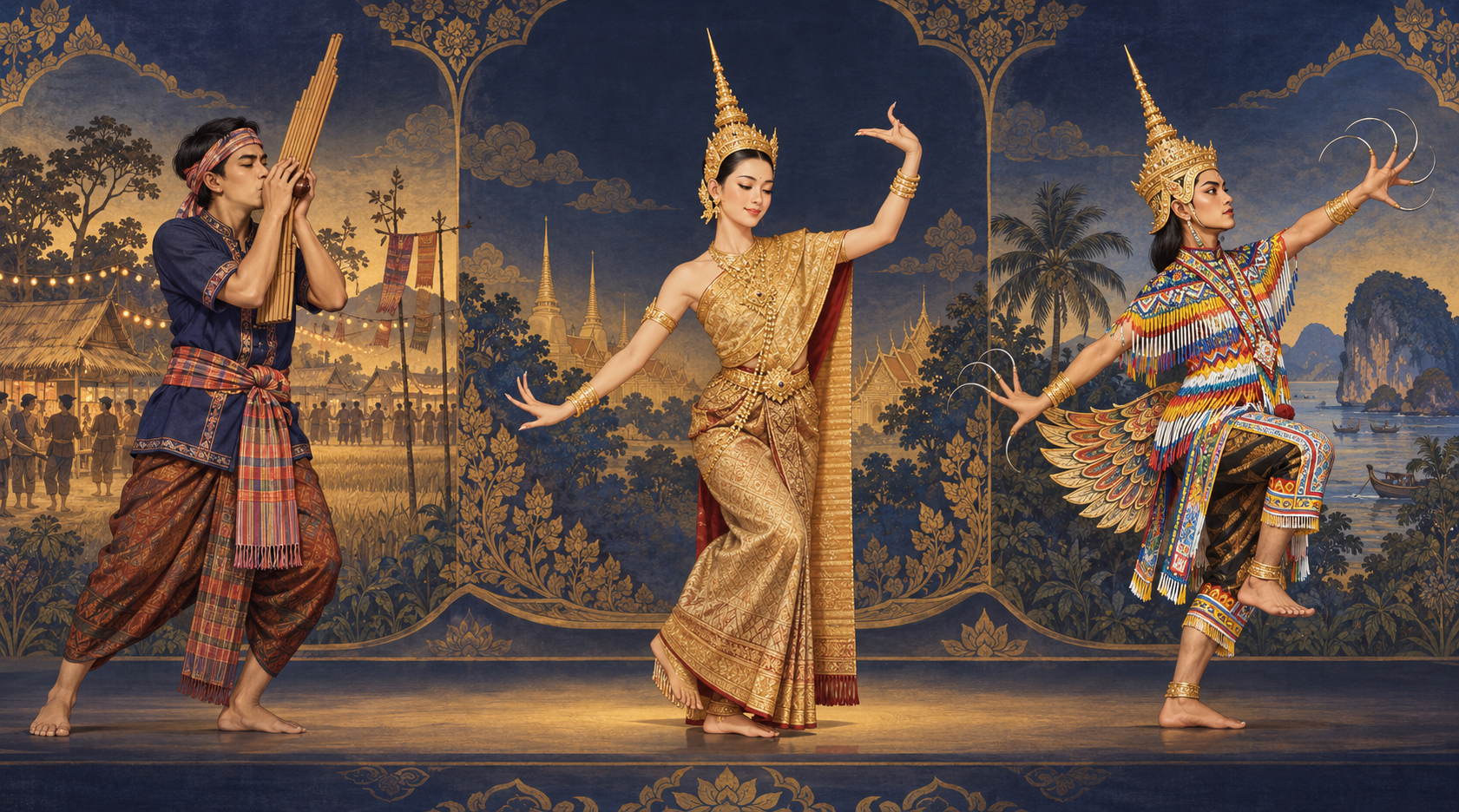
In Thai, mo can mean a skilled person or expert, while lam is melodic narration. Mo Lam grew from Isan life, Buddhist merit festivals, local stories and a Lao-language cultural environment. Older forms include responsive lam klon, alongside lam toei and lam phloen. The khaen, a bamboo free-reed mouth organ, is its most recognisable sound. Modern stages may add phin, drum kit, amplified instruments, lighting, comedy and dancers. Those dancers can be spectacular, but they are not the definition: remove the vocal style, verse, exchange and musical vocabulary, and a pretty costume alone does not explain Mo Lam.
Nang ram: a description, not a fixed genre
Nang ram translates roughly as ‘a woman who dances’ or ‘female dancer’. She may perform royal or classical dance, a local dance, in a ritual procession, a tourism show, a stage revue or a large Mo Lam troupe. The phrase answers ‘who is dancing?’, not ‘which performance tradition is this?’. When viewing a photograph or short clip, better questions are: Which region? What music accompanies it? Is there a story role, lineage or ritual setting? This avoids labelling every female dancer Nora, or mistaking the dancers in a Mo Lam troupe for the whole of Mo Lam.
Southern Nora: dance drama, improvised song and ritual lineage
Nora has long been practised in Southern Thailand. When UNESCO inscribed it on the Representative List of Intangible Cultural Heritage, it described a southern tradition joining dance drama with improvised singing. Performances may recount former lives of the Buddha, legendary heroes or local stories, accompanied by southern oboe, drums, gongs, cymbals and clappers. Pointed crowns, bead costumes, bird-like wing or tail elements and long metal fingernails are highly recognisable, but Nora is more than a visual code: performers also learn rhythm, singing, movement, narrative and rules of transmission. Folklore writing often uses Nora for the performance itself, while Manohra/Manora may also name a character, story or common spelling; community use can overlap.
Why Nora is more than ‘Southern dance’
Nora has both entertainment stages and ritual dimensions of honouring teachers, fulfilling vows and initiation. In Nora rong khru ceremonies, southern communities invite ancestral masters, pay respect, fulfil commitments and may initiate new apprentices; procedures vary among families and communities. This does not make every Nora event a religious rite, nor does it make a ritual excerpt exotic entertainment. The sound approach is to ask whether an event is a public performance, community festival or family rite, then follow local rules on filming, costume and conduct.
A practical viewing map
- 01When you hear khaen, Isan/Lao sung narration, vocal exchange or a large Mo Lam stage, begin with Mo Lam’s musical and oral tradition.
- 02When you see only a female dancer, do not rush to name a genre. Nang ram may simply describe her role; location, repertoire and music are still needed.
- 03Beadwork, a pointed crown, long fingernails and a southern ensemble can suggest Nora, but still distinguish a stage performance from a ritual context with its own rules.