Origins & Belief · Sep 2026 (B.E. 2569)
Jatukam: old guardians, a modern name, a national fever
Jatukam cannot be called a thousand-year Srivijaya god in one breath, nor a 1980s invention in the next. Separate what can be checked from the stories added later.
16 min
Jatukam: old guardians, a modern name, a national fever
Jatukam cannot be called a thousand-year Srivijaya god in one breath, nor a 1980s invention in the next. Separate what can be checked from the stories added later.
Anyone who lived through 2006–2007 in Thailand will remember the name Jatukam Ramathep. In a few years a local cult in Nakhon Si Thammarat became a national market in sacred objects. Temples, shrines and amulet floors issued new editions almost daily. The real question is not whether it ‘works’. It is: who is this figure? An ancient god, or a modern name?
You cannot pick only one side. The safer reading has three layers. First: old texts and the guardian tradition at Wat Phra Mahathat really do know names like Khattukam and Ramathep. Second: the compound name people now say as Jatukam Ramathep was assembled and used around B.E. 2528 (1985), during the city-pillar work in Nakhon Si Thammarat. Third: calling the figure a Srivijaya emperor, King Chandrabhanu, a bodhisattva or two princes is later interpretation. It is not the same as the first layer.
What is old is two guardians, not one compound name
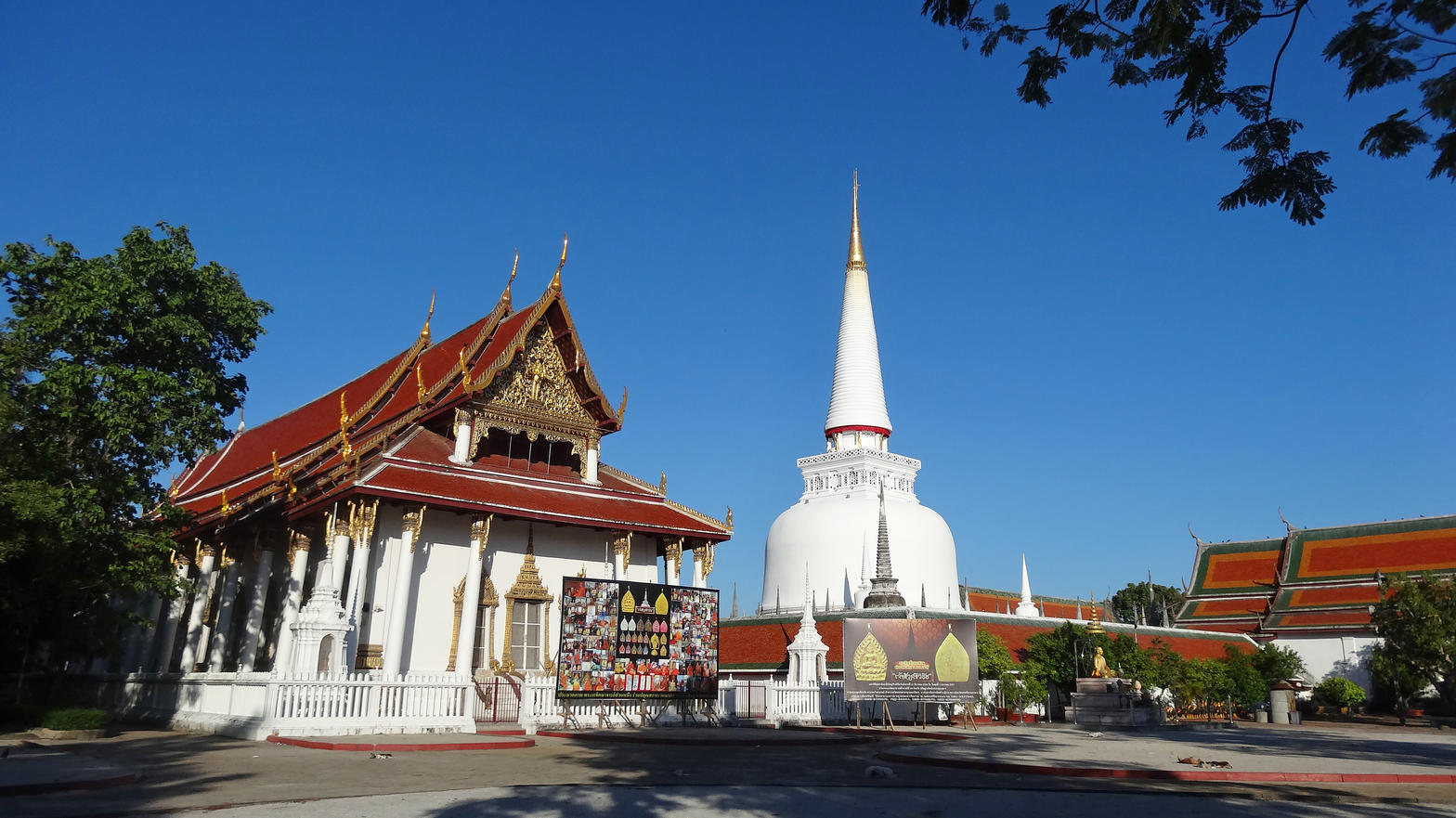
At Wat Phra Mahathat, on the way to the relic stupa, guardian figures have long been known, among them Thao Khattukam and Thao Ramathep. Southern records and later studies note that chronicles such as the Jinakalamali mention gods who guard Sri Lanka, including names of the Khattugama and Rama type; the tale of the Sinhala Buddha image also lists deities around that image. The safer sentence is this: those two guardian names and offices are old. A single god already called Jatukam Ramathep is not.
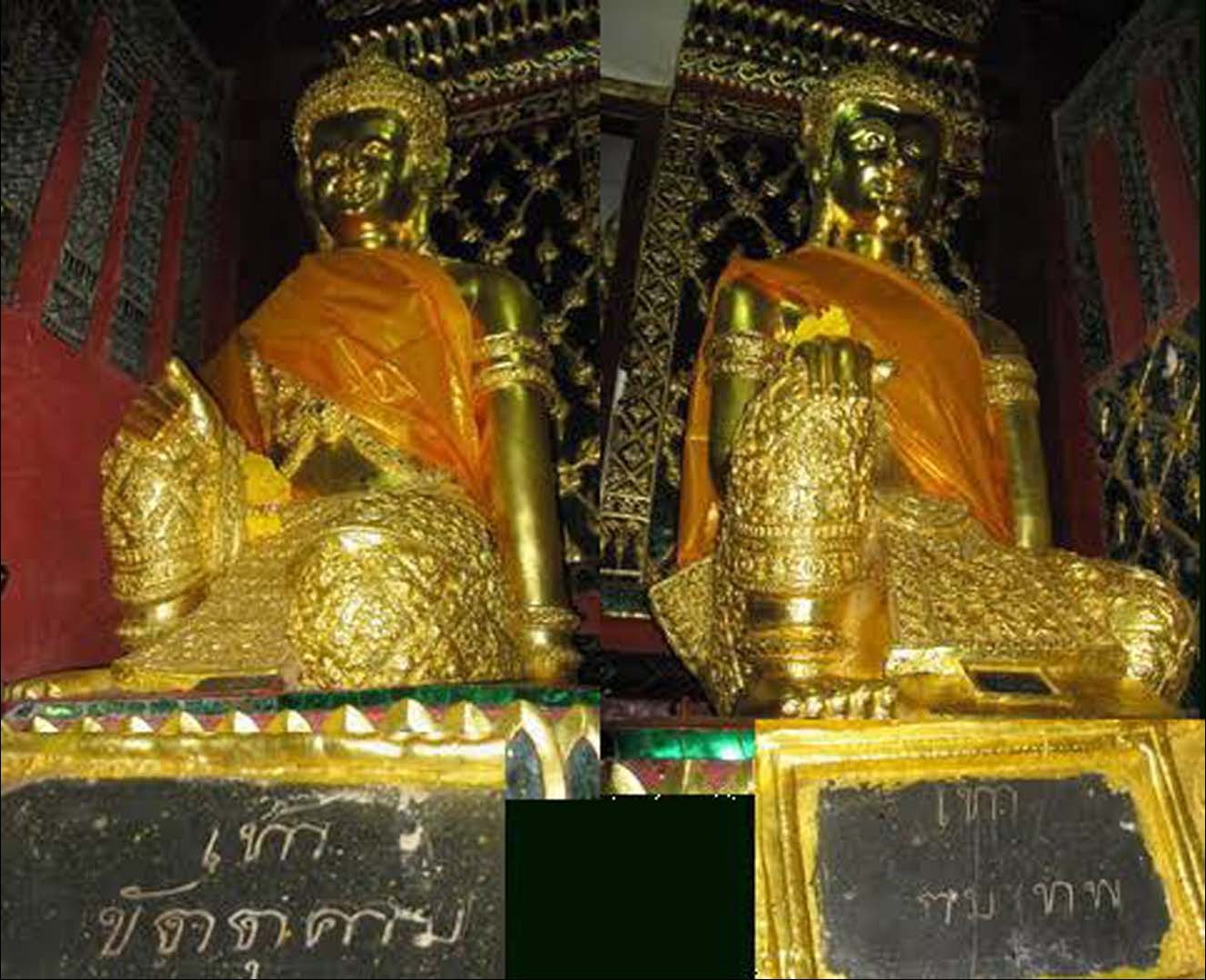
Some scholars link Khattukam with Kataragama in Sri Lanka — Skanda, Karttikeya, Murugan — a war-god who entered the island’s Buddhist guardian set and, with the Lankan monastic line, reached Nakhon Si Thammarat. Ramathep is read by some as Rama, by others as Upulvan (a Vishnu form in Sri Lanka). These are comparative readings with a basis. They are not a closed proof.
The compound name appears with the city pillar
The spoken name Jatukam Ramathep, as one title and one personality, is first reached in the surviving record around B.E. 2528–2529 (1985–86), when Nakhon Si Thammarat was raising a city pillar. Some notes say 2528, some 2529. Do not write that it was born on a single morning. The band is clear: the mid-1980s. Some researchers hold that the southern legend known in Chinese as the Iron-clad detective — Ajahn Khun Phan — joined Khattukam and Ramathep into that name. It is an influential reading of the file, not the only uncontested verdict.
The séance at Wat Nang Phraya is longer than the short version
The hinge of the modern cult is not a dig. It is a séance. Police officer Sanphet, then posted in the province, went to Wat Nang Phraya at Pak Nakhon. In later interviews he said the temple already had a medium for Chao Mae Nang Phraya, and the message was that the city’s fortune had been pinned down and a pillar must be raised again. That first medium was not Ko Phong, the man later famous in this story.
Only later was Sanphet introduced to Aphong Sakunamon, known as Ko Phong. He had already served as a medium in Chinese shrines. The fuller local accounts add that the first trial at Wat Nang Phraya did not take; after the offering tray was prepared again, the voice first recorded is often Phaya Chingchai, said to be an old general of the city’s east, asking for a pillar tied to Srivijaya and the twelve-animal cities. At the start, the name Jatukam Ramathep was not claimed.
In the next stage of the telling, another presence draws its own likeness and tells them to take the picture to Khun Phan. Khun Phan reads it as an old Srivijaya king and speaks the name Jatukam Ramathep. That is the naming scene later retold most often. Street versions collapse the temple’s earlier woman medium with Ko Phong, and write that Jatukam descended on the first night. The surviving oral lines do not all agree. The safer sentence: Ko Phong was not ‘the first man to find Jatukam’. He became the most central, best-recorded medium of the city-pillar years. He died in B.E. 2554 (2011). The press also records him among those who first raised the pillar shrine.
What Khun Phan did
Without Khun Phan the cult would likely look different. He was not a regular religious figure. He was a southern policeman of legend, known for hunting bandits and for mantra-work, the sort of man later called a master of the arts. In the pillar story he does more than name the likeness; he sits at later rites. Local notes record several ceremonies as the pillar was built; on 3 March B.E. 2530 he led the eye-opening tied to that pillar. Modern Jatukam is old local guardians, the séance, Ko Phong, Sanphet, Khun Phan and the pillar stacked together — not a statue lost for a thousand years and found on one morning.
King Chandrabhanu is historical. That does not make him Jatukam
King Chandrabhanu is on stone. The Princess Maha Chakri Sirindhorn Anthropology Centre files the Wat Hua Wiang inscription from Chaiya, around B.E. 1774 (about 1231 CE), in Sanskrit, naming Chandrabhanu Sridthammaraja of Tambralinga and his support of the Buddhist order. A thirteenth-century king on a stele is not proof that Chandrabhanu is Jatukam. Keep the two files apart.
Later tellings knead the pillar story into Tambralinga, Srivijaya and Nakhon’s old history. Identities then multiply and do not agree: Chandrabhanu; Sri Thammasokaraj; Phaya Phangphakan; a Srivijaya emperor; a Mahayana bodhisattva; or two princes split from the two halves of the name. Local databases keep these versions side by side. They cannot replace one another. That is the point: the modern myth is not one ancient story that never changed. It is a compound that keeps taking in local history, kingship, bodhisattva thought and the occult arts.
The first objects were thanks for the pillar, not a market
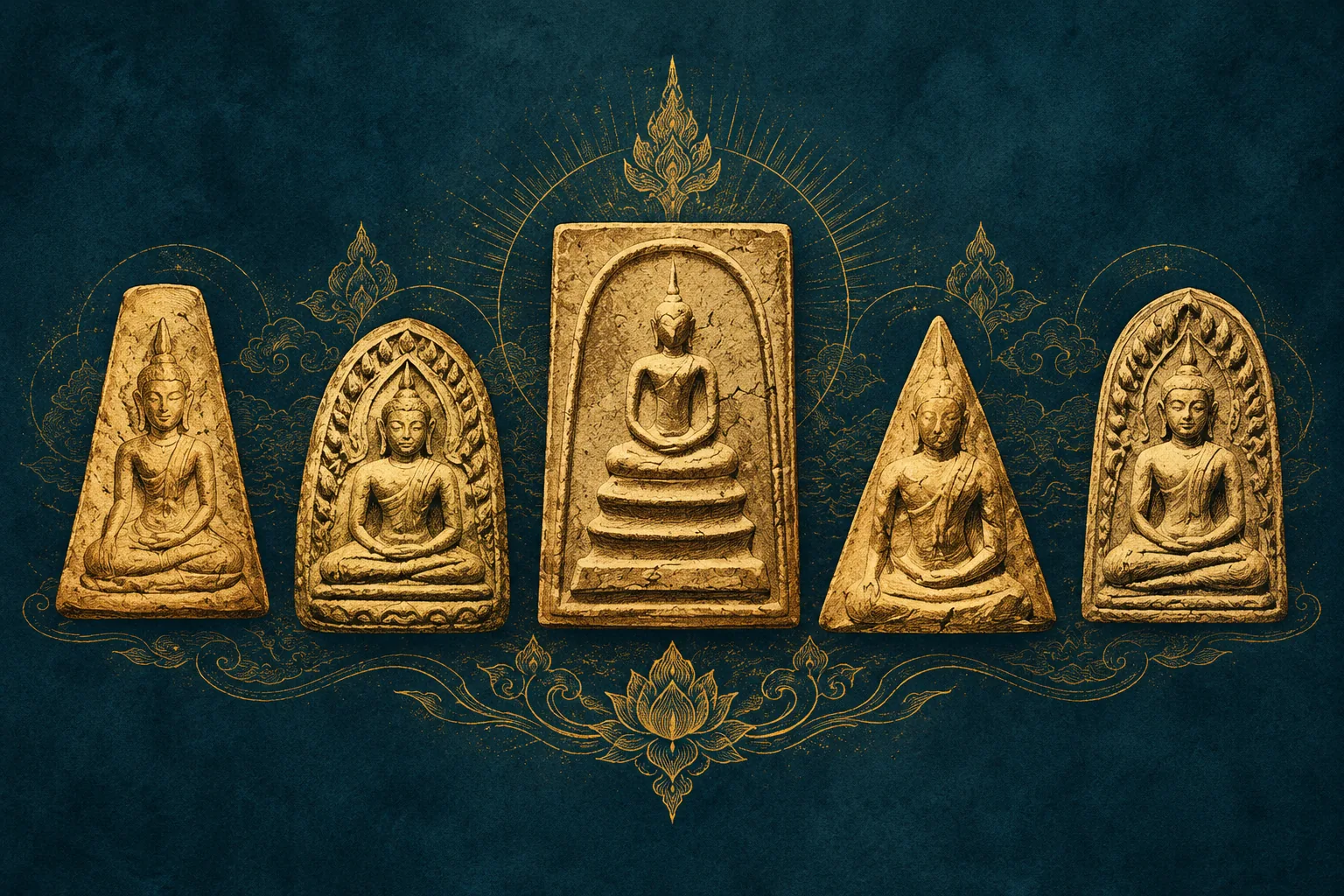
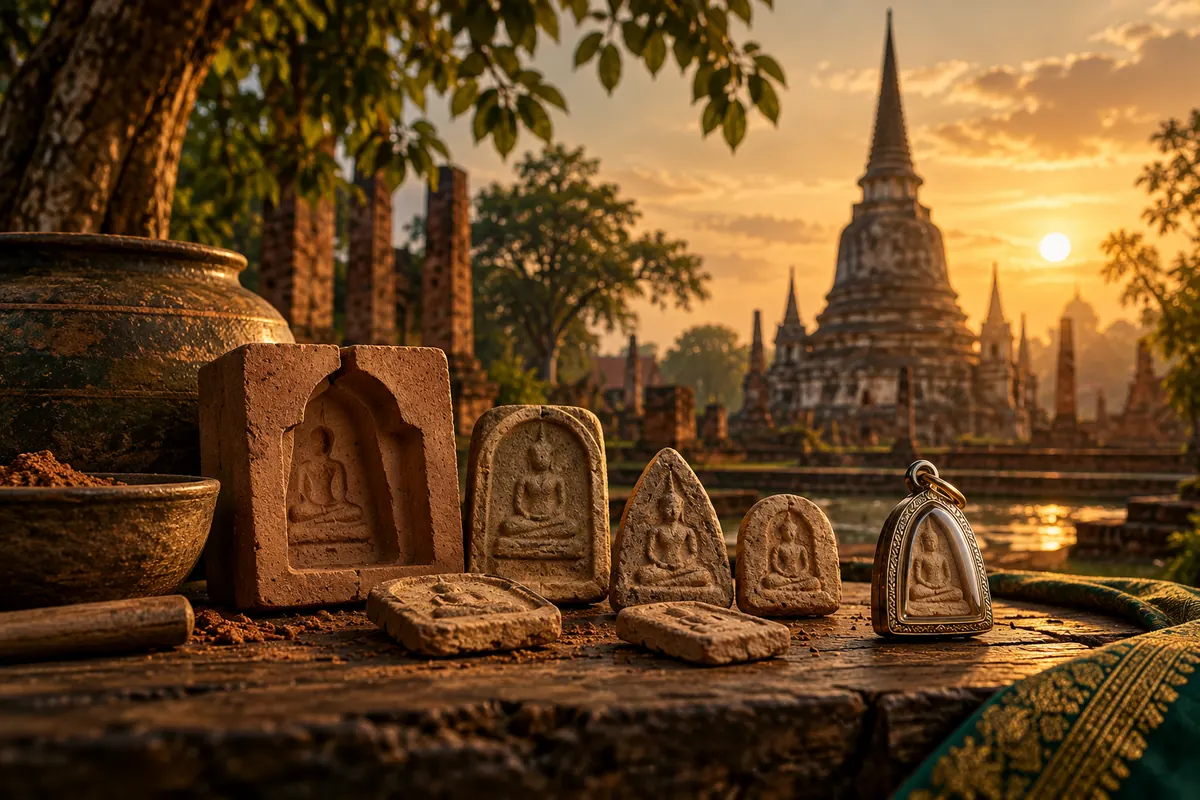
After the pillar cult took shape, objects followed. From 3 to 5 March B.E. 2530 (1987) the pillar’s eyes were opened, and the Sun–Moon powder tablet — later a collector’s landmark — was made. Local studies say the first pieces were thanks and souvenirs for those who helped raise the shrine, not the commercial editions people now imagine. Scholarship puts the start of Jatukam objects around 2530. Early on they were gifts or memorials. Around B.E. 2548–2551 they turned into sacred goods with a large price. Some early Sun–Moon pieces were later driven to extreme sums. A price proves heat. It does not prove authenticity.
Why the whole country only caught fire in 2005–2006
If objects already existed in 2530, why did the nation wait almost twenty years? Studies treat 2530–2546 as the early phase; heat rises after 2547. Khun Phan died in B.E. 2549; 2549–2550 then became the peak. Media is one of the hinges. A Chulalongkorn reading of four dailies in 2550 found miracle stories and advertising tightly bound, and the papers themselves allowed that they had pushed the fever. Commerce ran with it. A bank estimate at the time put the amulet and related flow around forty billion baht in 2550; hundreds of editions appeared in a few months. Jatukam moved from a pillar guardian to national talk of wealth, success, protection and ‘ask and receive’. The god’s identity kept widening with the market.
B.E. 2550: why the fever fell so fast
Into B.E. 2550 (2007) new editions were still coming, and queues were still seen. Within that same year the fever fell fast. Later news and market notes usually name several things happening together, not one cause.
First, oversupply. Notes from that year speak of 400 to 650 editions, and tens of millions of pieces. Factories ran day and night; molds were often not destroyed; rarity vanished. Second, quality and rite came into doubt. Reports already said some batches were crude, and whether a consecration was complete was argued. Once confidence moved, the price stopped. Third, speculation. Many treated Jatukam as stock to flip. When the price stopped climbing, panic selling followed. Later news even recorded investors dumping unsold pieces, some into waterways. Monks and public voices also said the commerce had gone too far.
TAMRA does not judge any piece’s power. What can be written is this: the fever came fast and left fast. A peak price does not prove a piece more genuine. A crash does not prove a piece suddenly fake. The market’s rise and fall is not the same file as authenticity.
History can date a name. It cannot prove a god’s power.
Ask history whether this is a ‘true god’ or a ‘new god’, and the question is already half wrong. History can date a name, a statue, a line in a chronicle, the people who built a cult, the first objects, the later stories. It cannot prove efficacy. On the file that can be checked, a neutral sentence is this: Jatukam is not a single god who can be shown to have come down from Srivijaya with today’s name, form, identity and story intact. Nor is he empty of old roots. Behind him stand at least Khattukam and Ramathep in Nakhon, and a Lankan-style Buddhist guardian tradition. In the 1980s those old materials were joined again to séance, Khun Phan, Sanphet, Ko Phong, local kingship and Srivijaya imagining. That is the Jatukam people now name. Sun–Moon tablets, mass editions in the late 1990s, and the 2006–2007 press and market then carried a local guardian into a name the whole country knows.