Origins & Belief · Oct 2026 (B.E. 2569)
Hun Phayon (หุ่นพยนต์): Animated Guardians in Thai Charm Traditions
It is not necessarily a ghost, and black versus white is not a complete technical system. This essay follows the name, documentary history, materials, functions and lineage claims behind a figure imagined as a guardian capable of receiving a task.
26 min
Hun Phayon (หุ่นพยนต์): Animated Guardians in Thai Charm Traditions
It is not necessarily a ghost, and black versus white is not a complete technical system. This essay follows the name, documentary history, materials, functions and lineage claims behind a figure imagined as a guardian capable of receiving a task.
Chinese-language amulet markets have long called หุ่นพยนต์ ‘Hun Pak Yung’, literally suggesting a soul-bearing warrior. The label is now familiar, but it can make readers assume that every figure contains a captured spirit. In Thai, hun is a model, puppet or surrogate body; phayon in this setting describes something made operative through occult means. Together the term is closer to an animated ritual effigy than to an automatic ghost-container. This essay therefore preserves the familiar Chinese market name while correcting the idea through the Thai original.
How old is it? Separating evidence from lineage legend
No defensible ‘first year’ for Hun Phayon is presently known. Claims that the art began in the Buddha’s lifetime or was invented by a named ancient sage usually belong to later lineage stories or sales literature, not securely dated contemporary evidence. A safer account is that surrogate bodies, guardian figures and commanded effigies are old human ideas; in Thailand the concept was established before the modern amulet market. One of the clearest publicly checkable witnesses is the Khun Chang Khun Phaen literary tradition. It preserves memories of Ayutthaya society, while major surviving texts were compiled and expanded in the early Bangkok period. Animated magical figures were already intelligible narrative devices there. That establishes the concept in the textual world, but it does not prove that any object sold today transmits an unchanged centuries-old formula.
The figure in Khun Chang Khun Phaen: first of all, a task technology
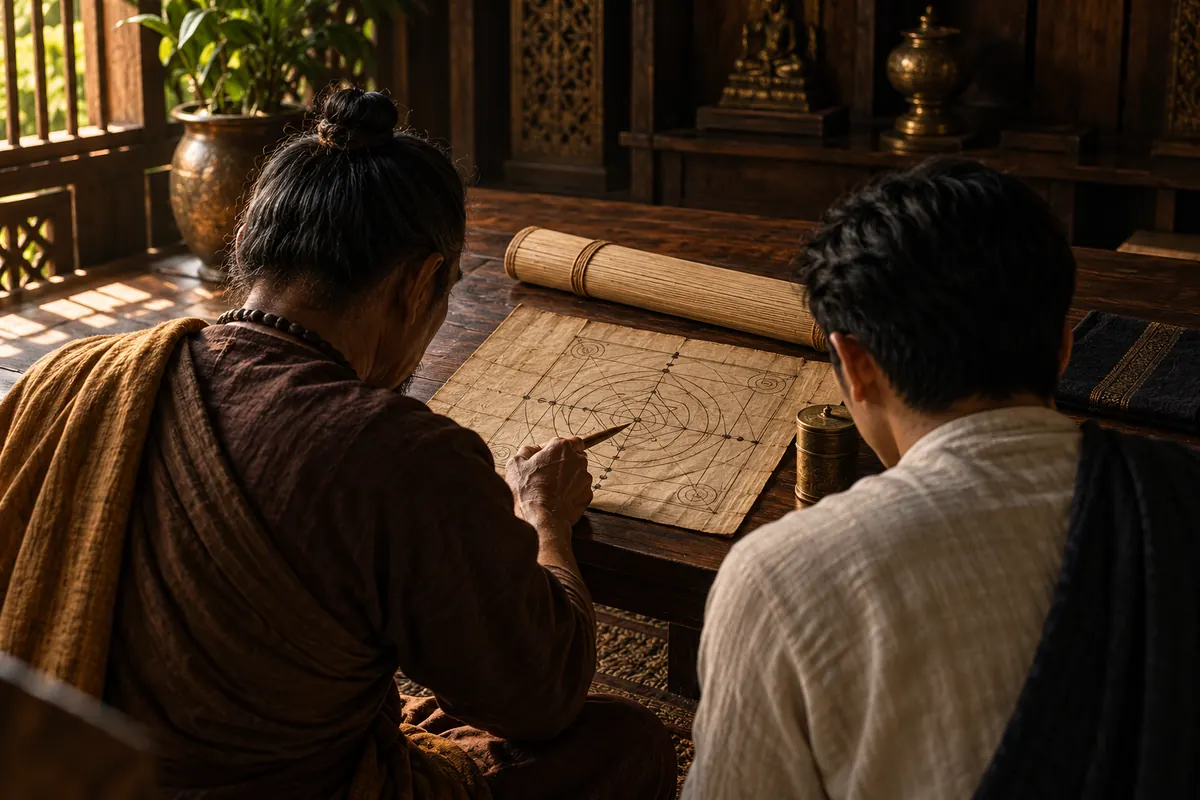
In literature, the Hun Phayon is not merely a statue placed for worship. A practitioner constructs and configures a body, then dispatches it to guard, scout, obstruct or fight. It turns a difficult social problem into an occult answer: when a person sleeps, travels or faces superior numbers, who protects the house, field, boat and property? The imagined answer is an artificial sentry that does not tire, draw an ordinary wage or negotiate orders. The figure’s centre is therefore not simply ‘power’ but delegation, boundaries and command. It extends the owner’s will and lets stories explore failed control, excessive orders and power returning upon its user.
Why make one? From guarding land to a wearable charm
The recurring early function is guardianship: houses, orchards, rice fields, livestock, boats, goods and hidden property. Such spaces were large, distant and beyond continuous lighting or modern security. A human figure made ‘someone is watching’ visible and gave form to anxiety during an owner’s absence. In the modern amulet market, the list expands to personal protection, theft prevention, defence against malign forces, warning, prosperity, negotiation and companionship. These are belief claims made by particular temples, teachers, vendors and devotees, not empirically established powers shared by every figure. Study an object by identifying issuer, date and original description before deciding which functions were added by later marketing.
Material is not decoration: it shapes what kind of body is imagined
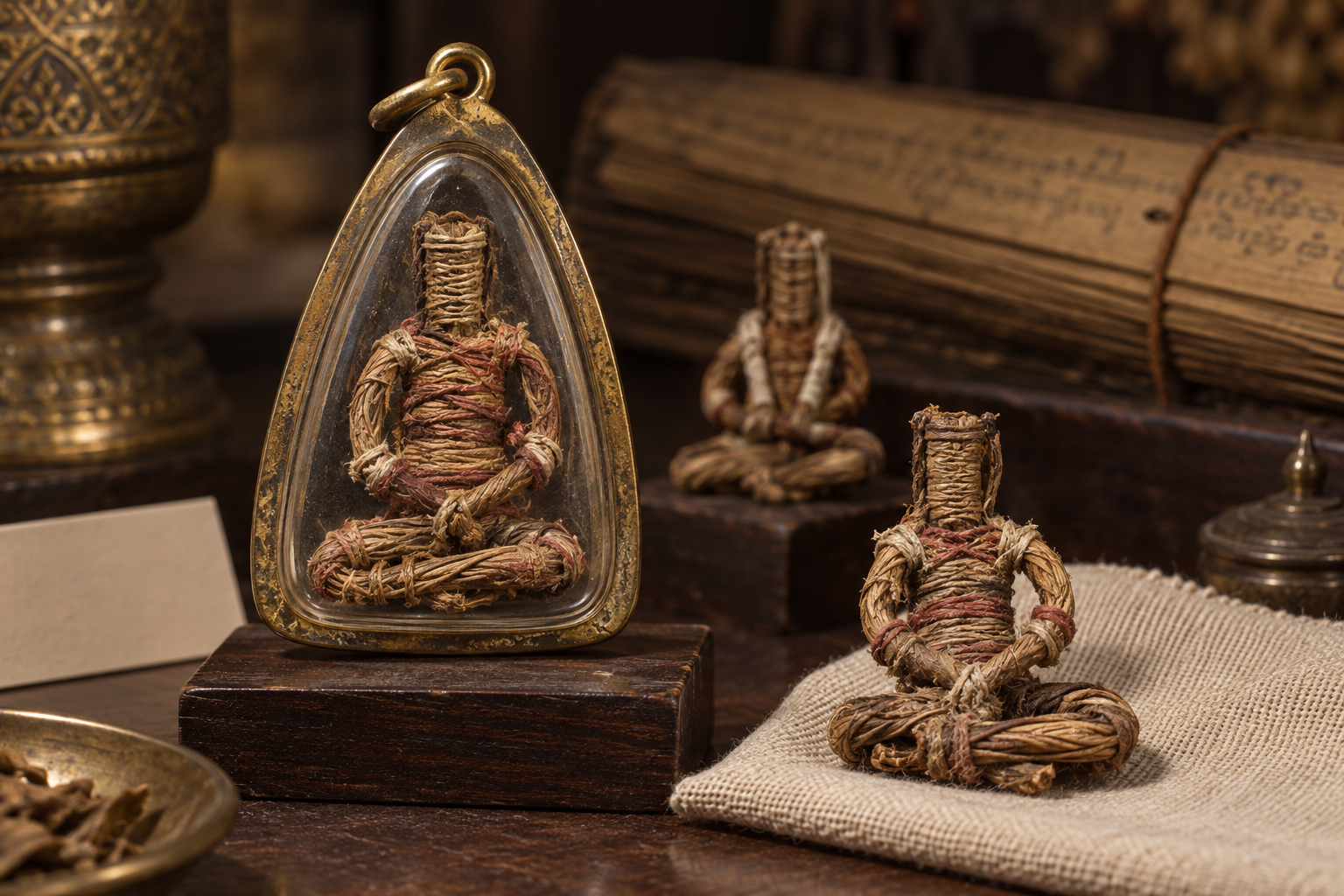
The most recognisable type is bound from grass, rice or maize stalk, bamboo strips, cotton or sacred cord. Phuk hun can mean both tying material into a body and, in ritual language, binding form, name, elements and duty together. Other figures are modelled or carved from beeswax, clay, herbal powder or wood; modern examples are cast in copper, lead, alloys or resin. Some contain a yantra sheet, takrut, cord or specified substance. Choice reflects local resources, craft, lineage and modes of commercial production. Metal is not automatically superior to straw, and cemetery material cannot be verified by a seller’s sentence alone. Size, weave, casting marks, packaging, records of the same issue and trustworthy provenance must be read together.
Black and white: useful language, but an incomplete map
Market speech usually describes a ‘white’ method as not binding a human soul. A guardian is established through the four elements, the thirty-two bodily parts, Buddhist recitation, teacher-lineage power, deity or protective force, with its task limited to defence, warning and legitimate livelihood. ‘Black’ methods are said to involve the dead, wandering spirits, cemetery substances, coercive service, attack or revenge. Yet no national examination fixes that boundary. One maker may combine Buddhist recitation, Brahmanical symbols, folk spirit language and local taboos. For some, ‘putting spirit in’ is a metaphor for effective consecration; others literally claim an attached being. Dark colour, skull decoration or a ‘white lineage’ label therefore decides nothing. Ask what source of agency is specifically claimed, whether a named dead person is alleged, what ethical limits govern the task, and what care rules apply. The answers form a more accurate map than a black–white binary.
How many consecration methods are there?
There is no fixed number because lineages divide ‘construction’, ‘establishing life’, ‘inviting agency’ and ‘final consecration’ differently. For research, one may identify overlapping technical families: binding or weaving a human form; modelling, carving or casting a body and adding yantra or an internal deposit; tang that or nun that, establishing and supporting the four elements; riak akan sam sip song, invoking the thirty-two bodily parts to complete a symbolic person; inviting the teacher-lineage, deity, guardian or another claimed force; assigning name, duty, range and termination; and finally sealing through recitation, meditation or a collective ceremony. One lineage may use three of these, another may treat six as one rite. To say there are only two consecrations, or to force a national count, flattens the living diversity of the tradition.
Hun Phayon, Kuman Thong and animal guardians are not one category
Hun Phayon centres on a constructed task-body, often an adult, warrior, sentry or simplified human figure. Kuman Thong is defined by child identity and is discussed through raising, kinship and care; within that category, traditions themselves disagree about whether a dead child-spirit is involved. Wua Thanu, Khwai Thanu and related bovine guardians place defensive force in an animal body. Markets may group them under the convenient story of an animate helper, but adult figure, child identity, animal guardian, deity image and ordinary takrut differ in provenance, ritual language and care. Similar advertised functions do not erase the categories.
Does it need feeding? Distinguish lineage rules from market folklore
Some issuers prescribe water, food, incense or spoken reports. Others explicitly say no feeding is required: respectful placement, ethical conduct or periodic recitation is enough. The difference reveals what they think the object is—an individual helper, a charm carrying lineage power, or a symbol that reminds an owner to protect what is entrusted to them. Copying one shop’s care sheet to every Hun Phayon may contradict its originating lineage. Preserve box, issue paper, teacher’s instructions and comparable records. If provenance is unknown, do not invent spirit-calling, vows or threats. Care for a sacred object must never replace locks, insurance, medicine, law or practical safety.
Collecting and identification: establish the object before debating the story
- 01Confirm the name: does the issue record actually say Hun Phayon, phayon, kuman, Wua Thanu, or a later vendor label?
- 02Confirm the issue: do issuer, teacher or temple, date, quantity, dimensions, material, mould and original packaging agree?
- 03Separate three voices: visible material facts, the issuer’s lineage claim, and later user testimony do not carry the same evidential weight.
- 04Do not replace provenance research with ‘it feels dark’ or a card. On woven figures, inspect fibre age, artificial staining, later-added inserts and repairs.
- 05Efficacy belongs to belief and testimony, not a warranty. Leave immediately if a seller uses threats, curses or ‘something will happen if you do not buy’ to force a transaction.
When the wish for protection takes form
Hun Phayon endures not only because it is mysterious, but because it answers a human wish: when I cannot be everywhere at once, can another body watch what matters to me? Literature makes it an artificial warrior under command; local lineages weave it from fibre, model it in wax or cast it in metal; the modern market turns it into a wearable and collectible charm surrounded by claims. The most useful stance is neither total belief nor ridicule. Keep text, lineage, object, commerce and personal experience distinct. When those five layers are not collapsed into one, the cultural force of Hun Phayon becomes visible without turning a compelling tradition into intimidation, invented history or unverifiable sales mythology.