TAMRA After Dark · Folk legend
Mae Nak: The House Still Waiting
He came home from war to find his wife and baby waiting. Why, then, would no neighbour approach the house?
3 min read
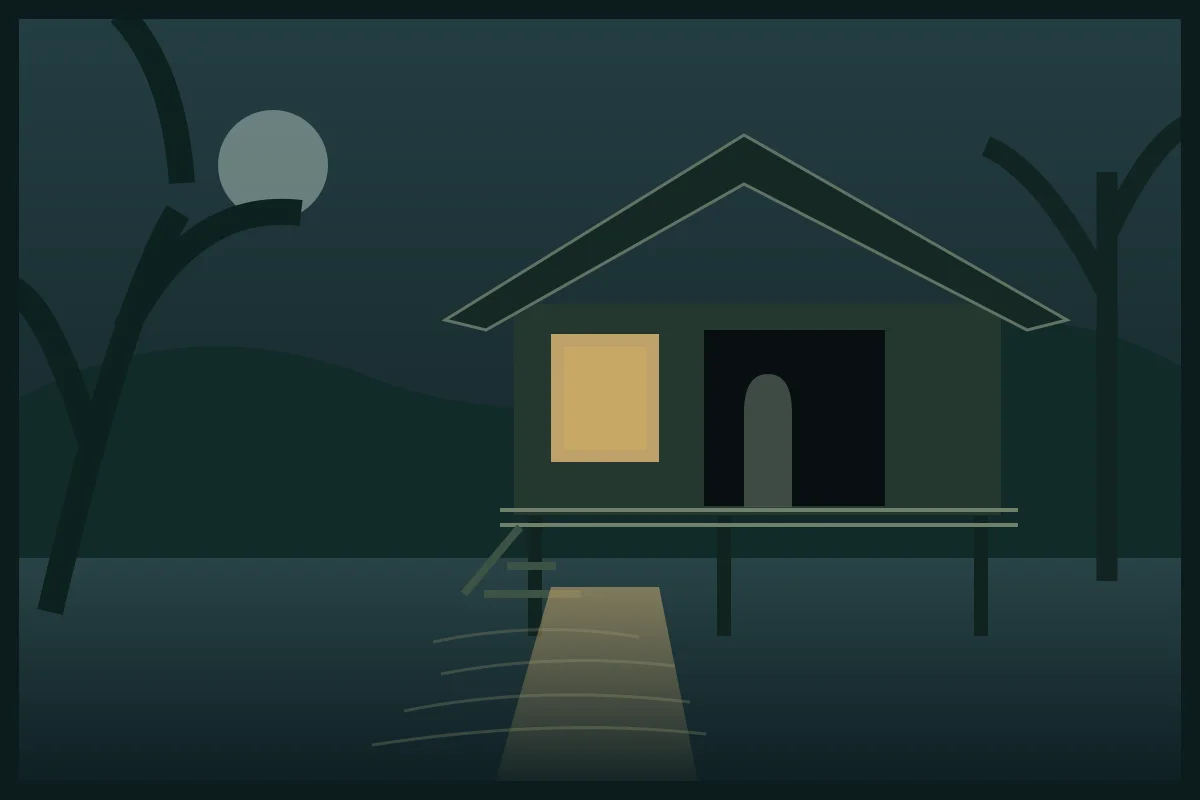
A retelling of the central Thai legend, following the ending in which Somdej Toh offers release. Not a synopsis of a particular film; other versions exist.
Begin with the house beside the canal.
In the central Thai legend of Mae Nak Phra Khanong (แม่นาคพระโขนง), Mak is called away for military service while his wife is pregnant. Neither knows how long he will be gone, or whether he will return before their child is born. War divides the life they expected to share.
Nak waits at home. But when childbirth comes, neither she nor the baby survives. Their neighbours bury them. The house ought to stand empty. In the legend, however, Nak does not leave. She keeps it as though her husband might come back along the bank at any moment.
Eventually, he does.
His wife is there, with the child he has never held. To a wounded man who has longed for his family, this is everything he struggled to return to. He settles into life with them, unaware that he has entered a waiting that death has not ended.
It is the people outside who seem strange.
Some avoid the house. Others try to tell him that his wife and child are dead. Mak refuses to believe them. How can their words be more real than the wife beside him? The harder they insist, the more it seems they are trying to destroy his home.
Then a lime falls.
In the familiar episode, Nak drops it while preparing food in the raised wooden house. She does not go downstairs. Her arm reaches out, lengthening across an impossible distance until her hand picks the lime up from the ground.
Mak sees.
Everything the neighbours have struggled to tell him suddenly takes shape. What frightens him is not only the spirit before him. He must accept that the road home remains, but the person who waited for him no longer belongs to the world he knows.
He flees to a temple. Nak loses him again. Grief becomes anger. In the legend, she searches for her husband and terrorises the neighbourhood, drawing the whole community into a loss that cannot release its hold.
The story has more than one ending. Some versions tell of a spirit subdued; others of a spirit persuaded to let go. Here the retelling follows the tradition in which Somdej Toh (สมเด็จโต) meets Nak with compassion. Fear is no longer answered only with fear. At last she loosens her attachment to their former life and stops holding her husband within her death.
Their life together reaches its parting.
Nak never disappears from Thai storytelling. A shrine associated with her remains at Wat Mahabut (วัดมหาบุศย์) in Bangkok. Her story returns on stage and screen, carrying the fears and longings of successive generations.
Perhaps its coldest moment is not the lengthening arm. It is the time before Mak knows, when he believes with all his heart that he has come safely home and will never have to leave her again.