Market & Verification · Oct 2026 (B.E. 2569)
Why community observation matters
An amulet should not be closed by a single word — genuine or fake. Put the photographs, details, disagreements and reasons in view, so fellow collectors can inspect, question and revise together.
12 min

Why community observation matters
An amulet should not be closed by a single word — genuine or fake. Put the photographs, details, disagreements and reasons in view, so fellow collectors can inspect, question and revise together.
The amulet world often begins — and too often ends — with a short sentence: ‘genuine’ or ‘fake’. Yet what deserves to be seen is never only the conclusion. Mold, material, edge, ageing, provenance, photographic angle, and the reasons people trust or doubt a piece can all be named, compared and discussed.
Community observation does not hand authenticity to a headcount; it places ‘why I see it this way’ back in front of everyone.
Look at the piece first, before an answer frames the observation
A public Community Observation page should begin with the object alone: front, reverse, sides, thickness and the details that need enlargement. A certificate, issuer, seller identity, price and any existing verdict should not appear in the first round. This does not deny the usefulness of a certificate in transaction checks. It separates that record from the act of looking, so fame, authority and a ready-made answer do not determine the direction before the piece is seen.
This is a simple blind-review arrangement. Reviewers first see the same photographs without an authority cue, then state what they observe, what they compare it with, and what the photographs still cannot show. Certificates and provenance documents may be checked separately later, during a transaction or in-person review. Keeping the two streams apart makes it easier to see whether they truly support each other.
Bring a conclusion back to visible details
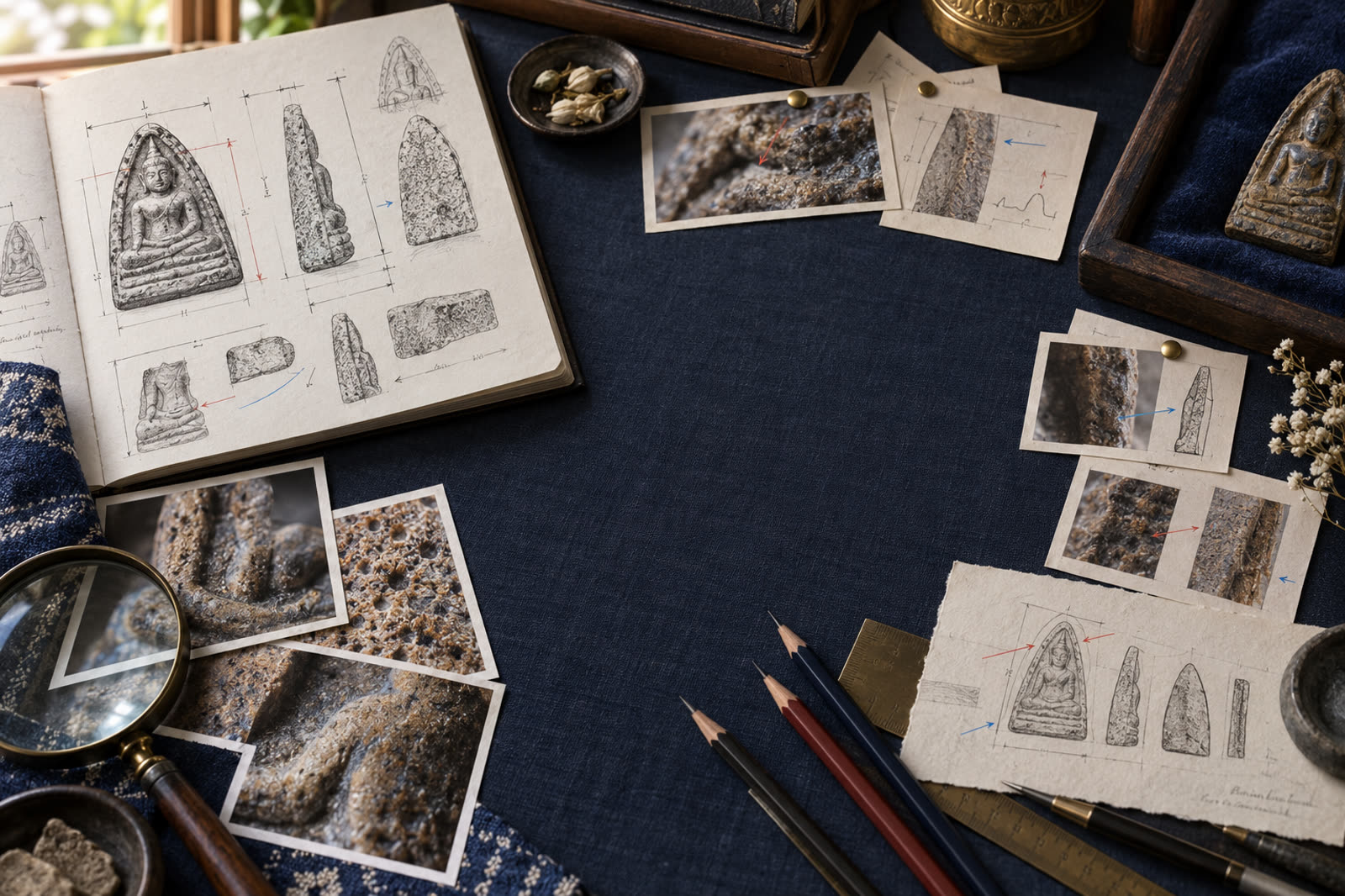
‘It looks genuine’ is not an observation. ‘The left shoulder line is thicker than the known specimen, the third base corner has rounded, and the reverse lettering does not match the stroke pattern of that issue’ is an observation. The first asks people to trust a feeling; the second lets them take the same image and specimen and look again. Even when views remain apart, the discussion can move forward.
- 01Name what is visible first: position, shape, dimension, colour, crack, mold line or a limit of the photograph.
- 02Then say what it is compared with: a specimen from the same issue, a published catalogue, temple material, or another adequately angled photograph.
- 03Finally name the limit: what a photograph cannot show, and what needs the object, dimensions, weight or side views before further claims are made.
A majority is not an oracle, and disagreement is not failure
When many people familiar with comparable objects point independently to the same issue, that overlap is valuable evidence; when they can jointly match mold, structure and provenance, it deserves careful record. But a crowd does not automatically become truth. A group can also be swayed by fame, price, inherited stories or one popular image. What matters is not that ‘everyone says the same thing’, but whether everyone can lay out a reason that later readers may inspect again.
Why leave this space to fellow enthusiasts everywhere
Someone who has handled objects in Thailand for years may know temple circulation and material. A collector in Hong Kong, Taiwan, mainland China or elsewhere may have seen the versions and casings that entered Chinese-speaking markets in different decades. Another researcher may have found an old catalogue or local record. No one should be believed automatically because of place or title, and no one should be ignored automatically for lacking a name. Put the material on the same table and let the details speak: that is the purpose of this section.
Community observation will not erase disagreement, nor should it pretend to. Its work is to keep disagreement from collapsing into volume, connection or price. When each view leaves as much visible basis as possible, the market gains a place to slow down, check again, and admit ‘the evidence is not enough yet’. That is already a basic fairness to collectors.