Market & Verification · Oct 2026 (B.E. 2569)
Why people collect and wear Thai amulets: faith, beauty, memory and capital
One amulet may be spiritual support, a temple connection, a family memory, a miniature artwork and a traded object. Understanding why people wear and collect them means seeing how these motives overlap—and where distinctions still matter.
24 min
Why people collect and wear Thai amulets: faith, beauty, memory and capital
One amulet may be spiritual support, a temple connection, a family memory, a miniature artwork and a traded object. Understanding why people wear and collect them means seeing how these motives overlap—and where distinctions still matter.
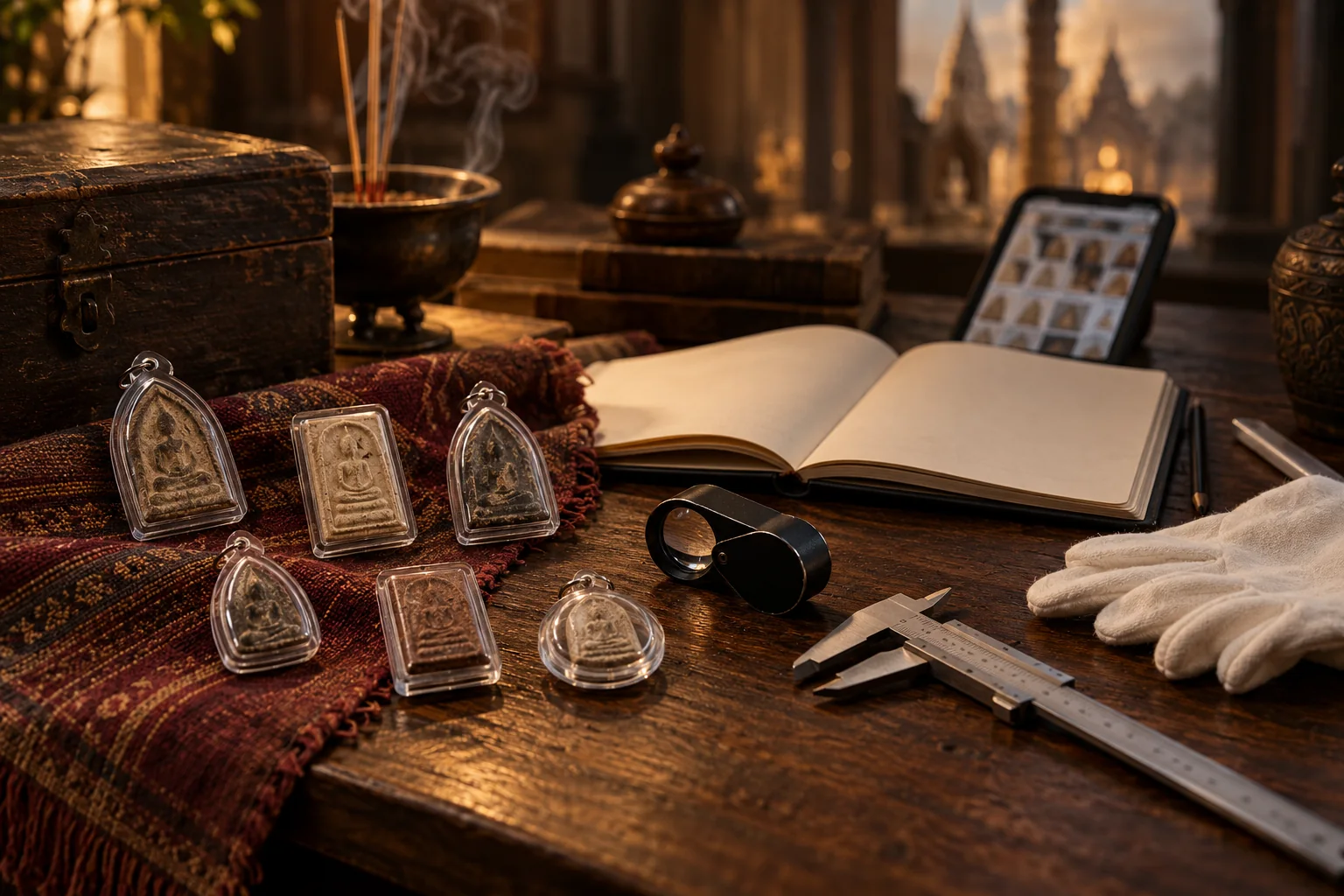
A Thai amulet may hang close to the chest, rest on a household altar, sit in a collector's tray or be locked in a safe. It may have been received at a temple, inherited from a relative or acquired later for a substantial price.
The same object can carry religious devotion, personal memory, craft value, social identity and a market price at once. Reducing all of this to either superstition or investment therefore misses most of the picture.
Some wear an amulet for reassurance. Some value the temple, master and lineage behind it. Others are drawn to molds, materials and traces of age, while another group sees a collectible that can circulate through a market. These motives need not cancel one another, and they often change with experience, knowledge and market conditions.
Wearing, collecting and trading are different relationships
For a wearer, rarity and price may be secondary. The only piece that matters may be one given by a parent, received during a temple visit or linked to a turning point in life. Its market value can be modest while its personal value is irreplaceable.
A collector may instead focus on one master, temple, period, material or series. What grows is not only the number of objects but a system of classification, comparison and research. A trader must also consider authenticity, condition, demand, price movement, liquidity and resale risk.
One person may occupy all three roles: wearing one deeply personal piece, researching a group of historically interesting objects and passing on duplicates that no longer fit the collection. The fact that amulets can be sold does not prove an absence of faith; the presence of faith does not make price and exchange disappear.
Something tangible in an uncertain life
The most direct motive is the hope for the protection or support described in tradition. Competition at work, economic pressure, changes in health, travel risk, family responsibility and an uncertain future all remind people that life is never fully under their control. An amulet gives abstract belief a visible, touchable and portable form, and can provide a sense of company, order and psychological security.
Promises of wealth, charm, authority, safety, career progress or secure travel often translate ordinary needs for income, relationships, recognition and security into religious language. Wearing a piece may help someone feel calmer, more confident or more focused. That is not the same as scientific evidence that an amulet guarantees wealth, cures illness or removes danger.
Not only a request, but a reminder
If an amulet is understood only as a device for obtaining benefits, another part of wearing it disappears. For some Buddhists, it first recalls the Buddha, the teachings, the monastic community or the guidance of a respected master. Touching it may prompt the wearer to speak carefully, act honestly, avoid harm and accept responsibility for personal choices.
An amulet may not change the world for its wearer, but it can remind the wearer how to meet that world—with attention, discipline and judgement.
Temple distribution, giving and merit
Before an amulet reaches a modern market, it may already belong to a temple ceremony, a commemorative issue or an act of giving. A supporter makes a donation and receives an amulet or another sacred object in remembrance; funds may support buildings, monastic education, community services or other religious work. The participant may not experience this as buying a product at all, but as taking part in merit-making and keeping a trace of that relationship.
Temple distribution and the secondary market should be kept distinct. The original donation, the purpose of a temple fundraiser and a later resale price are not the same figure. Once a piece leaves the temple, scarcity, a master's reputation, condition, authenticity judgements and current demand can all reshape its price. Conflating the two stages can turn a religious activity into a story of speculation—or falsely present later appreciation as a temple guarantee.
Miniature sculpture, material and the traces of time
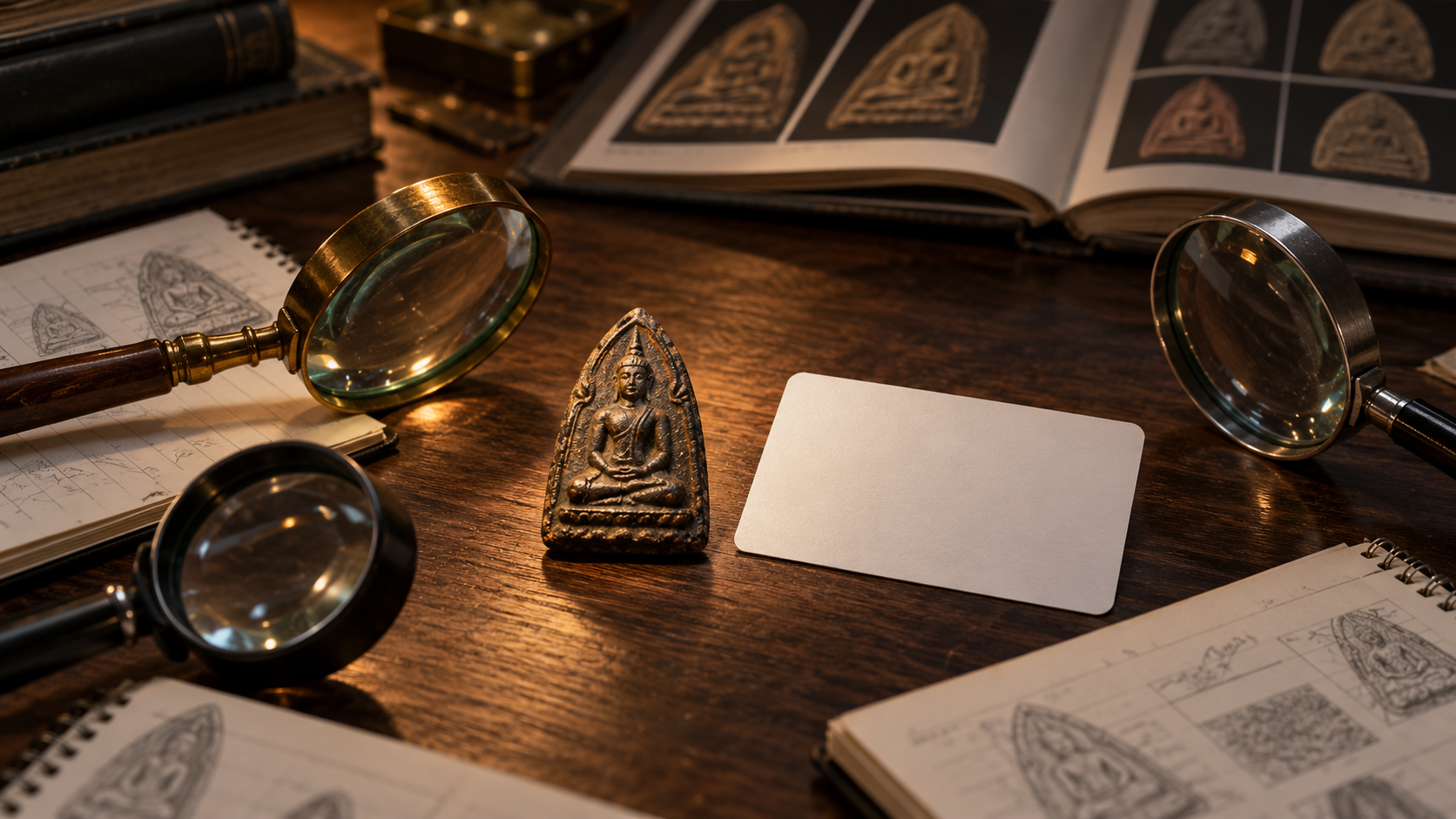
Many collectors enter through faith and stay for craft and history. A small amulet still contains proportion, mold lines, script, yantra, borders, bases and reverse design. Metal pieces may involve casting, striking, alloy recipes, heat and surface treatment. Powder tablets may combine mineral, plant and binding materials with different pressures and drying methods.
Time may leave oxidation, wear and patina on metal, or shrinkage, fine cracks, colour change and handling marks on powder. These can be evidence to study, but an old appearance is not a verdict. Artificial ageing, copied molds, later reproductions and poor storage can produce similar effects.
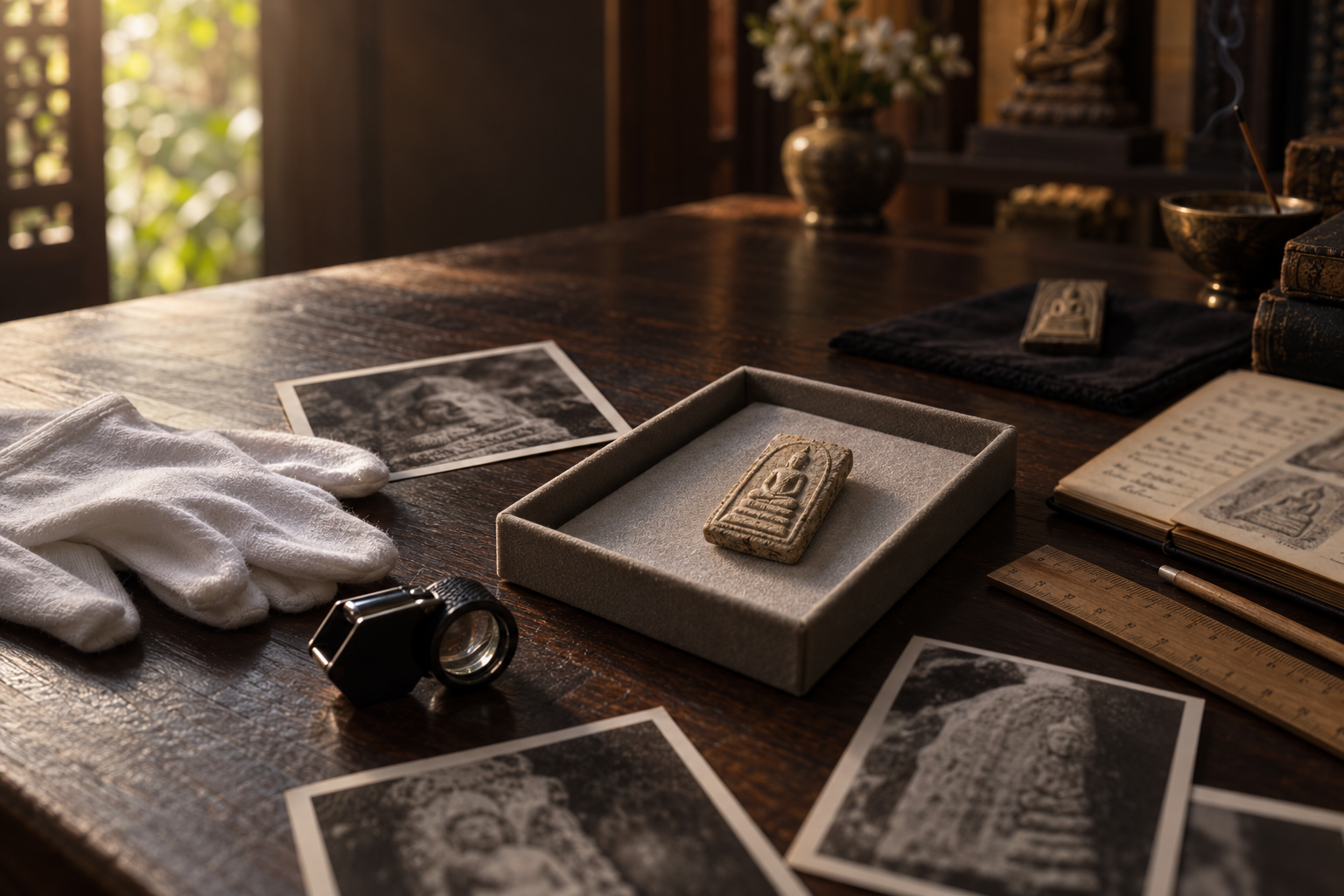
Connoisseurship brings the mold, material, dimensions, production method, provenance and reliable comparison pieces together. Its satisfaction lies not only in finding something beautiful, but in understanding why the object looks as it does and whether that appearance fits the claimed period and context.
When collecting opens into history
Researching one piece can lead to a maker's biography, temple history, ceremony dates, participating monks, purpose of issue, material sources, mold variants and the society in which it was made. An object only a few centimetres wide may open onto local, religious and craft history, memories of conflict, community building and the movement of belief across regions.
Historical interest does not turn every market story into history. Temple records, contemporary documents, material evidence, later recollections and advertising do not carry equal weight. A responsible collector distinguishes verifiable facts, retrospective oral memory and stories that have circulated for years without confirmation.
A collection can help preserve material culture when objects were obtained lawfully, records survive and evidence is allowed to challenge a convenient story. Preservation is not simply keeping the object while protecting only the version that raises its price.
Gifts, inheritance and private memory
The importance of some amulets has nothing to do with market rankings. A parent may give one before a child travels. It may come from a temple visit made together, or from a period of military service, a new job, marriage, illness or personal crisis. Seeing it later recalls the people and circumstances around that moment.
When an amulet passes between generations, it preserves family relationships and personal history as well as religious meaning. A well-documented family piece may carry far more emotional value than its resale price, even if it is not a celebrated issue. Prices can be compared; private memory has no common market scale.
Knowledge, belonging and status in collecting communities
Collecting is rarely solitary. Learning molds, issues, materials and periods requires exchanging photographs, objects, catalogues and experience. Communities form around a master, a temple or a type. Within them, the ability to point to evidence, recognise details and preserve dependable records can become a form of earned reputation.
A collection can also display identity. A rare and recognised piece may signal means, seniority, connections or connoisseurship to people who know the code. Display is not always simple boasting: wearing a master's amulet may express a bond with a temple or tradition, while completing a series may represent years of learning and patience. An outsider sees an expensive object; the owner may see an order built through long study.
When a sacred object enters a capital market
Once an amulet enters an open market, it acquires features of both a commodity and an asset. Price may reflect a master's reputation, age, issue size, mold, material, condition, provenance, authentication opinions and current demand. Some scarce and established pieces have circulated readily and appreciated sharply. Past appreciation is not a promise of future appreciation, and no amulet investment is risk-free.
Amulets are not uniformly regulated financial products. Prices may be inferred from a small number of sales, private agreements or community consensus, and an asking price is not a completed sale. Authentication standards may change, fashion may move on, and unclear provenance, disputed attribution, restoration or damage can destroy liquidity. The phrase highly liquid usually applies only when provenance is clear, dispute is limited and real buyers are present.
How social media changes amulet value
Collectors once relied mainly on temples, physical markets, shops and personal networks. Livestreams, short video, social groups, online auctions and cross-border platforms now move information and objects much faster. They widen access to comparisons and discussion, but also amplify emotion, manufactured scarcity and herd behaviour.
A piece may surge after a celebrity appearance, a viral clip, an accident story or concentrated promotion. Algorithms repeat what captures attention; they do not verify history, authenticity or value. Images create a further illusion that the object has been seen clearly, although lighting, focal length, filters and compression alter colour and detail. A card in frame, an endorsement or thousands of comments cannot replace physical examination and independent judgement.
The internet expands knowledge and accelerates misinformation, imitation and hype at the same time. Digital connoisseurship therefore means more than knowing how to search. It also means checking origins, preserving disagreement and recognising when the safest decision is to stop a transaction.
Motives coexist—and change over time
Few collectors begin with a finished philosophy. Someone may first wear a piece for safety, then study its master and temple. Another begins with craft and develops a devotional connection through research. A market trader may eventually keep one deeply personal piece permanently. Encounters with fakes, losses or disputed information may turn a trend-driven buyer toward provenance and careful study.
The sacred and the worldly are not sealed compartments. A valuable piece may still carry sincere devotion, while a person who begins in faith still enters a market when buying, preserving or transferring it. The important question is not whether the two can coexist, but whether motives are acknowledged honestly and belief, evidence and price remain distinguishable.
The question is larger than “what is it worth?”
Before acquiring or wearing an amulet, it helps to ask:
- 01Am I here for devotion, history, craft, memory, resale—or a mixture of them?
- 02What can be verified about provenance, date, temple, master and issue?
- 03Is the story based on a contemporary record, a later memory or market promotion?
- 04Would I still want it if the price did not rise—or if its attribution were revised?
- 05Would the cost affect daily life or exceed the loss I can afford?
- 06Am I respecting the religious and cultural setting rather than treating it only as a profit device?
- 07If I transfer it, can I disclose repairs, damage, provenance and conflicting opinions honestly?
Thai amulets have endured not because everyone understands them in the same way, but because they can hold devotion, merit, memory, art, knowledge, community and trade at once. For one person an amulet is support in an uncertain life; for another it is material evidence to research. A family may preserve a relationship through it. In a market, it becomes a collectible with a price and a risk.
A mature view does not force the amulet to belong exclusively to either sanctity or capital. It sees how the two intertwine while preserving necessary boundaries: belief is not scientific proof; market price is not cultural value; an authentication opinion is not immutable truth; and collecting never outranks honesty, everyday responsibility or respect for religious culture.