หลวงปู่ทวด วัดช้างให้
Luang Pu Thuad
A southern monk placed in the later Ayutthaya period. The Luang Pu Thuad pieces on the market today were made in his name in the twentieth century. He did not press them himself.
Temple · Wat Chang Hai, Khok Pho, Pattani · Life dates · 1582–1682 (B.E. 2125–2225); the month and day are not agreed
Names and readings
- Thai name
- · หลวงปู่ทวด
- Chinese name used here
- · 龍婆托
- Mandarin near-sound
- · 龍婆托
- Cantonese near-sound
- · 龍婆托
- English spelling
- · Luang Pu Thuad
The essay uses the short name after this. A near-sound helps Chinese readers say the name. It is not a second official name.
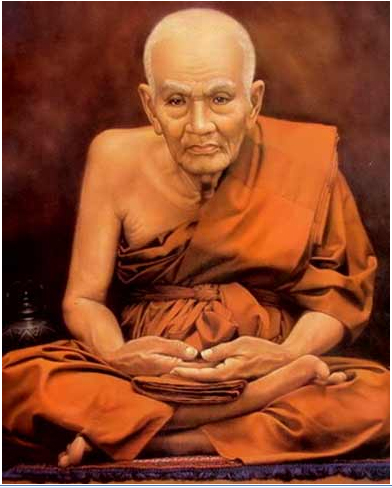
Luang Pu Thuad
A southern monk placed in the later Ayutthaya period. The Luang Pu Thuad pieces on the market today were made in his name in the twentieth century. He did not press them himself.
Luang Pu Thuad is among the monks most often named in the south. A second, equally common Thai form is Luang Phor Thuad. The long devotional name is Luang Pu Thuad Who Stepped the Sea into Fresh Water. Later memory places him in the later Ayutthaya kingdom. Nearly all the pieces sold today under his name were not made in his lifetime. From 1954 (B.E. 2497) onward, Wat Chang Hai and other temples made them in his name. The man is one subject. The medals are another. The man comes first.
Birth and name
Local legend and later press summaries usually place the birth in 1582 (B.E. 2125), in what is now Sathing Phra, Songkhla. The lay name is written Pu, and the vowel is not stable from one account to the next. The month and the day are less stable still: some say April, some 3 March, some 4 March. Those days are later retellings, not a birth register from the time. This page keeps the year and the district, and does not close the calendar.
Two temples
One compilation says he received full ordination at Wat Chang Hai in 1602 (B.E. 2145) and then went north to Ayutthaya to study the discipline. Another only says that he ordained as an adult and became known around Sathing Phra and Pattani, without a year on the ordination record. Both are later arrangements. What can stand is that the name is tied to two temples at once. Wat Pha Kho is in his birth district, Sathing Phra in Songkhla, and devotion also calls him Somdet Chao Pha Kho. Wat Chang Hai is in Khok Pho, Pattani. Temple memory makes him the first abbot, invited by Phraya Kaem Dam, lord of Sai Buri. The temple is more than three hundred years old. Its formal Thai name is Wat Ratburana. Chang Hai is the name people use, from the legend of an elephant set loose to choose the ground.
The sea turned fresh
The story told most often is the foot that turned the sea fresh. Luang Pu Thuad was sailing for Ayutthaya when the weather turned heavy and the fresh water ran out. He put his foot into the sea, the water around the boat became drinkable, and the people on board were saved. Thai newspapers mark this as a legend. It comes from oral telling around Sathing Phra and Pattani, and from local notes written down later. It is not a ship's log from the time. Devotion may go on telling it. It cannot be treated as a record that he reached a particular stretch of sea in a particular month of a particular year, and the story of fresh water cannot be used to say that any one amulet is genuine.
Death
Several Thai reports date the death to 6 March 1682 (B.E. 2225), at Sai Buri, a city south of Pattani, now in the region of Kedah in Malaysia. The age is given as about one hundred. Chinese pages say ninety-nine or one hundred. The one-year gap comes from the unsettled birthday, not from two different deaths. Another telling says he asked that the body be carried to Wat Chang Hai, and that stakes be set wherever fluid fell on the road. The temple account says that after cremation one part of the ashes went back to Sai Buri and one part stayed at Wat Chang Hai, later kept in a stupa in the temple. The instruction and the ashes differ in detail from book to book. This page marks them as local telling, not as a coroner's record from the day.
The medals come later
About two hundred and seventy years after his death, Wat Chang Hai began making large numbers of amulets in his name. Luang Pu Thuad himself never made an amulet, so there is no batch that he consecrated in person. The Chinese-language market often folds the two into one, as if Luang Pu Thuad himself had pressed a batch now on sale. They have to be read apart. The Luang Pu Thuad of the seventeenth century was a monk. What the temples made in the twentieth century are amulets in his memory. So the first questions of true and false are three: which year the piece was made, which temple made it, and what material it is. Until those three are clear, a later amulet cannot be described as his own handiwork.
The herbal tablets of 1954
In 1954 (B.E. 2497) the abbot of Wat Chang Hai, Ajarn Tim, monastic name Dhammadharo, rank Phra Khru Wisai Sophon, together with the layman Anan Khananurak, made the first batch in Luang Pu Thuad's name in order to raise funds for a new ordination hall. The material was herbal powder. Ajarn Tim led the consecration, with other well-known monks of the time taking part. This batch is powder, not a metal medal. Thai sometimes still calls it the first issue, using the word for a medal in the wide sense. When collectors say the first metal issue, they mean the later batch. The two are not one object.
This Ajarn Tim was abbot of Wat Chang Hai in Pattani. His lay name was also Tim. He is not Luang Pu Tim of Wat Lahan Rai in Rayong. Both are called Tim, but they are not the same person. The temple, the province and the years are not the same. Write them as one, and Prai Kuman powder is spoken of as the work of the same master who made the Chang Hai medals.
The large-head medal of 1957
Only in 1957 and 1958 (B.E. 2500 and 2501) did Wat Chang Hai make metal medals. Collectors call this issue the large-head mold. The first striking was copper alone. There were not enough, so in 1958 the temple added gold, silver and two further copper alloys, on the same master mold. One mold, several metals. The year and the metal come before any talk of price.
The iron-back of 1962
In 1962 (B.E. 2505) Wat Chang Hai issued several metal batches in a single year. The one most often recognized is the iron-back: the shape of an old iron, with Thai letters on the reverse. It is a famous commemorative issue. It is still not a tablet pressed by the seventeenth-century monk. After 1962 many other temples went on using his name. Those are their own years and their own molds. The same face on the front does not make them one batch.
What devotion expects
Devotion speaks of these medals as protection from danger, safe travel, and a way through harm. That is the hope and the storytelling of the people who wear them. It is not a guarantee attached to any one piece. Some sales pages say that accident reports contain no death of a person wearing Luang Pu Thuad. That sentence cannot be checked. This page does not use it.