หลวงพ่อปาน วัดบางนมโค
Luang Phor Pan
Luang Phor Pan of Wat Bang Nom Kho in Ayutthaya, the third abbot. Monastic name Sonando. He died in B.E. 2481 (1938). The market remembers him chiefly for the six-animal tablets.
Temple · Wat Bang Nom Kho, Sena, Ayutthaya · Life dates · B.E. 2418–2481 (1875–1938)
Names and readings
- Thai name
- · หลวงพ่อปาน
- Chinese name used here
- · 龍婆班
- Mandarin near-sound
- · 龍婆班
- Cantonese near-sound
- · 龍婆班
- English spelling
- · Luang Phor Pan
The essay uses the short name after this. A near-sound helps Chinese readers say the name. It is not a second official name.
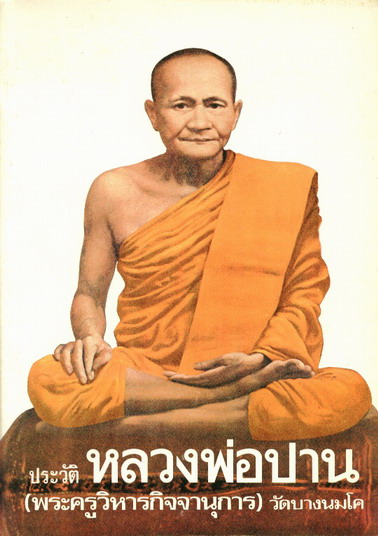
Luang Phor Pan
Luang Phor Pan of Wat Bang Nom Kho in Ayutthaya, the third abbot. Monastic name Sonando. He died in B.E. 2481 (1938). The market remembers him chiefly for the six-animal tablets.
Luang Phor Pan was a monk of Wat Bang Nom Kho in Sena, Ayutthaya, and the third abbot. Lay name Pan. Monastic name Sonando. Rank Phra Khru Wihan Kitcanukan. Born under Rama V, he died under Rama VIII.
Birth and family
16 July B.E. 2418 (1875), at Bang Nom Kho, Sena, Ayutthaya. The father was Sa-at, the mother was Im, family name Sutthawong. Rama V was on the throne.
Ordination and study
Two years are written for the ordination. One is Monday 1 April B.E. 2438 (1895). The other is simply B.E. 2439 (1896), with no day. Both place it in the ordination hall of Wat Bang Nom Kho. The preceptor was Luang Phor Sun of Wat Pla Mo. The chanting teacher was Phra Ajarn Choi of Wat Ban Phaen. The instructing teacher was Phra Ajarn Um of Wat Sutthaphot. The name given was Sonando.
After ordination he first studied with Luang Phor Sun. Later he read scripture at Wat Saket in Bangkok and at Wat Chao Chet in Ayutthaya. Herbal medicine was learned at Wat Sangwet. He also studied with Luang Phor Niam and Luang Phor Nong. The clay for powder tablets was learned from a teacher called the white-clad man. Consecration and the diamond-armor yantra were learned from Ajarn Jaeng of Sawankhalok. A pacceka-bodhisatta verse was learned from Khru Phueng of Nakhon Si Thammarat. This is a list of study. It does not mean every later tablet passed through all of these hands.
Abbot, rank, and the day's work
On 6 November B.E. 2474 (1931) Rama VII granted the rank Phra Khru Wihan Kitcanukan. Prince Dhani Nivat came to the temple to present it. He was the third abbot. The years written for the abbot's post are B.E. 2478 to 2481 (1935 to 1938). The year of the rank and the years of the post are not the same year. Do not write them as one day.
After the midday meal he came out to help people who came to the temple. There were two ways. One was holy water, for the sick and for people who believed they had been harmed by another's spell. The other was herbal medicine. Holy water is a temple practice. It is not a laboratory report of whether something works.
The six animals
The market usually speaks of six animals together: Hanuman the monkey, the garuda, the rooster, the porcupine, the bird and the fish. A later telling says a white-clad man came for six nights, one animal and one verse each night, in that order. The telling has no year and no name for the visitor, so it cannot be used as a dated record. It explains why the six animals are placed under one master.
Collectors also divide the tablets into batches. The first batch was few, mostly given to close disciples. The second batch has a small hole in the base, filled with yantra powder. Each animal has more than one mold. True and false begin with which animal, which batch and which mold. Until those three match, an animal is not enough to name a batch made by his hand.
The death he announced, and the date of death
What the disciples wrote down is this: before death he told them that in three years he would die, on the fourteenth waning day of the eighth lunar month, at six in the evening. That is the announcement they recorded. The dated death is 26 July B.E. 2481 (1938). He was sixty-three. The vassa count is forty-two. A vassa is one rains retreat after full ordination, so forty-two vassas are about forty-two years as a monk. The lunar day in the announcement and the civil date 26 July are two records. Do not make them the same hour before the lunar calendar has been matched.