หลวงพ่อคูณ วัดบ้านไร่
Luang Phor Khun
A monk of Wat Ban Rai in Nakhon Ratchasima. Mandarin writes him Luang Phor Khun; Cantonese writes him Luang Phor Kun. Lay name Khun, monastic name Parisuttho. He died in B.E. 2558 (2015). The market calls him the head-tapping monk and a wealth monk. Those are later names, not his monastic rank.
Temple · Wat Ban Rai, Dan Khun Thot, Nakhon Ratchasima · Life dates · B.E. 2466–2558 (1923–2015)
Names and readings
- Thai name
- · หลวงพ่อคูณ
- Chinese name used here
- · 龍婆坤
- Mandarin near-sound
- · 龍婆坤
- Cantonese near-sound
- · 龍婆冠
- English spelling
- · Luang Phor Khun
The essay uses the short name after this. A near-sound helps Chinese readers say the name. It is not a second official name.
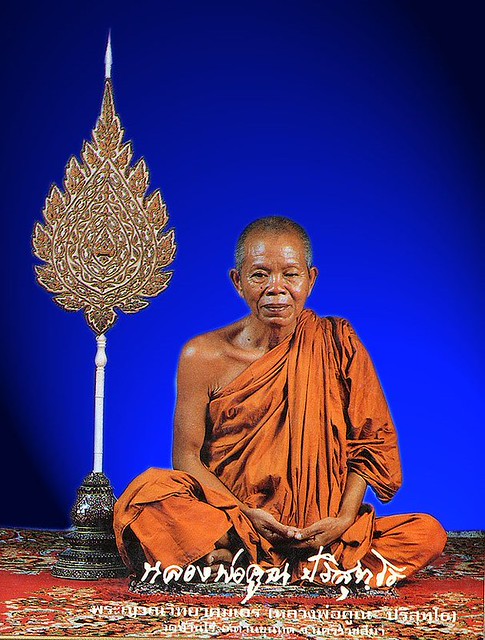
Luang Phor Khun
A monk of Wat Ban Rai in Nakhon Ratchasima. Mandarin writes him Luang Phor Khun; Cantonese writes him Luang Phor Kun. Lay name Khun, monastic name Parisuttho. He died in B.E. 2558 (2015). The market calls him the head-tapping monk and a wealth monk. Those are later names, not his monastic rank.
Mandarin writes this monk as Luang Phor Khun. Cantonese writes him as Luang Phor Kun. In Thai he is Luang Phor Khun of Wat Ban Rai, Dan Khun Thot, Nakhon Ratchasima, and he was the abbot. His lay name was Khun Chatphonklang. His monastic name was Parisuttho. His last rank was Phra Thep Wittayakhom. The market calls him the head-tapping monk, a wealth monk, and one of three modern great monks. Those are later names. They were not his monastic rank.
Birth and family
Thursday 4 October B.E. 2466 (1923), the tenth waning day of the tenth lunar month, a pig year, at Ban Rai, village six, Kut Phiman, Dan Khun Thot, Nakhon Ratchasima. The father was Bun, the mother was Thongkhao, both of the Chatphonklang family, and they farmed. There were three children. He was the eldest. The sisters were Khamman, later Wongkanchanarat, and Thonglo, later Phenchan.
Both parents died while the three children were still small, and an aunt raised them. At about six or seven he was already studying at Wat Ban Rai with three teachers: Phra Ajarn Chueam, Phra Ajarn Chai and Phra Ajarn Lee. They taught Thai, Khmer, and protective incantations. Another account says his mother died when he was eleven and his father sent him to the temple. Both accounts agree that he lived and studied there as a boy. Wat Ban Rai began as a monastic residence in B.E. 2436 (1893), before he was born. Phra Ajarn Chueam was the first abbot.
Ordination
He received full ordination at twenty-one, at Wat Thanon Hak Yai in Kut Phiman. One date is Friday 5 May B.E. 2487 (1944), a monkey year. Another is 11 a.m. on 2 May of the same year. 5 May was a Friday, which matches an ordination said to have fallen on Friday. 2 May was a Tuesday. The three officiating monks are the same set of names, with two ways of assigning the seats. In one, the preceptor was Phra Khru Wichan Yatikit, former abbot of Wat Thanon Hak Noi and former district head of Dan Khun Thot; the chanting teacher was Phra Athikan Si of Wat Ban Chan; the instructing teacher was Phra Athikan Suk of Wat Khok Rak. The other writing puts Phra Athikan Suk in the chanting seat. The names match. The seats do not fully match. The preceptor gave him the name Parisuttho.
Before ordination he said he meant to stay only three vassas and then disrobe. A vassa is counted by one rains retreat after full ordination. A rains retreat is about three months in the rainy season, when a monk stays put. Three vassas are about three years. After ordination he remembered the poverty he had seen as a child, and he decided to remain a monk.
Two teachers, and the ascetic practice
After ordination he went to Wat Ban Nong Pho to study with Luang Phor Daeng. The temple is in Samnak Takhro, Dan Khun Thot, later placed in Thepharak district. Luang Phor Daeng taught scripture and insight, and was known for ritual knowledge. Luang Phor Daeng then introduced him to Luang Phor Khong Phutthasaro, a fellow monk. The two teachers exchanged both doctrine and ritual knowledge. Luang Phor Khong judged that the student had learned enough, and told him to leave the temple and wander in the forest to practice a higher insight.
The first part of the wandering stayed inside Nakhon Ratchasima. Later he went to Laos and to Cambodia, into deeper forest. On the return he passed through Surin, then back to Nakhon Ratchasima and to Ban Rai. After the return he began to turn the residence into a settled temple. In B.E. 2496 (1953) he began the ordination hall. He also built monks' quarters and a sermon hall, dug a pond for the temple, and built the Wat Ban Rai school for the village children.
The tap on the head, and the gun of B.E. 2515
He spoke in short country sentences and did not keep a high-monk manner. The gesture people remember from his later years is a tap on the head. A person knelt or bowed, he tapped once, and he said a very short sentence, often a wish for wealth or safety. That is why the market later called him the head-tapping monk. The tap is a gesture toward a person. It is not the name of an amulet mold.
In April B.E. 2515 (1972), two men who had robbed and harmed people, Thong and Jira, were in the Dan Khun Thot area. They took villagers hostage and threw a grenade at people who tried to seize them. The villagers surrounded them, but the two had guns and could not be taken. Luang Phor Khun went to talk with them about the consequence of what they had done. Thong threw the gun down and agreed to surrender. Jira ran. Luang Phor Khun followed for nearly a kilometre. Jira saw villagers blocking the way ahead and pointed a gun at Luang Phor Khun. The account says that shot did not fire. This account has names and a year.
Ranks
On 12 August B.E. 2535 (1992) he received the ordinary royal ecclesiastical rank Phra Yan Wittayakhom Thera, on the insight side. On 10 June B.E. 2539 (1996) he rose to the royal rank Phra Rat Wittayakhom. On 12 August B.E. 2547 (2004) he rose to the thep rank Phra Thep Wittayakhom. That was his highest rank before death. He was also an adviser to the ecclesiastical head of Region 11, the region that includes Nakhon Ratchasima.
Three medals people compare
There are many sacred objects under his name. A person who is just beginning can start with three medals, and should not treat the three as one batch.
The first batch is B.E. 2512 (1969). It is an oval copper medal, darkened, and that is the only metal. The face is his half-length figure, looking forward, in the monk's robe. The upper rim reads Phra Ajarn Khun Parisuttho. The lower rim reads Wat Ban Rai, Dan Khun Thot, Nakhon Ratchasima. The centre of the back is a yantra, and the letters around it say this is a medal for the principal Buddha image of Wat Chaeng Nok, in the town of Nakhon Ratchasima, on 9 August B.E. 2512. So this batch was issued at Wat Chaeng Nok, not at Wat Ban Rai.
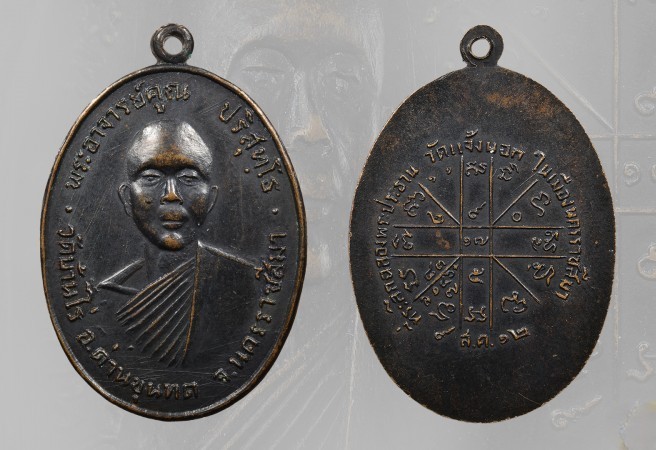
The second batch was cast in B.E. 2514 (1971) and kept in the ordination hall of Wat Sa Kaeo in the town of Nakhon Ratchasima. Each morning after the chanting he sat there and recited. He did this for about four years. Only in B.E. 2517 (1974) were the medals given out. The market calls this batch the pond-throw mold. The Thai name means thrown into a pond. The metals are not only darkened copper. There are also gilt copper, nak, and gold. The batch was made to raise money for a two-storey monks' building at Wat Sa Kaeo, used at once as sermon hall, dining hall and sleeping quarters.
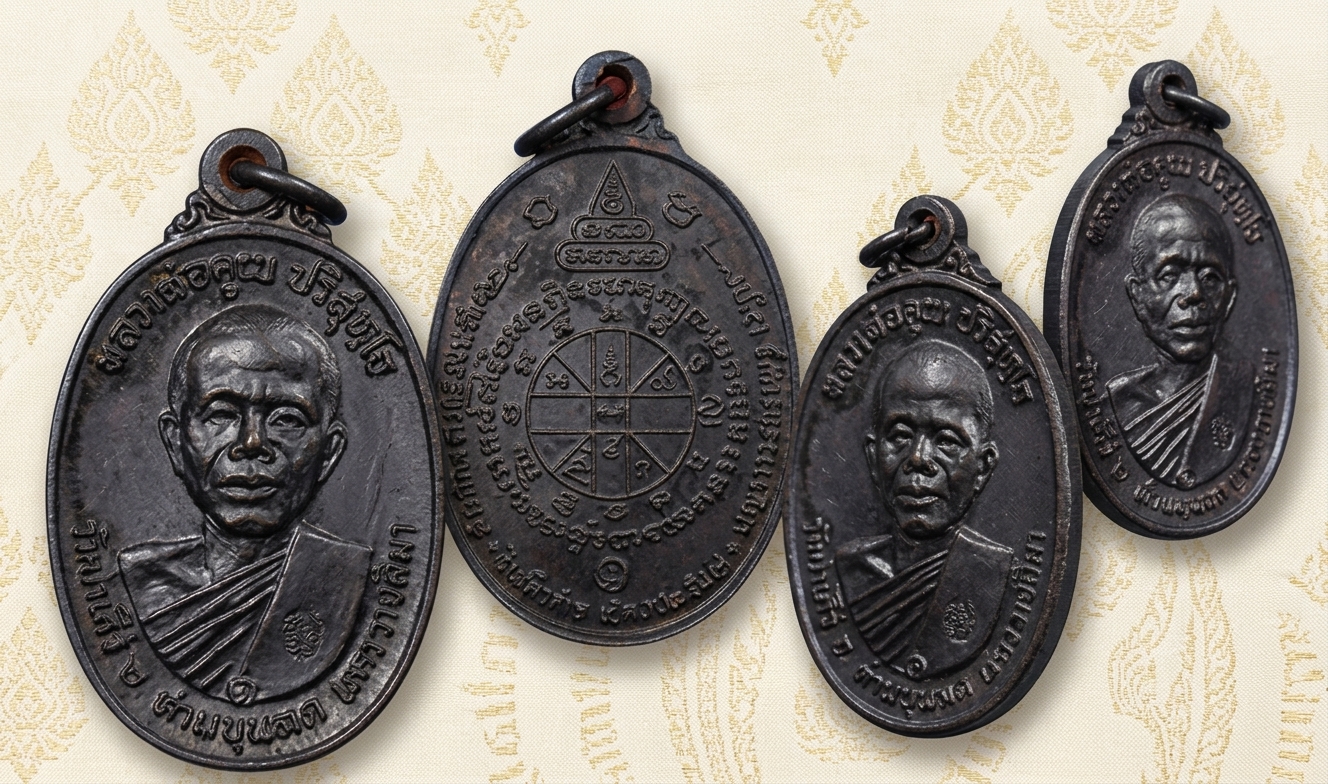
The third batch is B.E. 2519 (1976). This is the first medal batch issued at Wat Ban Rai itself. The gold pieces are very few. The account says there are nine in gold. In his later years, and after his death, objects made in his name became very numerous, and so did the false ones. True and false begin with three questions: which year, which temple issued it, and which mold. Until those three match, a face that looks like his is not enough to name a batch from his lifetime.
Death and cremation
On the morning of 15 May B.E. 2558 (2015) his breathing stopped and he fell unconscious. He was taken to Maharat Nakhon Ratchasima Hospital. The next day, Saturday 16 May B.E. 2558, at 11:45 in the morning, he died peacefully in that hospital. The account says ninety-two years and seventy-one vassas. Counted from 4 October B.E. 2466 to that day, the span is ninety-one years and a little more than seven months. Ninety-two counts the year that was not yet complete. Seventy-one vassas run from the ordination in B.E. 2487. A vassa is one rains retreat after full ordination, so seventy-one vassas are about seventy-one years as a monk.
His will gave the body to Khon Kaen University for the medical school to use in teaching. So the body was not cremated immediately after death. The cremation was on the evening of 29 January B.E. 2562 (2019), at the Golden Jubilee Convention Hall of Khon Kaen University. That day was three years and eight months after the death. In life he liked Korat song, likay drama and Muay Thai. During the cremation, Wat Ban Rai arranged those things he had liked. After the cremation there was no unburnt body.